
Robotic Palletizing Systems for Shipping Cases and Trays
Packaging Knowledge Hub

If you're seeking packaging automation solutions, please contact us, and we'll be delighted to offer you the most tailored solution.
This article is part of the Soontrue Packaging Knowledge Series under the "Packaging Machine Classification & Applications" section. For a broader view of packaging layers and machine types, see Packaging Machine Classification & Applications and Primary, Secondary & Tertiary Packaging Explained.
After products have been packed into shipping cases or trays—by case erectors, case packers and case sealers—they still need to be stacked on pallets for storage and transport. This final step is handled by palletizing systems, increasingly based on robotic palletizers rather than purely mechanical equipment.
A robotic palletizing system (also called a robotic palletizer, robotic case palletizer or automatic palletizing system) uses one or more robots to pick cases, trays, bags or bundles from a conveyor and place them onto pallets according to defined patterns. Compared with manual stacking or conventional palletizers, robotic palletizing offers higher flexibility, better ergonomics and easier adaptation to changing SKUs and pallet formats. Many manufacturers now evaluate conventional vs robotic palletizing as a key decision when upgrading their end-of-line.
This article explains what robotic palletizing systems are, how they work, the main palletizer types (robotic arm, collaborative robot palletizer, layer palletizer, gantry and mixed-case palletizing), typical applications and pallet patterns, and how palletizing fits into fully automated end-of-line packaging systems—as well as what to consider when choosing a robotic palletizer manufacturer.
1. What Is a Robotic Palletizing System and How Does It Work?
A robotic palletizing system is an automated cell where one or more robots stack cases, trays, bags or bundles onto pallets. The system typically includes:
- infeed conveyors bringing cases or bundles from upstream case packing and case sealing machines
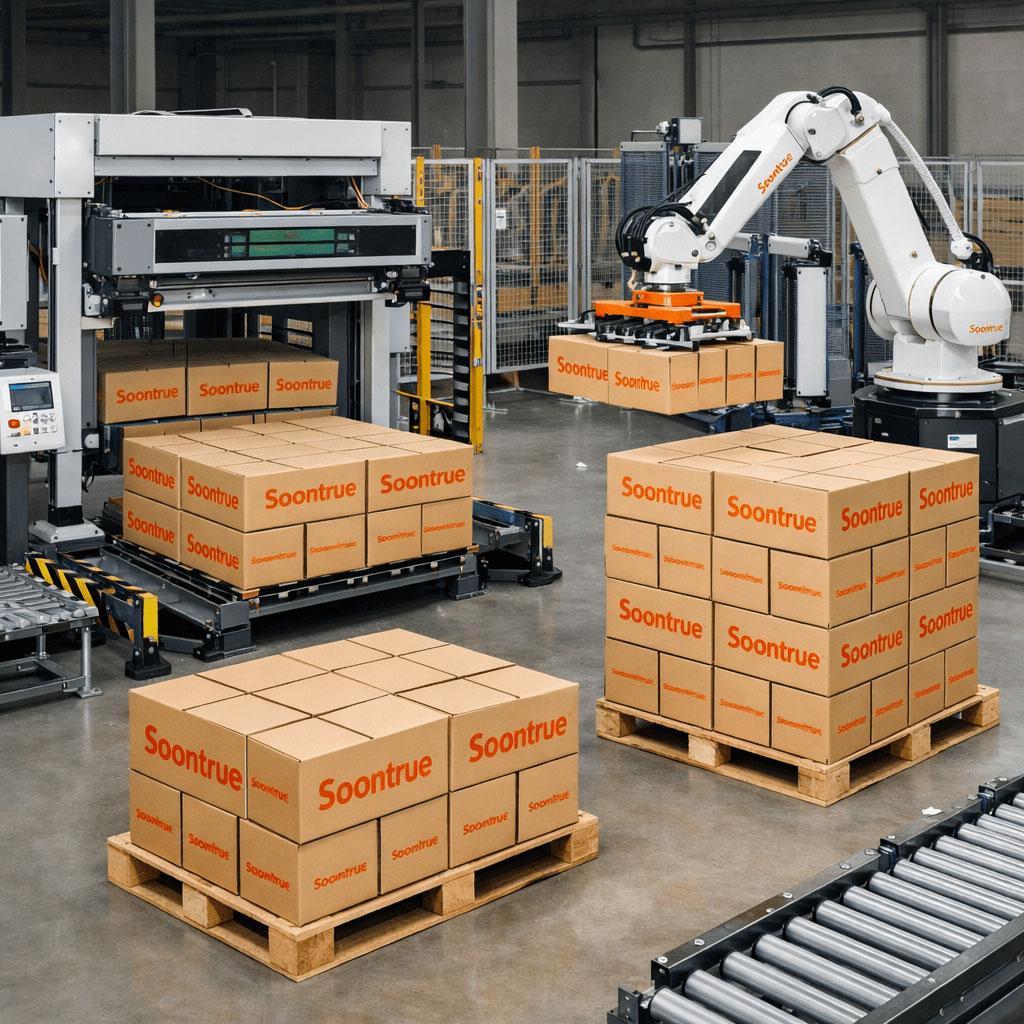
- a robotic palletizer with a gripper or suction head
- pallet dispensers and outfeed conveyors
- safety guarding and controls, sometimes integrated with warehouse or ERP systems
Although layouts vary, most robotic palletizing cells follow the same basic sequence:
- Product infeed and accumulation
Sealed cases, trays, bags or bundles arrive from upstream on one or more conveyors. Accumulation and metering devices control spacing and ensure a stable flow to the robot pick position.
- Pallet supply and positioning
Empty pallets are supplied from a pallet dispenser or forklift and positioned at the palletizing station. Slip sheets or layer sheets may also be dispensed if required.
- Robotic picking and placing
The palletizing robot picks one or multiple units at a time using a gripper or suction head, then places them onto the pallet according to a programmed pattern—row by row and layer by layer. When handling bags (for example flour, sugar, rice or pet food), a dedicated robotic bag palletizer uses special bag grippers and flattening devices to keep layers stable.
- Layer building and layer transitions
Once a layer is complete, the robot builds the next layer, sometimes using interlocking or rotated patterns to improve pallet stability. Layer pads can be inserted between layers if needed.
- Full pallet discharge
When the pallet is full, it moves to an outfeed conveyor for stretch wrapping, labeling and storage, and a new empty pallet is positioned for the next cycle.
By combining these steps, a robotic palletizing system can run continuously with minimal operator intervention, significantly reducing manual lifting and improving consistency in pallet quality.
2. Main Types of Palletizing Systems
Palletizing solutions can be classified by the type of equipment (robotic vs mechanical), the way layers are formed and the level of flexibility required.
2.1 Robotic arm palletizer and collaborative robot palletizer
The most common modern design is the robotic arm palletizer, which uses an articulated robot (typically with 4 or 6 axes) to pick and place unit loads.
Key characteristics:
- High flexibility in reach and movement
- Able to serve one or multiple infeed lines and pallet positions
- Many types of grippers available—clamp, fork, suction, bag grippers—for different products
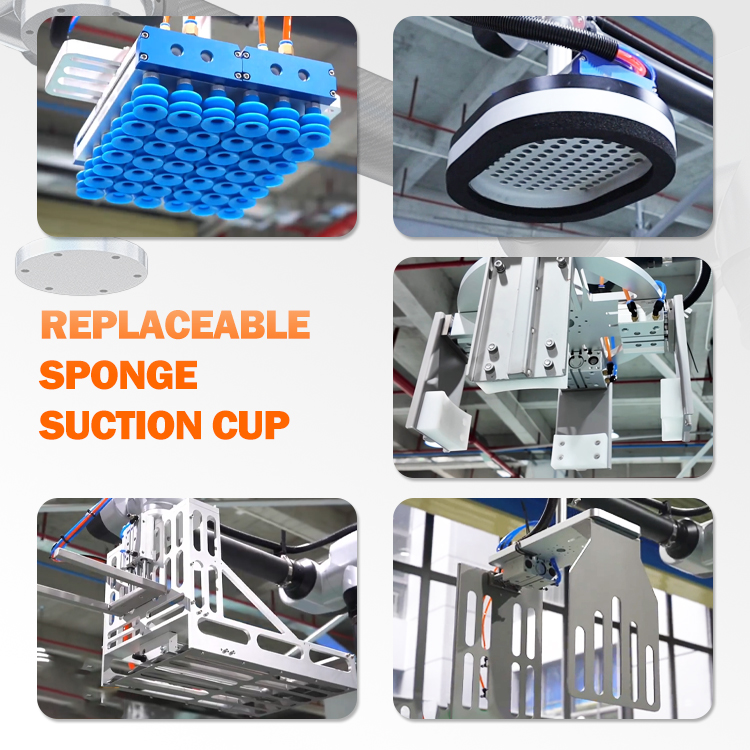
Best suited for:
- Shipping cases, trays, wrapped bundles and bags
- Multi-line operations where one robot services several SKUs
- Applications that require frequent changes in pallet patterns or product sizes
Within this category, a special sub-type is the collaborative robot palletizer (cobot palletizer). A collaborative robot palletizer uses a cobot with built-in safety functions, designed to work closer to operators with reduced fencing or shared workspaces.
Collaborative robot palletizer – typical use cases:
- Low to medium-speed palletizing where floor space is limited
- Flexible palletizing for small batch production or contract packaging
- Upgrade from purely manual palletizing without building a large fenced robotic cell
Because pallet patterns are defined in software recipes, both industrial robotic arm palletizers and collaborative robot palletizers can switch between products and pallet layouts without major mechanical changes.
2.2 Layer palletizer and hybrid systems
A layer palletizer builds complete layers of cases on a layer-forming table or conveyor and then transfers the entire layer onto the pallet in one motion. Traditional conventional palletizers of this type remain effective for:
- very high-speed, single-SKU lines
- standardized case sizes and pallet formats
- applications where maximum throughput is more important than flexibility
Hybrid systems combine layer-forming equipment with a robotic palletizer that handles complex tasks such as mixed-SKU layers, special interlocking patterns or integration with automated storage and retrieval systems.
2.3 Gantry palletizer
In a gantry palletizer, a Cartesian or gantry robot moves over the pallet area on linear axes, picking and placing cases or bundles. Gantry systems:
- offer good flexibility for large palletizing zones
- can handle heavy loads with good positioning accuracy
- are suitable for environments with low ceiling height where articulated robots may be constrained
They are often used in heavy industries, building materials and some large-format packaging applications.

2.4 Mixed-case and multi-line palletizing
Modern robotic palletizing systems can be configured for:
- single-line, single-SKU palletizing – one product, one pallet pattern
- multi-line palletizing – one robot palletizes products from several production lines
- mixed-case palletizing – pallets built from multiple SKUs, commonly for retail-ready or e-commerce distribution
Mixed-case palletizing may use additional technology—such as buffering, sequencing conveyors or even vision systems—to ensure the correct sequence of cases reaches the robot for each layer and pattern.
2.5 Conventional vs robotic palletizing
When upgrading end-of-line automation, many factories explicitly compare conventional vs robotic palletizing:
- Conventional palletizers (typically layer palletizers)
- Very high throughput on a single or limited range of SKUs
- Mechanically robust with well-defined case sizes and patterns
- Less flexible when adding new case dimensions or complex mixed-SKU pallets
- Robotic palletizers (robotic arm palletizer, gantry robot or collaborative robot palletizer)
- High flexibility for frequent SKU changes and custom pallet patterns
- Easier to adapt to new package sizes, new product launches or customer-specific pallets
- Well suited for multi-line palletizing and mixed-SKU or e-commerce-oriented pallets
In many modern projects, the decision between conventional and robotic palletizing is driven by SKU complexity, required flexibility, growth plans and available floor space.
3. End-of-Line Applications and Pallet Patterns
Because palletizing operates at the very end of the packaging line, robotic palletizers are used in almost every industry that ships products on pallets.
3.1 Food, bakery, snacks and confectionery
In food and bakery plants, robotic palletizers stack:
- corrugated cases of biscuits, wafers, bread or frozen bakery products
- trays or cases of snacks, chips, nuts or candy
- shrink-wrapped bundles or display-ready cases for retail
Pallet patterns are designed for stability and efficient use of pallet space, often taking into account downstream automated storage or container loading.
3.2 Coffee, tea, beverage and powdered products
In coffee, tea and beverage lines, palletizing systems handle:
- cases of coffee cartons, tea cartons and powdered drinks
- shrink-wrapped bottle or can packs
- bags and bricks of coffee or milk powder packed in cases
Where large bags are used (for example 20–50 kg), a dedicated robotic bag palletizer uses special grippers and conditioning devices to keep each layer flat and stable.
Here, automatic palletizing is tightly integrated with stretch wrapping, pallet labels and warehouse management systems to support high-throughput distribution.
3.3 Household, personal care and pharmaceuticals
For household and personal care products:
- cases of detergents, cleaning products and refills are palletized in regular patterns
- mixed-SKU pallets may be built for specific retailers or distribution centers
In pharmaceuticals and healthcare:
- serialized cases of medicine cartons are palletized in controlled patterns
- pallet-level aggregation and labeling are integrated with track-and-trace systems
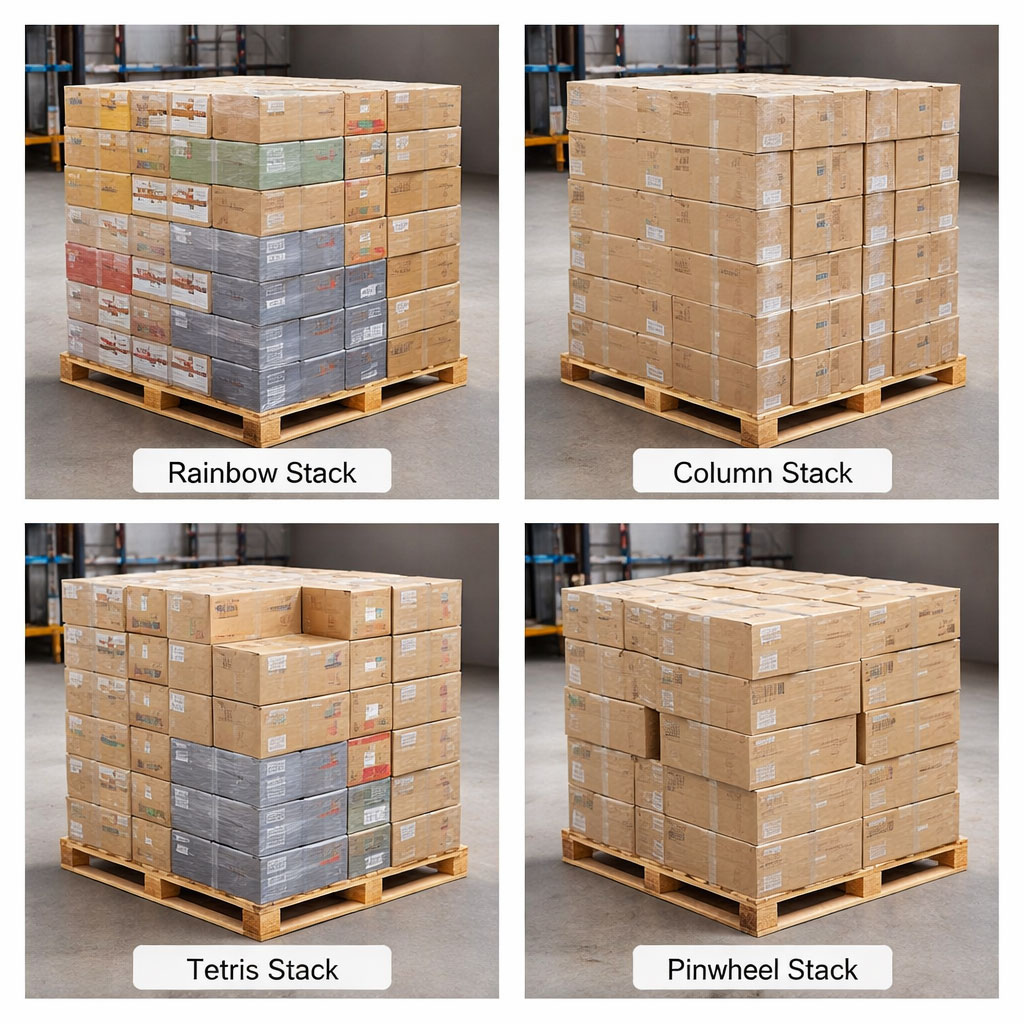
3.4 Typical pallet patterns
Common patterns in palletizing systems include:
- Column stack – simple stacking with all cases aligned, maximizing vertical stability
- Interlocking or brick patterns – alternating orientation between layers, improving lateral stability
- Pinwheel or cross patterns – used when specific footprint or stability requirements must be met
- Mixed-SKU patterns – defined by retailer or distribution requirements for shelf-ready and e-commerce logistics
The palletizing robot executes these patterns based on configurable recipes, which define case orientation, layer sequence, slip sheets and pallet changeover rules.
4. Robotic Palletizing in End-of-Line Packaging Systems
In a fully automated end-of-line packaging system, robotic palletizers are the last major piece of equipment after case forming, packing and sealing. A typical configuration looks like this:
Products are packed by horizontal flow wrappers, vertical packaging machines (VFFS), premade pouch packing machines, cartoning machines or overwrapping machines.
- Case forming and packing
- Case erectors form and bottom-seal cases.
- Case packers load products into cases or trays according to defined pack patterns.
- Case sealers close and seal the tops with tape or hot-melt glue.
- Case conveying and buffering
Sealed cases move through conveyors, accumulation sections and, if needed, checkweighers or inspection systems, before reaching the palletizing area.
- Robotic palletizing
- A robotic palletizer or robotic palletizing system picks cases, trays, bags or bundles from infeed conveyors and stacks them onto pallets according to selected recipes.
- Pallet and slip-sheet dispensers manage empty pallet supply and layer pads.
- In lower-speed, flexible cells, a collaborative robot palletizer can be used instead of a traditional industrial robot.
- Pallet handling, stretch wrapping and labeling
Full pallets are conveyed to a stretch wrapper, then labeled and transferred to storage or loading bays.
When planning a palletizing project, manufacturers should consider:
- current and future SKU mix and required pallet patterns
- throughput and peak speeds
- case, tray and bag dimensions, weight and stability
- available floor space and required palletizing zones
- whether single-line, multi-line or mixed-case palletizing is needed
- the right balance of conventional vs robotic palletizing for the site
- criteria for selecting a robotic palletizer manufacturer (experience with similar products, support, software capabilities, safety concepts and integration with upstream packaging)
A well-designed robotic palletizing system helps achieve consistent pallet quality, reduce manual handling and support overall plant automation goals.
FAQ
Q1: What is the difference between a robotic palletizer and a conventional layer palletizer?
A robotic palletizer uses one or more articulated or gantry robots to pick and place cases, trays, bags or bundles and offers high flexibility for SKU changes and pallet patterns. A conventional palletizer (typically a layer palletizer) forms complete layers mechanically and is ideal for very high-speed, single-SKU lines with standardized cases.
Q2: Can one palletizing robot handle multiple production lines?
Yes. Many robotic palletizing systems are designed to handle multiple infeed lines and pallet positions. The robot switches between lines based on predefined priorities and recipes, balancing output and minimizing bottlenecks.
Q3: What is a robotic case palletizer and a robotic bag palletizer?
A robotic case palletizer is designed to handle corrugated cases and trays, building stable pallets of boxed products. A robotic bag palletizer is optimized for bags of powder, granules or bulk products and uses special grippers and conditioning devices to keep soft bags flat and stable in each layer.
Q4: When should I consider a collaborative robot palletizer?
A collaborative robot palletizer is ideal for low to medium-speed lines where floor space is limited and you want a more compact, flexible solution. It is often used to automate previously manual palletizing stations without building a large fenced cell.
Q5: What should I look for in a robotic palletizer manufacturer?
When choosing a robotic palletizer manufacturer, consider experience with your product types (cases, trays, bags), support for multi-line or mixed-case palletizing, software and recipe management capabilities, integration with upstream packaging and downstream logistics, and the ability to provide both robotic palletizers and complete end-of-line solutions.
Related Knowledge Articles
How empty cases are formed and sealed before palletizing.
- Case Packer Machine for Automatic Shipping Case Packing
Case packing systems that feed cases and trays into palletizing cells.
Secondary packaging stage that often feeds cartons into cases and then onto pallets.
Primary packaging of bars, biscuits and bakery products before case packing and palletizing.
Bagging of snacks, pasta or frozen food that are later loaded into cases and palletized.
Stand-up pouches and zipper bags that usually end up in cases and on pallets for distribution.