
How to Choose Cartoning and Case Packing Equipment for an Automatic Packaging Line
Packaging Knowledge Hub

If you're seeking packaging automation solutions, please contact us, and we'll be delighted to offer you the most tailored solution.
As manufacturers move toward higher levels of automation, packaging lines need to achieve stable performance across every stage of production. While primary packaging equipment often receives the most attention, cartoning and case packing systems play an equally important role in product handling, logistics efficiency, and overall line performance.
Choosing suitable cartoning and case packing equipment requires more than comparing machine speed or technical specifications. The right solution needs to match product characteristics, packaging formats, production targets, and future expansion plans. A well-designed secondary packaging system can improve operational consistency while creating a smoother connection between upstream and downstream processes. This guide explains the key factors manufacturers can consider when selecting cartoning and case packing equipment for an automatic packaging line.
Understand How Cartoner and Case Packer Fit into an Automatic Packaging Line
Cartoning and case packing equipment are essential parts of a complete packaging workflow. They connect individual product packaging with transportation and distribution requirements, creating a bridge between production output and supply chain operations.
In a typical automatic packaging line, the process may include primary packaging, cartoning, case packing, and palletizing. Each stage has a specific role in maintaining product flow and packaging efficiency.
Cartoning machine is mainly designed to place individual products or product groups into cartons. It supports retail-ready packaging requirements by improving presentation, organization, and product protection. For industries such as food, beverages, and consumer goods, carton packaging often represents the final appearance customers see on shelves.
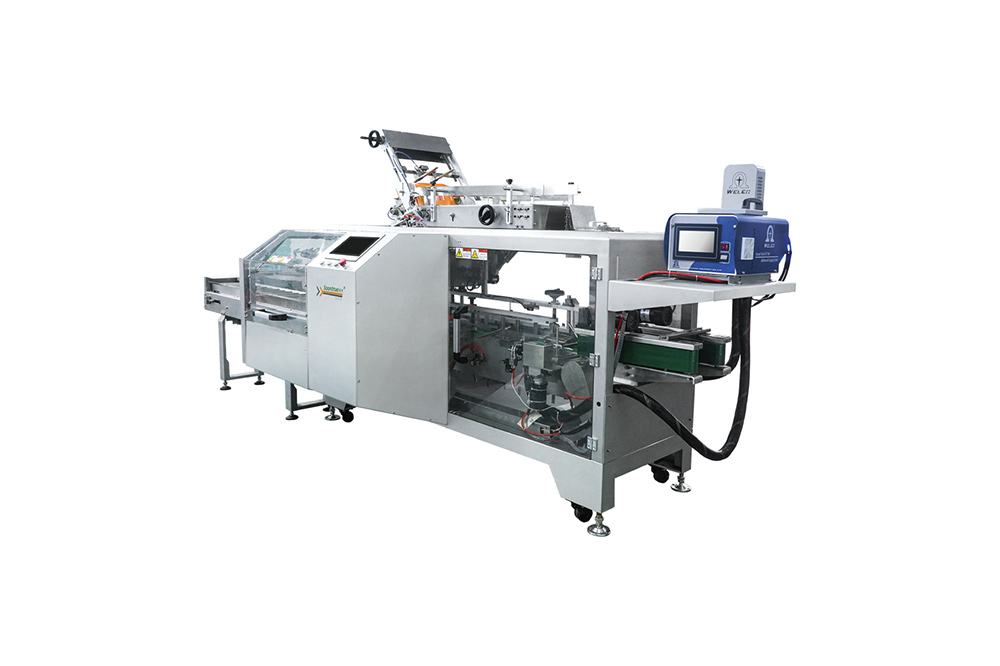
Soontrue ZH200 Cartoning Machine
Case packer handles the next stage by grouping cartons or packaged products into larger shipping cases. It helps manufacturers improve warehouse handling, transportation efficiency, and order fulfillment.
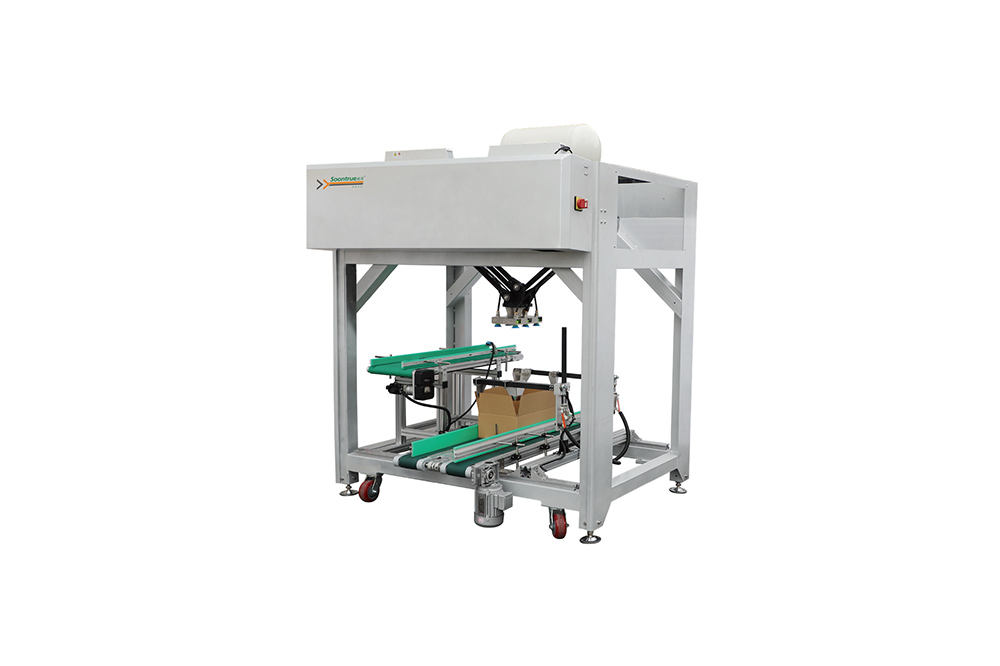
Soontrue 2-axis Robotic Box Packing Machine
When selecting equipment, it is important to view cartoning and case packing as connected systems within an automatic packaging line. Their compatibility with upstream machines, such as flow wrappers, and downstream equipment, such as palletizing systems, directly affects the stability of the entire production process.
Evaluate Equipment Compatibility with Your Products and Packaging Formats
Product characteristics are one of the most important factors when selecting cartoning and case packing equipment. Different products require different handling methods to maintain consistent operation.
The evaluation process usually begins with product dimensions, weight, shape stability, and handling sensitivity. For example, lightweight snacks, frozen foods, bakery products, and household goods may require different feeding and transfer solutions due to variations in size and physical properties.
Packaging format is another key consideration. Cartoning equipment needs to match carton dimensions, styles, and sealing requirements. Case packing systems should support the required case size, loading arrangement, and transportation standards.
Product transfer between machines also deserves attention. Even when individual machines perform well, unstable product spacing or inconsistent feeding can reduce the efficiency of the entire line. A reliable packaging solution should maintain smooth product movement from primary packaging through secondary packaging.
For manufacturers operating multiple product categories, flexibility becomes an important selection factor. Equipment that supports different product formats can help improve production adaptability and reduce future modification requirements.
Match Equipment Speed with Your Real Production Requirements
Machine speed is often one of the first specifications considered during equipment selection, but actual production performance depends on more than the rated output shown in technical documents.
A cartoning machine or case packer may achieve a certain speed under ideal conditions, while real production environments involve factors such as product feeding stability, packaging material consistency, operator requirements, and changes between product formats.
A practical evaluation focuses on how the equipment performs within the complete packaging line. The speed of the cartoner should align with upstream production output, while the case packer should support the carton flow without creating bottlenecks.
Line balance is especially important for automated production. A high-speed machine can only deliver value when other processes operate at a similar level of efficiency. For this reason, manufacturers often evaluate proven running performance with similar products and packaging conditions during supplier discussions.
Consider Integration Capability Before Choosing Individual Machines
For an automatic packaging line, integration capability is a key factor that influences long-term performance. Cartoning and case packing equipment need to communicate effectively with other machines to create a continuous and reliable production flow.
Upstream compatibility should be evaluated first. The cartoner needs to receive products consistently from feeding systems, flow wrappers, or inspection equipment. Stable product transfer helps maintain efficiency and reduces unnecessary manual adjustments.
Downstream connection is equally important. Case packing equipment may need to work together with case sealers, palletizing systems, and warehouse processes. A well-integrated system allows manufacturers to manage production expansion more efficiently.
When reviewing equipment options, the overall packaging solution often provides a clearer picture than individual machine specifications. A supplier with experience in complete packaging line integration can help ensure that each stage works together effectively.
Choose Equipment That Supports Future Production Changes
Production requirements often evolve as manufacturers introduce new products, adjust packaging formats, or expand market demand. Equipment flexibility can influence the long-term value of an automatic packaging line.
For companies producing multiple SKUs, changeover efficiency is an important consideration. Features such as convenient format adjustment, recipe management, and flexible configuration help reduce downtime when switching between products.
Future expansion capability should also be considered during the initial planning stage. A production line may begin with primary packaging and cartoning requirements, then gradually add case packing, palletizing, or other automation modules.
Selecting equipment with suitable flexibility allows manufacturers to adapt their packaging operations as business needs develop while maintaining consistent production performance.
Questions to Ask Before Purchasing Cartoning and Case Packing Equipment
Before investing in cartoning and case packing equipment, manufacturers usually evaluate several areas related to performance, compatibility, and long-term support.
|
Evaluation Area |
Questions to Consider |
|
Product compatibility |
Can the equipment handle current and future product variations? |
|
Packaging format |
Does the system support required carton and case specifications? |
|
Production speed |
What is the actual running output under similar production conditions? |
|
Line integration |
Can the equipment connect smoothly with existing packaging machines? |
|
Flexibility |
How efficiently can operators change between product formats? |
|
Technical support |
What installation, testing, and after-sales services are available? |
A detailed evaluation process helps manufacturers identify solutions that match both current production goals and future development plans.
Why Choose Soontrue for Integrated Packaging Line Solutions
Selecting cartoning and case packing equipment is an important step in building an efficient automatic packaging line. Beyond individual machine performance, manufacturers benefit from solutions that consider the complete production process.
Soontrue provides integrated packaging solutions that connect primary packaging, secondary packaging, and end-of-line automation. With experience in flow wrapping technology and customized packaging line design, Soontrue helps manufacturers develop solutions based on specific product requirements, production targets, and application scenarios.
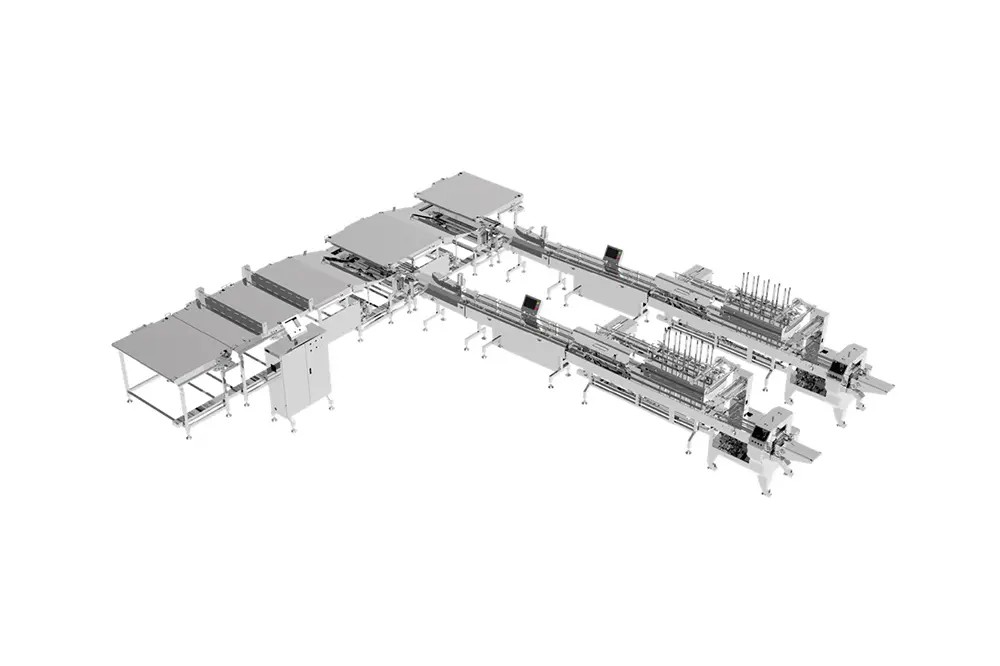
Soontrue Automatic Packaging Line With Tray is available to link with case packers, cartoners, palletizers.
For companies planning to upgrade their packaging operations, a complete line approach can support higher efficiency, smoother integration, and long-term production flexibility.
Contact Soontrue to explore a customized automatic packaging line solution for your production needs.
FAQ
What is the difference between cartoning and case packing equipment?
Cartoning equipment places products into cartons for retail or distribution packaging, while case packing equipment groups cartons or products into larger shipping cases.
How do I choose a cartoning machine for my packaging line?
The selection depends on product characteristics, carton requirements, production speed, and compatibility with existing packaging equipment.
What factors affect case packing efficiency?
Case size, product arrangement, feeding stability, machine speed, and integration with upstream equipment can influence case packing performance.
Should cartoning and case packing equipment be integrated into one system?
An integrated system can improve coordination between machines and create a more stable packaging workflow.
Can cartoning and case packing machines support multiple products?
Many modern systems are designed with flexible configurations that allow manufacturers to handle different SKUs and packaging formats.
How do I know if my production line needs a cartoner, a case packer, or both?
The choice depends on the packaging process and distribution requirements. A cartoner is typically used when products need to be packed into individual cartons, while a case packer is used for grouping products or cartons into shipping cases. Many manufacturers use both systems together to create a complete secondary packaging process within an automatic packaging line.
What should be tested before installing cartoning and case packing equipment?
Before installation, manufacturers can evaluate product handling performance, packaging accuracy, production speed, changeover process, and integration with existing equipment. Factory acceptance testing with actual products and packaging materials can help verify that the system meets expected production requirements.
How does automation improve cartoning and case packing operations?
Automated cartoning and case packing systems help improve production consistency by reducing manual handling, maintaining stable product flow, and supporting continuous operation. When integrated with other packaging equipment, automation can also improve line efficiency and provide better control over the overall packaging process.