
Integrating Flow Wrapping Machines into a Complete Automatic Packaging Line: A Guide for Food Manufacturers
HFFS Machine Blog

If you're seeking packaging automation solutions, please contact us, and we'll be delighted to offer you the most tailored solution.
Standalone packaging machines often create hidden friction on the factory floor. Product arrives at uneven intervals, film seals form inconsistently, and operators spend valuable time adjusting speeds by hand. Modern food plants move beyond isolated equipment toward fully coordinated automatic packaging systems. Within these systems the flow wrapping machine serves as the critical bridge between primary product protection and secondary carton or case packing.
A well-integrated flow wrapper receives product at a steady rate, forms a reliable pillow pack, and hands the finished unit to the next station without interruption. The result is higher overall equipment effectiveness, fewer stoppages, and packaging that consistently meets retailer and regulatory expectations. This guide examines the engineering principles, equipment layers, communication methods, and practical solutions that turn a single flow wrapper into the core of a complete automatic packaging line.
The Role of Flow Wrapping Machines in an Automatic Packaging Line
Horizontal form-fill-seal technology places the flow wrapper at the heart of primary packaging. Product travels horizontally on a continuous film web that is formed into a tube, sealed longitudinally, and then cross-sealed to create individual pillow packs. This process delivers both barrier protection and visual presentation in a single continuous motion.
Beyond the sealing function, the machine acts as the synchronization point for the entire line. Upstream feeders must deliver correctly spaced and oriented product. Downstream inspection and secondary packaging must accept packs at matching speed. When these rates align, the flow wrapper becomes the central clock that keeps every station in rhythm. Product protection remains consistent because film tension, seal temperature, and dwell time stay within tight tolerances. Factories that treat the flow wrapper as an isolated unit frequently discover later that speed mismatches and buffer shortages limit the line’s true capacity. The full range of horizontal flow wrapping machines covers bakery, snack, frozen, and tray applications with matching servo performance levels.
Components of a Complete Flow Wrapping Packaging Line
A complete line begins with product preparation and ends with palletized cases ready for shipment. Each layer must be selected and calibrated for the specific product family.
Feeding System
Automatic feeding converts bulk or randomly oriented product into a single-file or multi-lane stream with precise spacing. Servo-driven belts, timing screws, and flighted conveyors control the interval between items so that each product enters the film tube at the exact moment required by the sealing jaws. Multi-lane distribution systems further increase throughput by feeding several parallel streams into one high-speed wrapper or into multiple wrappers running in parallel. Proper orientation protects product appearance and ensures that printed film registers correctly on every pack.
Flow Wrapping Machine
Modern horizontal form-fill-seal machines rely on full servo control for film feed, end-seal timing, and jaw pressure. Servo motors replace mechanical cams, allowing recipe-driven changeovers that take minutes rather than hours. Film handling systems maintain consistent tension across a wide range of materials, from standard polypropylene laminates to high-barrier films used for extended shelf life. Sealing systems combine precise temperature control with adjustable dwell time so that both longitudinal and transverse seals remain strong and free of leaks. High-speed models reach several hundred packs per minute while still accommodating frequent product changeovers.
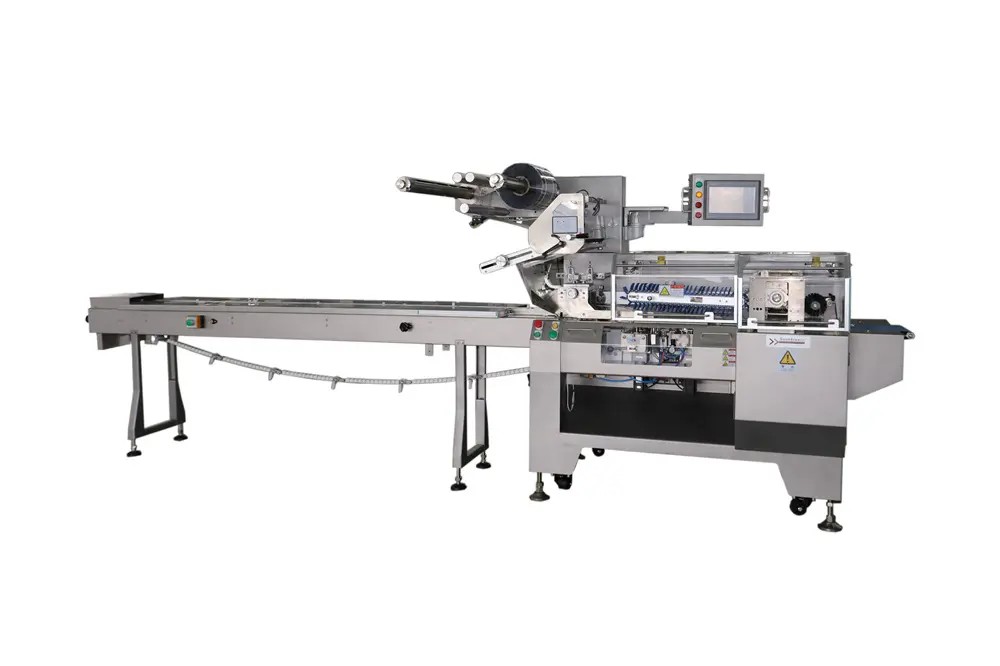
Soontrue SZ602 Flow Wrapping Machine engineered for frozen food and tray-packed products
Inspection System
Inline quality gates protect both product integrity and brand reputation. Metal detectors identify ferrous and non-ferrous contaminants before packs leave the primary zone. Checkweighers verify fill weight and reject under- or overweight units without stopping the line. Vision systems inspect seal integrity, print registration, and package appearance. When these devices communicate directly with the line PLC, rejected packs are diverted automatically and the root cause is logged for continuous improvement.
Secondary Packaging Equipment
After primary wrapping, cartoning machines erect, load, and close retail cartons at matching speed. Case packers group finished cartons into shipping cases using top-load, side-load, or wraparound methods. Robotic palletizers stack cases according to optimized patterns that maximize warehouse density and protect product during transport. Buffer conveyors and accumulation tables between stages absorb short speed variations so that upstream machines continue running even when a downstream station pauses briefly for film or carton replenishment. These stages form the backbone of a complete automatic packing line that moves product from primary pack to shipping-ready pallet without manual intervention.
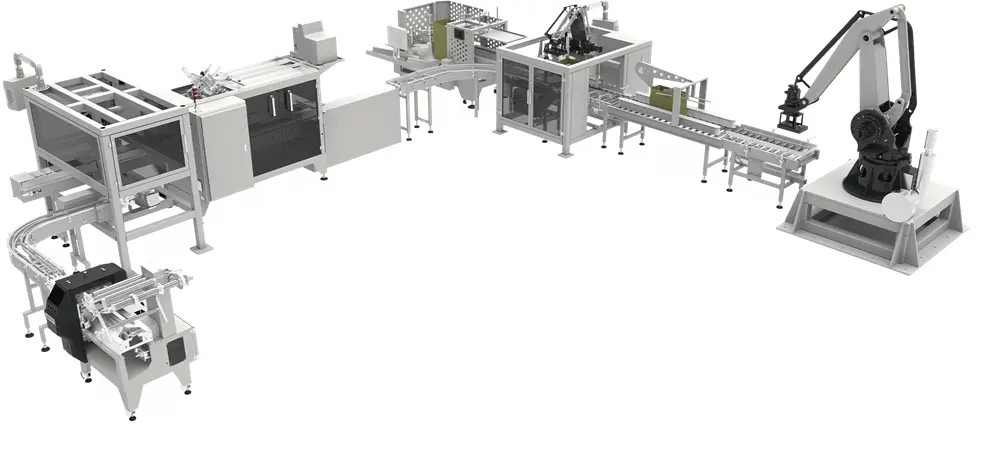
Complete automatic packaging solution built around a horizontal flow wrapping machine
How Flow Wrappers Communicate with Other Packaging Machines
Reliable integration depends on shared control architecture. A central PLC or distributed control network exchanges status signals, recipe parameters, and real-time speed commands among all stations. Servo synchronization keeps film advance, product infeed, and downstream conveyors locked to the same master clock. When the flow wrapper accelerates or decelerates, connected belts and feeders adjust proportionally so that product spacing remains constant.
Conveyor speed matching prevents both gaps and pile-ups. Buffer management algorithms monitor accumulation levels and instruct upstream equipment to slow or stop before overflow occurs. Modern systems also exchange quality data. A metal detector reject signal can trigger the flow wrapper to insert a marker pack or to log the event for later review. This continuous dialogue turns separate machines into a single coordinated process.
Common Challenges When Integrating Flow Wrapping Machines
Even well-designed equipment can encounter friction during integration. The following table summarizes frequent issues and the engineering responses that resolve them.
|
Challenge |
Solution |
|
Inconsistent product spacing |
Servo-driven automatic feeding with real-time position feedback |
|
Speed mismatch between stations |
Full servo synchronization and shared master clock |
|
Product jams at transfer points |
Buffer conveyors and accumulation tables with controlled release |
|
Frequent SKU changeovers |
Recipe-driven servo systems and tool-less change parts |
|
Quality variations and rejects |
Inline metal detection, checkweighing, and vision inspection with closed-loop feedback |
Addressing these points early in the design phase keeps the finished line running at design capacity from the first day of production. Practical layout principles and component matching appear throughout the packaging machine knowledge resources that support equipment selection and line planning.
Automatic Flow Wrapping Line Solutions for Different Food Applications
Bakery products such as bread, cakes, and biscuits benefit from gentle handling and precise spacing. Soft items require flighted infeeds and low-impact transfers to preserve shape. Frozen foods demand stainless-steel construction, wash-down capability, and film systems that maintain seal integrity at low temperatures. Snack items often run at the highest speeds and need multi-lane distribution plus rapid film changeover. Fresh produce and ready meals use modified-atmosphere or high-barrier films and may incorporate tray feeding before the flow wrapper. Daily chemical and non-food items share many of the same mechanical principles while adding requirements for chemical resistance and cleanability.
Each application shapes the choice of feeder, film system, sealing technology, and secondary equipment. A single standardized platform rarely fits every product family. Customized line architecture based on product characteristics delivers higher efficiency and fewer quality deviations. Similar product-driven approaches appear in specialized guides for snack food packing lines and frozen food packaging systems.
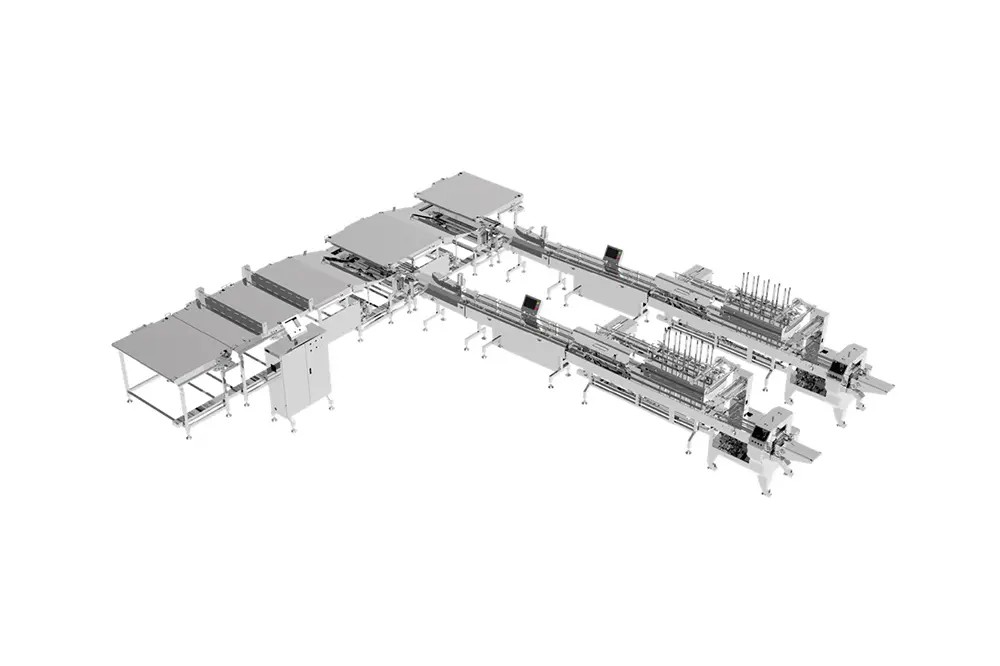
Automatic packaging line configured for tray-packed bakery and convenience products
Flow Wrapping Machine Integration: Standalone Equipment vs One-stop Solution
Purchasing a single flow wrapper and connecting it later to existing conveyors and cartoners can appear cost-effective at the outset. In practice the engineering effort required for mechanical interfaces, electrical signals, and software handshakes often exceeds the original equipment cost. Speed mismatches surface only after installation, forcing additional buffer conveyors or software upgrades. Changeover procedures become inconsistent because each machine follows its own recipe format.
A one-stop solution designs the entire sequence as a single system. Product analysis, film trials, line layout, and control architecture are developed together. Mechanical interfaces are pre-engineered, servo parameters are shared, and operators receive unified training. The resulting line reaches stable production faster and maintains higher overall equipment effectiveness across multiple shifts and product changeovers.
How Soontrue Builds Complete Automatic Packaging Solutions
The engineering process begins with product analysis. Physical characteristics, target speed, film requirements, and factory layout constraints are documented in detail. Packaging tests confirm film selection, seal parameters, and product handling methods under realistic conditions. Line design then maps every station from infeed through palletizing, including buffer zones and operator access points.
Equipment integration combines flow wrapping machines with matched feeding systems, inspection devices, cartoners, case packers, and robotic palletizers. Installation follows a staged plan that minimizes disruption to ongoing production. Commissioning includes full-speed trials, recipe validation, and operator training. Ongoing technical support covers spare parts, remote diagnostics, and continuous improvement recommendations.
Soontrue supplies the full range of equipment required for these projects. Horizontal flow wrapping machines cover bakery, snack, frozen, and tray applications. Complementary feeding solutions, inline inspection integration, cartoning systems, case packing modules, and palletizing cells complete the line. The same engineering team that designs the layout also oversees installation and start-up, ensuring consistent responsibility from first contact to stable production. Project details and equipment options are available through the Soontrue packaging solutions platform.
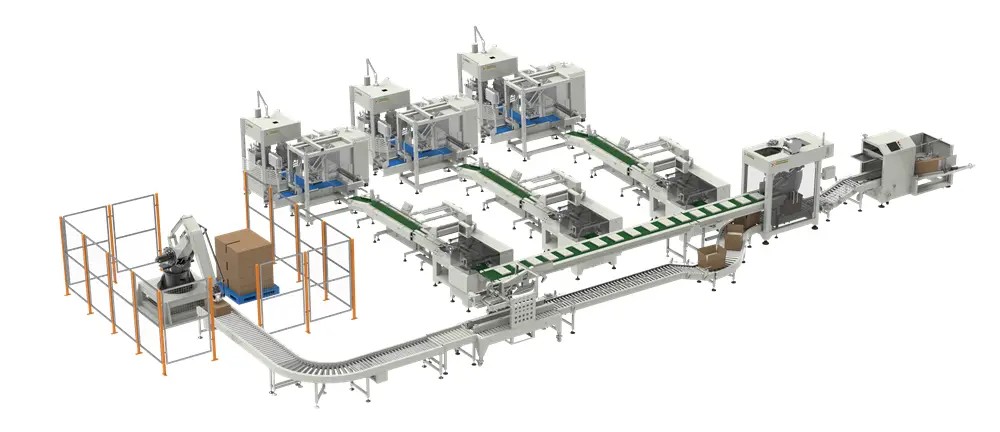
Automated packing solution for frozen dumplings combining flow wrapping with secondary packaging
Conclusion
Integrating a flow wrapping machine into a complete automatic packaging line transforms isolated primary packaging into a continuous, high-efficiency process. Matched feeding, synchronized controls, inline inspection, and coordinated secondary equipment remove the bottlenecks that limit standalone machines. Food manufacturers gain consistent pack quality, higher throughput, and reduced labor intensity.
Soontrue designs and supplies these complete solutions from product analysis through long-term technical support. The combination of horizontal flow wrapping machines, matched feeding systems, inspection integration, cartoning, case packing, and palletizing creates a single accountable system. Factories that adopt this approach achieve stable production and a clear path to further capacity growth. Specific product or line requirements can be reviewed directly with the Soontrue engineering team.
FAQ
1. How does a flow wrapping machine integrate with existing secondary packaging equipment?
Integration relies on matching conveyor heights, shared control signals, and synchronized speeds. Buffer conveyors and servo-driven transfers absorb minor rate differences. A unified PLC architecture ensures that start, stop, and recipe changes propagate correctly across all stations.
2. What speed range is typical for a complete automatic flow wrapping line?
Entry-level lines operate between 50 and 150 packs per minute. Intermediate systems reach 150 to 400 packs per minute. High-speed configurations exceed 400 packs per minute and can approach 1,000 packs per minute for regular-shaped products with multi-lane feeding.
3. Can one line handle multiple product formats?
Yes. Recipe-driven servo systems store parameters for each SKU. Tool-less change parts and adjustable guides allow format changes in a short time. The same line can process single packs, multipacks, and tray-in-bag configurations when the mechanical design accounts for the size range.
4. What maintenance practices keep a flow wrapping line running reliably?
Daily cleaning of sealing jaws and film paths, scheduled lubrication of servo components, and periodic inspection of sensors prevent most unplanned stops. Predictive monitoring of temperature and torque values further reduces downtime. Training operators to recognize early warning signs improves response time.
5. How long does installation and commissioning typically take?
A complete line project usually requires several weeks for mechanical installation, electrical connection, and software configuration. Full-speed trials and operator training add further days. The exact schedule depends on line complexity and factory readiness. Clear project planning and staged testing keep the overall timeline predictable.