
How to Design an Automatic Packing Line Based on Product Characteristics
Packaging Knowledge Hub

If you're seeking packaging automation solutions, please contact us, and we'll be delighted to offer you the most tailored solution.
Selecting packaging equipment without a clear picture of the product itself remains one of the most common sources of inefficiency on the factory floor. Many production teams begin the process by reviewing machine catalogs, speed ratings, and supplier quotations. The result is often a line that runs below its rated capacity, requires frequent adjustments, or forces costly modifications after installation.
Unstable sealing, product damage during transfer, and mismatched cycle times between primary and secondary packaging all point back to the same root cause: the design started with the machine rather than the product. A successful automatic packing line begins with a precise understanding of product shape, material behavior, required output, and final packaging format. Only after those variables are defined does equipment selection become a logical next step.
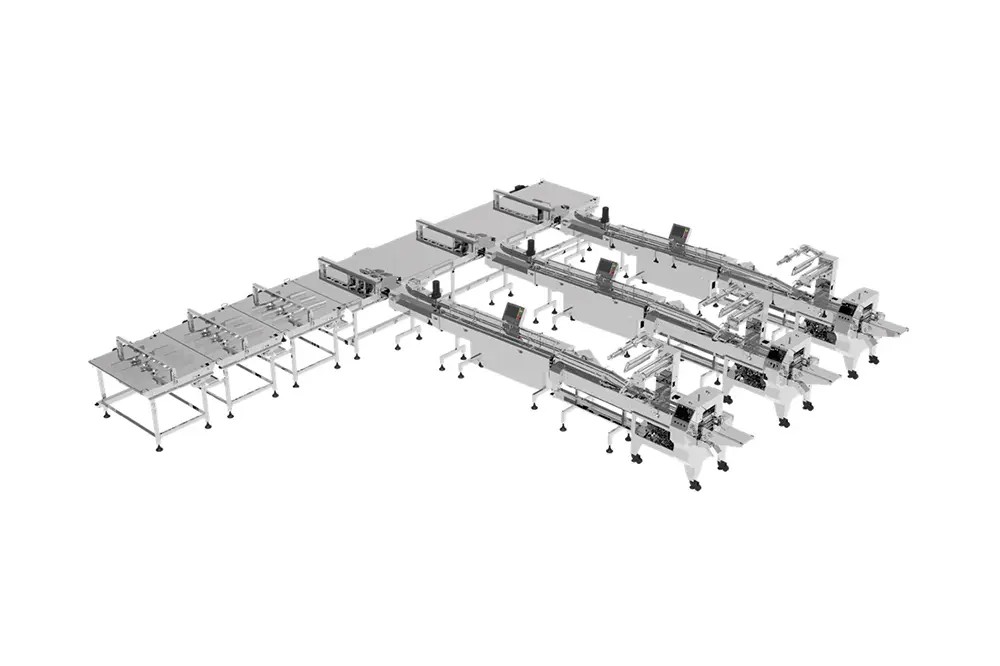
Soontrue automatic packaging line with deoxidizer for food products
Why Product Characteristics Matter in Automatic Packing Line Design
Every product carries unique physical and production constraints. Soft bakery items compress under pressure. Frozen dumplings require controlled temperature zones and gentle handling. Snack pellets flow freely but generate dust that affects sealing jaws. Daily chemical sachets demand accurate dosing and consistent film tension. When these traits are mapped early, the packing line can be engineered around actual process needs instead of theoretical maximum speeds.
Product-driven design also shortens commissioning time. Feeders, conveyors, forming tools, and sealing systems arrive already matched to the items they will handle. Changeover procedures become simpler because the mechanical interfaces were planned with the full product range in mind. Maintenance teams gain clearer access paths and spare-parts lists tailored to the specific configuration. In short, starting from the product reduces both technical risk and long-term operating cost across the full range of Soontrue packaging solutions.
Key Product Characteristics to Analyze Before Designing a Packing Line
Product Shape and Size
Shape and dimensional consistency determine the entire infeed and transfer architecture. Regular rectangular biscuits or cookie bars travel reliably on flighted conveyors and enter flow-wrapping machines with minimal orientation correction. Irregular or soft items such as croissants, bread rolls, or certain frozen dumplings need belt conveyors with side guides, vacuum transfer, or robotic pick-and-place systems to maintain orientation.
Size range across the SKU portfolio is equally important. A line designed only for the largest pack will waste film and floor space on smaller products. Conversely, a machine sized exclusively for the smallest item may lack the film-width capacity or jaw opening required for larger formats. Recording the full spectrum of length, width, and height early allows engineers to select adjustable forming boxes, servo-driven film feed, and multi-size recipe storage on the HMI when specifying flow wrapping machines.
Product Material and Physical Properties
Material behavior governs contact surfaces, hygiene design, and sealing parameters. Fragile bakery products require low-pressure contact and soft-start conveyors to limit breakage. Sticky or high-fat items need non-stick belts and frequent clean-in-place capability. Frozen products demand stainless-steel construction rated for low temperatures and condensation control. Powders and granules used in snack seasoning or daily chemical sachets call for dust-tight enclosures and accurate multihead weighing or volumetric dosing.
Physical properties also influence film selection and sealing technology. Moisture-sensitive products benefit from high-barrier films and precise temperature control on sealing jaws. Products that generate crumbs or fine particles require scrapers and vacuum extraction near the sealing area to maintain seal integrity. Mapping these traits prevents later redesign of critical interfaces.
Product Production Speed Requirement
Target line speed must reflect real upstream output rather than theoretical machine ratings. A bakery oven producing 120 units per minute sets a clear ceiling for the packing section. Adding buffer conveyors or accumulation tables allows the packing line to absorb short stops without forcing the oven to slow down. For multi-SKU operations, average and peak speeds both need documentation so that the control system can switch recipes without losing overall throughput. High-speed applications commonly rely on servo-driven horizontal packaging systems for precise motion control.
Speed also drives decisions on single-lane versus multi-lane configurations and on the choice between continuous-motion and intermittent-motion sealing. High-speed biscuit or snack lines often employ dual-lane flow wrappers or rotary premade-pouch systems to keep pace with continuous upstream processes. Lower-volume or highly variable products may operate efficiently on single-lane servo machines with rapid changeover capability.
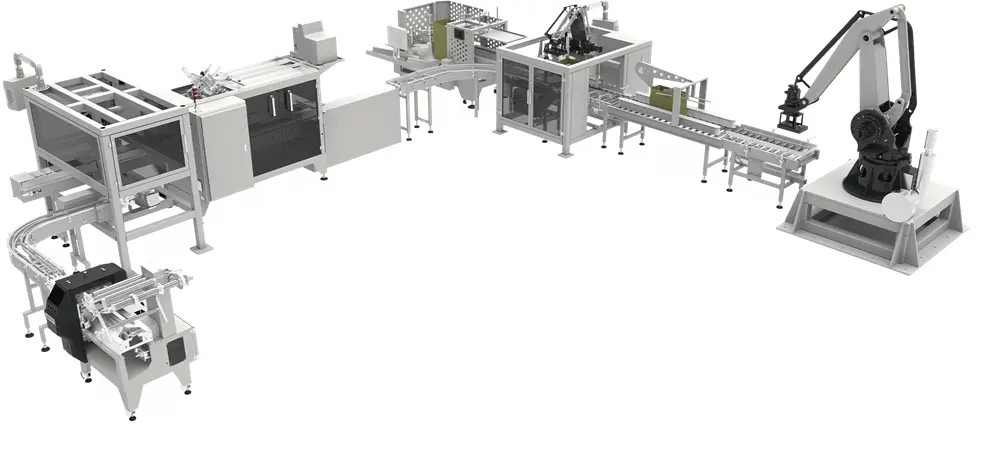
Automated packing solution with flow packaging machine
Packaging Format Requirements
The final pack style dictates machine family selection. Pillow packs produced by horizontal flow wrappers suit many bakery, biscuit, and snack items. Vertical form-fill-seal machines handle free-flowing snacks, powders, and certain frozen products. Premade pouch systems deliver stand-up or shaped bags preferred for premium snacks and daily chemical goods. Secondary packaging requirements—cartons, display trays, or shipping cases—must be defined at the same stage so that case erecting, loading, and palletizing modules can be integrated without later bottlenecks.
Retail and distribution constraints further refine the format. Multipack configurations, deoxidizer insertion, MAP gas flushing, or tray-loading all add specific stations that must be sequenced correctly within the overall process flow. Flexible bag formats are well supported by modern premade pouch packing machines with rapid changeover capability across SKUs.
Step-by-Step Process to Design an Automatic Packing Line
Analyze Product Characteristics
The first practical step is a structured product audit. Samples of every SKU are measured for dimensions, weight, fragility, surface condition, and temperature at the point of packaging. Production data from the upstream process establish realistic cycle times and variability. Packaging specifications—film type, bag style, print registration, and any inserts—are collected and verified against market requirements. This data set becomes the foundation for every subsequent engineering decision.
Define Production Requirements
With product data in hand, the team translates commercial targets into technical requirements. Daily and peak output, number of shifts, expected SKU change frequency, and available floor space are quantified. Utility capacities (power, compressed air, cooling water) and hygiene standards (food-grade materials, wash-down capability) are recorded. These requirements form the performance specification used to evaluate automatic packing line solutions against actual capacity needs.
Design the Packaging Process Flow
Process flow design maps every transfer, orientation, grouping, and sealing step from product arrival to finished case. Primary packaging is selected first—flow wrapping for solid bakery and snack items, vertical form-fill-seal for free-flowing products, or premade pouch filling for flexible bag styles. Feeding systems, counting or stacking modules, and any special stations (deoxidizer insertion, tray loading) are positioned next. Secondary packaging and end-of-line functions complete the sequence. Buffer zones and inspection points are inserted where process variability is expected.
The resulting flow diagram becomes the blueprint for equipment selection and mechanical layout. It also reveals opportunities for modular expansion: additional lanes, future secondary packaging, or higher-speed primary machines can be planned without redesigning the entire line.
Optimize Packing Line Layout
Layout optimization balances material flow, operator access, and maintenance space within the available factory footprint. Linear layouts suit continuous high-speed production. U-shaped or L-shaped configurations reduce walking distances and can fit constrained buildings. Height clearances for multihead weighers or overhead conveyors are verified early. Clearances around film-roll loading stations, electrical cabinets, and cleaning access points are built into the drawing. Simulation or 3D modeling helps confirm that product path distances remain short and that accumulation capacity matches the planned buffer strategy, especially when integrating a vertical packing machine into the line.
How Soontrue Designs Automatic Packing Lines for Different Products
Soontrue applies the product-first approach across multiple food and daily chemical categories, drawing on more than three decades of packaging machinery experience and a full range of in-house equipment—from high-speed flow wrappers and vertical form-fill-seal systems to premade pouch machines, case packers, and robotic palletizers.
Bakery Products
Bakery lines handle soft bread, cakes, croissants, and similar items that require gentle transfer and stable sealing. Soontrue solutions typically combine soft-contact infeed conveyors with servo-driven flow wrapping machines. The systems accommodate single packs and multipacks while protecting product appearance. Modular secondary packaging modules can be added for tray loading or cartoning when retail formats demand them, as seen in many bakery and biscuit packaging configurations.
Snacks and Biscuits
Snack and biscuit applications emphasize high speed and precise counting. On-edge biscuit packing machines, multi-lane flow wrappers, and automatic stacking systems arrange products into neat rows or layers before pillow packing. For puffed snacks and rice rollers, specialized feeding systems manage light, cylindrical shapes without crushing. Deoxidizer insertion stations are frequently integrated to extend shelf life of baked snacks.
Frozen Food
Frozen dumpling and ready-meal lines operate under low-temperature conditions and often incorporate tray loading. Soontrue designs feature stainless-steel construction, condensation management, and servo flow wrappers or specialized tray packaging modules. The complete process—from product orientation through primary wrapping to case packing—is engineered as a continuous cold-chain compatible system.
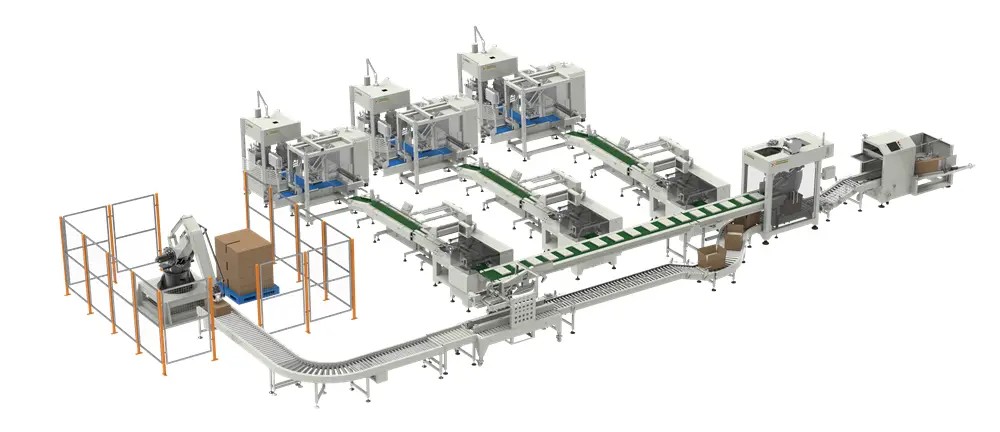
Soontrue automated packaging solution tailored to industry-specific requirements for frozen dumpling
Daily Chemical Products
Daily chemical sachets and small pouches benefit from accurate dosing and flexible bag formats. Vertical packaging machines and rotary or horizontal premade pouch systems deliver consistent fill weights and clean seals. The same modular end-of-line architecture used in food applications—case erecting, robotic packing, and palletizing—extends the line into full warehouse-ready output on the Soontrue platform.
Conclusion
Designing an automatic packing line around product characteristics produces stable output, lower waste, and simpler long-term operation. Shape, material behavior, production speed, and packaging format together define the mechanical and control architecture. When these elements are clarified first, equipment selection becomes a precise matching exercise rather than a series of compromises.
Soontrue supports this product-driven methodology with a complete portfolio of flow wrapping machines, vertical packaging systems, premade pouch equipment, and fully integrated packing line solutions. From bakery and snack production through frozen food and daily chemical applications, the engineering focus remains on matching real product behavior to reliable, scalable automation. Manufacturers seeking higher efficiency and consistent pack quality can draw on this experience to build lines that perform as intended from the first production run.
FAQ
What is the first step when planning a new packing line?
Begin with a detailed product audit covering dimensions, physical properties, upstream production rates, and required pack formats. This information guides every later decision on machine type, layout, and secondary packaging.
Can one line handle multiple product sizes?
Yes. Servo-driven machines with recipe storage and adjustable forming tools routinely process a defined size range. Clear documentation of the full SKU portfolio during the design phase ensures the selected equipment covers all required formats.
How are fragile bakery products protected during high-speed packaging?
Soft-contact conveyors, controlled acceleration, and carefully timed transfer stations minimize mechanical stress. Flow wrapping machines designed for bakery applications further protect shape and appearance while maintaining required throughput.
What role does secondary packaging play in overall line design?
Secondary packaging must be planned in parallel with primary packaging. Cartoners, case packers, and palletizers determine the rhythm of the entire line. Integrating them from the start prevents capacity mismatches that would otherwise appear after primary packaging is installed.
How long does a typical product changeover take on a modern automatic line?
With pre-programmed recipes, quick-release mechanisms, and tool-less adjustments, many changeovers can be completed in 15 to 25 minutes by a trained operator. Design choices made during the initial layout phase directly influence this speed.