
Complete Line vs Individual Machines – How to Choose the Right Packaging Solution
Packaging Knowledge Hub

If you're seeking packaging automation solutions, please contact us, and we'll be delighted to offer you the most tailored solution.
Many food manufacturers begin their packaging journey with standalone machines. A flow wrapper here, a vertical form-fill-seal unit there, and a simple case sealer completing the picture. This approach works well during early growth stages. As daily output climbs and product ranges expand, the same setup starts to reveal its limits. Throughput becomes uneven, operators move constantly between stations, and small process gaps turn into daily production headaches.
Selecting between individual packaging machines and a complete packing line involves far more than comparing equipment price tags. Efficiency across the full process, ease of integration, labor stability, and readiness for future volume growth all enter the equation. This guide walks through the practical differences so production managers and plant owners can match the right solution to their current stage and long-term plans within a full range of automatic packing line solutions for the food industry.
Complete Packing Line vs Individual Machines: Quick Comparison
A side-by-side view of the two approaches highlights where each delivers its strongest value.
|
Factor |
Individual Machines |
Complete Packing Line |
|
Initial investment |
Lower entry cost |
Higher upfront outlay |
|
Installation |
Multiple suppliers and timelines |
One integrated solution and schedule |
|
Production workflow |
Separate operations with manual transfers |
Continuous automated flow |
|
Labor requirement |
Higher operator count |
Significantly lower staffing needs |
|
Expansion capability |
Limited by interface gaps |
Modular scaling built into design |
|
Maintenance |
Multiple systems and contacts |
Unified support from single partner |
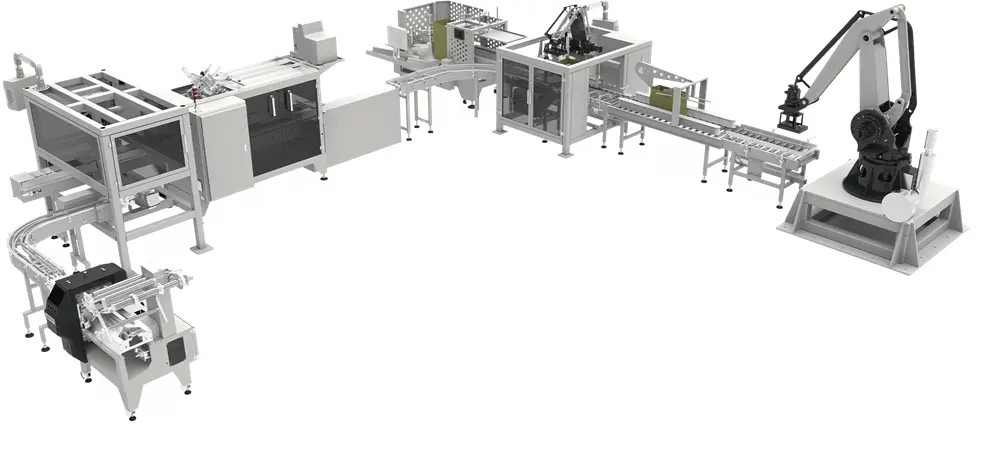
Soontrue automated packing solution with flow packaging machine – integrated primary to end-of-line flow
Why Do Some Factories Start with Individual Packaging Machines?
Standalone equipment remains a practical first step for many operations. Understanding the reasons behind this choice helps clarify when the transition to a full line becomes the stronger option.
Lower Production Volume
When daily output sits at moderate levels, a single flow wrapping machine or vertical packaging unit can keep pace with demand. Operators load product, monitor film quality, and move finished packs to the next station without creating long queues. Capital stays available for other priorities such as raw material inventory or upstream processing equipment. The simpler setup also allows production teams to refine recipes and packaging formats before committing to larger automation investments.
Need for Flexibility
Factories handling frequent SKU changes or short seasonal runs often value the ability to reconfigure individual machines quickly. A premade pouch machine can shift from one bag size to another in a short window. A separate cartoner can be adjusted independently. This modular freedom supports pilot runs and special promotions without forcing an entire line changeover. Plants still testing market response to new products gain operational breathing room from unit independence, especially when planning an automatic packing line for snack foods that must handle multiple formats.
Limited Automation Budget
Early-stage manufacturers frequently allocate funds across multiple areas of the plant. Purchasing one high-quality packaging machine at a time spreads the investment and lets the team gain hands-on experience with automation before expanding further. Training stays focused on a single piece of equipment, and any learning curve remains contained. This stepwise path builds internal confidence and creates a clear record of performance data that later supports larger capital requests.
Why Do Growing Factories Upgrade to a Complete Packing Line?
As volume and complexity rise, the advantages of an integrated system become increasingly visible. Three pressures commonly drive the decision to move from separate machines to a continuous packing line.
Production Bottlenecks Between Processes
When primary packaging outpaces secondary packaging, or when manual transfer steps sit between stations, finished product piles up at intermediate points. Operators spend more time moving packs than monitoring quality. A complete packing line removes these gaps by linking feeding, primary packaging, cartoning, case packing, and palletizing into one continuous flow. Conveyors and automatic transfer modules keep product moving at a steady rate, consistent with the principles of modern automated packaging lines that synchronize every stage from product handling to palletizing.
Rising Labor Costs and Operator Dependency
Labor markets in many regions have tightened, and skilled packaging operators command higher wages. Standalone machines still require staff to load product, clear jams, and transfer packs between units. An integrated line reduces the number of touch points. Once product enters the system, automatic sorting, counting, wrapping, cartoning, and case packing handle the majority of the work. Fewer operators can oversee a larger output volume, and the risk of fatigue-related errors declines. Plants facing recruitment challenges find that the labor savings alone often justify the move to full automation.
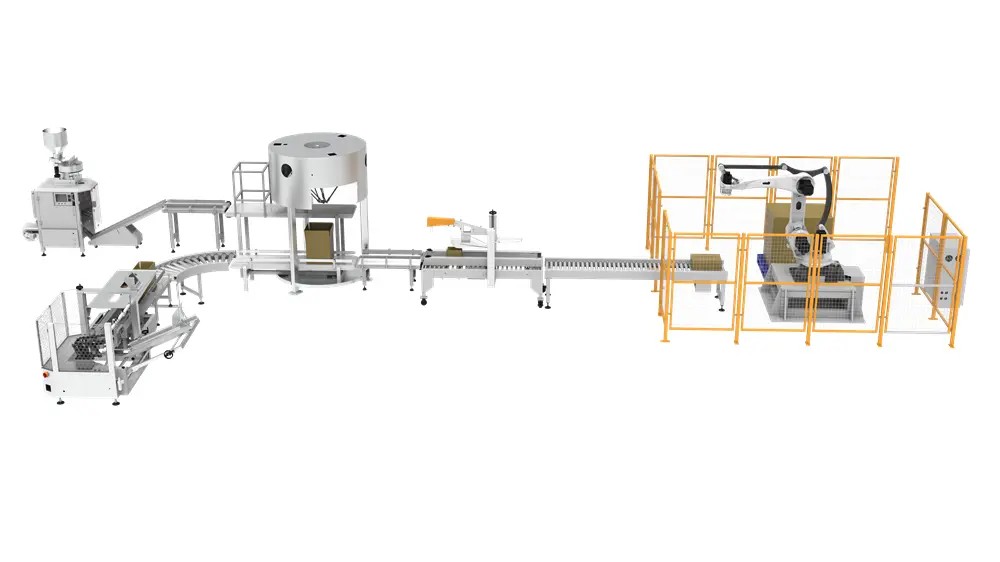
Automated packaging solution with vertical packing machine integrated into a complete line
Increasing Demand Requires Stable Output
Retail and distribution partners expect consistent daily volumes and reliable delivery schedules. Fluctuations caused by operator absence or mismatched machine speeds become harder to absorb. A complete packing line delivers predictable throughput hour after hour. Recipe-driven changeovers and standardized settings keep quality uniform across shifts. When demand spikes, the line can run longer periods with minimal additional staffing. This stability supports long-term contracts and strengthens the factory’s position in competitive supply chains.
The Hidden Costs of Buying Individual Machines
The purchase price of standalone equipment forms only part of the total picture. Several secondary costs accumulate over time and can shift the economic balance in favor of an integrated solution.
Integration Costs
Connecting machines from different suppliers requires custom conveyors, height adjustments, and control interfaces. Engineering time, special brackets, and electrical synchronization add expense after the initial purchase. Communication protocols may differ, forcing extra programming or gateway hardware. These integration tasks often surface only after the machines arrive on site. A coordinated automation packaging line built from matched modules avoids most of these late-stage costs.
Installation and Commissioning Complexity
Each supplier typically sends its own technicians on separate schedules. Coordinating multiple teams extends the installation window and increases the chance of schedule conflicts. Operators receive training on different control systems, lengthening the learning period. Commissioning becomes a series of isolated tests rather than a single coordinated validation of the entire process flow. The cumulative downtime during this phase can exceed the time required to install a pre-engineered complete line.
Higher Operational Costs
Separate machines generate higher ongoing labor and maintenance expenses. Operators move between stations, and each machine may need its own spare-parts inventory and service contract. When one unit stops, the entire sequence often pauses while material is cleared or rerouted. Energy consumption also tends to be less optimized because each machine runs its own motors and heaters without shared process intelligence.
Future Upgrade Limitations
Adding capacity later means finding another machine that matches existing interfaces and speeds. Physical layout constraints and control-system differences can force costly modifications or force the plant to replace earlier equipment sooner than planned. An integrated line designed with modular expansion points accommodates additional modules or higher-speed units with far less disruption.
Total Cost of Ownership: Individual Machines vs Complete Packing Line
Evaluating real ownership cost requires looking beyond the equipment invoice. The full equation includes installation, labor over the equipment life, maintenance, downtime impact, and the cost of future upgrades.
Equipment investment + Installation + Labor + Maintenance + Downtime + Future upgrades = Real ownership cost
|
Cost Factor |
Individual Machines |
Complete Packing Line |
|
Equipment cost |
Lower |
Higher |
|
Labor cost |
Higher ongoing |
Lower ongoing |
|
Integration cost |
Higher (often unplanned) |
Lower (pre-engineered) |
|
Downtime risk |
Higher |
Lower |
|
Long-term ROI |
Depends on scale and labor rates |
Stronger for medium-to-large production |
For plants running multiple shifts or facing rising wage pressure, the labor and downtime savings of a complete line frequently recover the higher initial investment within 18 to 36 months. The exact payback period depends on local labor rates, the number of shifts, and the complexity of the packaging formats involved. Selecting the right configuration is covered in detail in the buyer’s guide on the automatic packing line for a food factory.
How to Decide Which Solution Fits Your Factory?
The right choice depends on current volume, product mix stability, available capital, and growth trajectory. Clear criteria help production and finance teams reach a shared conclusion.
Choose Individual Machines If
- Production volume remains limited and daily output stays well within the capacity of one or two primary packaging units.
- Product formats change frequently and the team needs maximum reconfiguration freedom.
- Automation investment is still at an early stage and capital must be spread across several plant areas.
- The factory prefers to expand capacity step by step while building internal operating experience.
Choose a Complete Packing Line If
- Production demand is growing steadily and current manual or semi-automatic steps already create bottlenecks.
- Labor shortage or rising wage costs affect daily operations and shift staffing.
- Multiple packaging steps (primary wrapping, cartoning, case packing, palletizing) form part of the process, including modules from an end-of-line packing series.
- Consistent output volume and pack quality are required to meet retail or distribution commitments.
- Long-term automation planning is already underway and the plant seeks a scalable foundation.
Many factories begin with individual machines and later add modules that gradually form a complete line. When the decision is made early, specifying equipment that can later connect into an integrated system reduces future conversion cost.
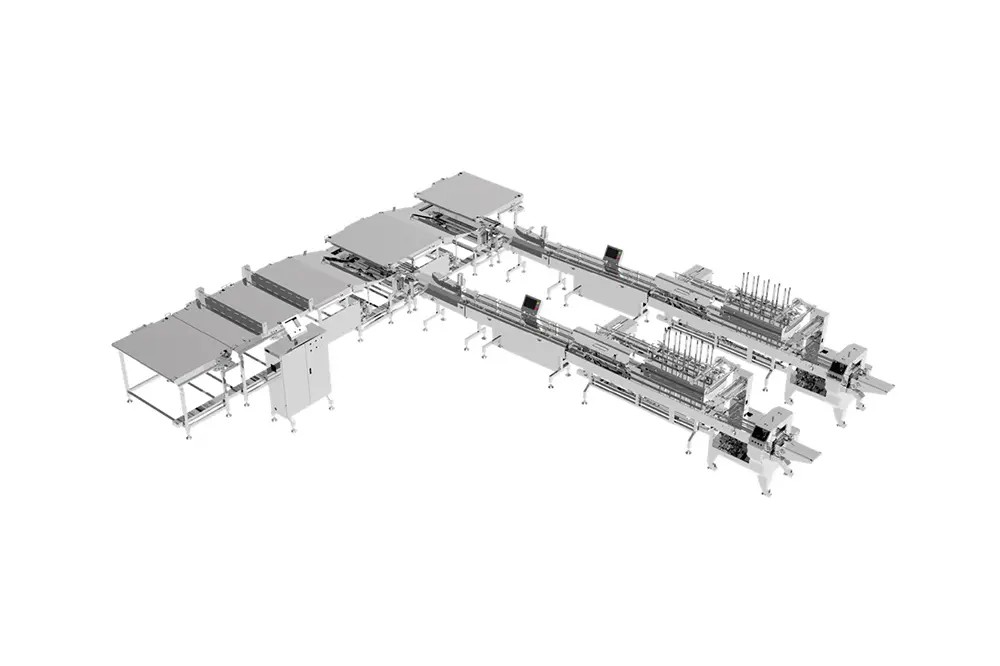
Automatic packaging line with tray – suitable for bakery, snacks and ready-meal formats
Why Choose Soontrue for Complete Packing Line Solutions?
Soontrue designs and manufactures fully integrated automatic packing lines for the food industry, covering bakery, snacks, frozen products, and related categories. The company supplies both primary packaging machines and end-of-line systems from a single engineering base, which simplifies project coordination and long-term support. The full portfolio of packaging solutions is available on the Soontrue homepage.
Complete Project Capability
Soontrue packing line solutions handle the full sequence from product sorting and primary packaging through secondary packaging, case erecting, robotic case packing, and palletizing. Lines can start with flow wrapping machines, vertical form-fill-seal systems, or premade pouch machines and then continue seamlessly into cartoning and case packing. This one-stop approach ensures every module is designed to the same mechanical and control standards, reducing interface problems and accelerating commissioning.
Single Supplier Advantage
Working with one supplier for the entire line means a single project timeline, one set of documentation, and one technical team responsible for performance. Spare parts, operator training, and remote support all come from the same source. When a question arises about upstream feeding speed or downstream case pattern, the answer sits with the same engineering group that designed the system. This continuity shortens response times and keeps overall equipment effectiveness high over the life of the installation.
Flexible Solutions for Different Factories
Soontrue configures lines according to product characteristics and factory constraints. Bakery and biscuit lines emphasize gentle handling and high-speed flow wrapping. Snack and frozen-food lines incorporate vertical packaging or tray systems as required. End-of-line modules adapt to organized or random case packing and can integrate robotic palletizers. Layouts remain modular so that capacity can expand by adding parallel modules or higher-speed units without redesigning the entire system. Cold-chain applications benefit from the same modular approach described in solving frozen food packaging challenges.
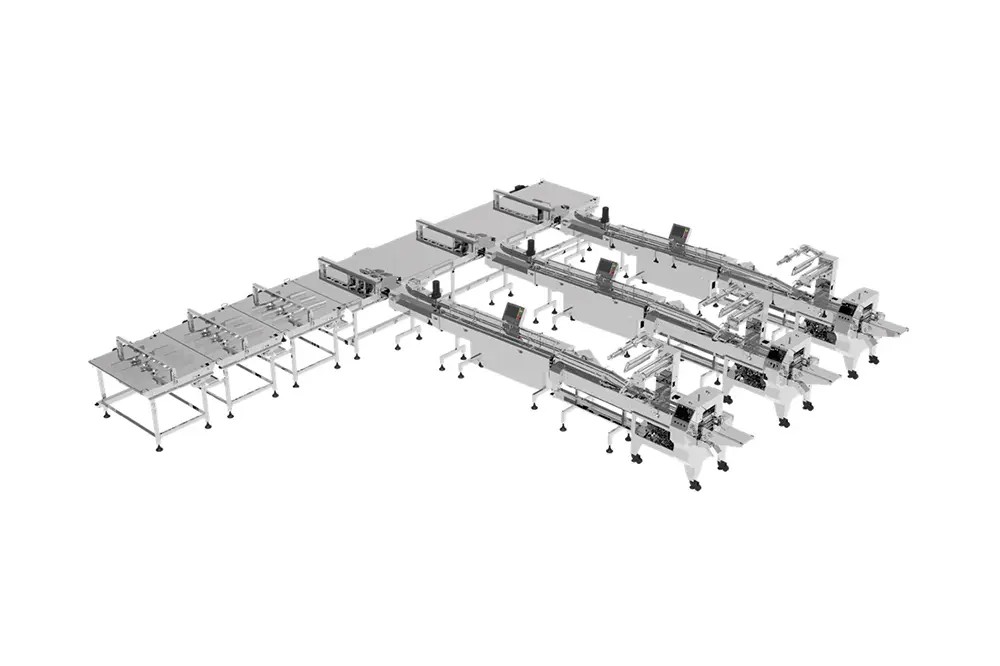
Bakery and biscuit packing line configuration from primary wrapping through secondary packaging
Conclusion
The decision between individual packaging machines and a complete packing line rests on a clear view of current volume, labor conditions, and growth plans. Standalone equipment serves early-stage or highly flexible operations effectively. As output rises and process steps multiply, the continuous flow, lower labor demand, and unified support of an integrated line deliver stronger long-term value.
Soontrue provides complete project capability, single-supplier accountability, and flexible configurations tailored to bakery, snack, frozen, and related food categories. Factories ready to move from separate machines to a coordinated automatic packing line can explore solutions that match both present requirements and future expansion goals through the Soontrue packaging solutions platform, where product characteristics, target speeds, and plant layout can be reviewed with the engineering team.
FAQ
How long does it typically take to recover the investment in a complete packing line?
Most installations achieve payback between 18 and 36 months. The exact period depends on local labor costs, the number of operating shifts, and the reduction in product waste and downtime. A detailed cost-benefit model prepared during the project planning stage provides a realistic forecast for each factory.
What floor space is required for a turnkey packing line?
Footprint is customized to the specific product range and target speed. Modular design keeps the layout compact. During the initial consultation, plant CAD drawings are used to develop a layout that fits existing building constraints and optimizes material and personnel flow.
How are product changeovers handled on a complete line?
Modern lines incorporate recipe management on the HMI, quick-release change parts, and SMED principles. Trained operators can complete most format changes in 15 to 25 minutes. Tool-less adjustments further reduce the time needed between different pack sizes or product types.
Can a new packing line connect to existing upstream processing equipment?
Yes. Soontrue lines are designed with open control architecture supporting standard industrial protocols. Product infeed can be adapted to match the discharge of existing ovens, fryers, or freezers, ensuring continuous material flow from processing into packaging.
What support is available after installation?
Support includes on-site installation and commissioning, structured operator and maintenance training, ready availability of spare parts, and ongoing technical assistance. The same team that engineered the line remains available for optimization as production needs evolve.