
How to Choose the Right Automatic Packing Line for Your Food Factory
Packaging Knowledge Hub

If you're seeking packaging automation solutions, please contact us, and we'll be delighted to offer you the most tailored solution.
Food manufacturers operate under constant pressure. Labor shortages continue to tighten the available workforce, hourly wages climb year after year, and food safety audits grow stricter with every inspection cycle. At the same time, retail buyers demand faster SKU changes and more flexible pack formats. These forces push plants toward automation, yet many decision-makers still start the equipment search by asking only one question: how many packs per minute can the line deliver?
That single metric creates a common trap. Maximum rated speed rarely survives contact with real production conditions. Upstream processes may lag, product characteristics may force slower transfer rates, and changeover times can erase the theoretical advantage of high PPM numbers. The result is idle time, buffer piles, and capital spent on capacity that never materializes on the shop floor.
This guide offers a practical roadmap for evaluating, selecting, and integrating an automatic packing line. It focuses on measurable production goals, product-specific requirements, factory layout realities, total cost of ownership, and supplier capability. The aim is to help managers make investment decisions that deliver reliable output, protect product quality, and scale with future demand.
Define Your True Production Goals
Equipment specifications must match actual shop-floor conditions. Over-specifying inflates capital cost and energy use; under-specifying creates chronic bottlenecks. A clear picture of current constraints and future targets prevents both mistakes.
Calculating Current Bottlenecks and Target Daily Output
Begin by mapping the entire process from raw processing to finished case. Baking ovens, freezing tunnels, and frying lines set the true pace of product arrival. Packaging equipment that runs faster than this upstream flow simply waits. Measure peak hourly output from each processing stage, then calculate the packaging speed needed to clear that volume during planned operating windows, including scheduled maintenance and sanitation stops.
Real-world line speed also depends on product yield variation and the buffer capacity between stages. A modest accumulation conveyor can absorb short interruptions, allowing the packing section to maintain steady throughput. Without that buffer, every minor upstream slowdown forces the entire line to idle.
Accounting for Labor Constraints and Shift Planning
Decide early whether the plant needs a semi-automatic configuration or a fully automatic turnkey system. Semi-automatic lines keep operators at tray loading or case packing stations and suit plants that still value flexible human intervention. Fully automatic systems reduce continuous-path staffing to one or two supervisory roles and suit facilities facing severe labor shortages or multi-shift schedules.
Capacity planning must also absorb the demands of two or three daily shifts. A line sized only for single-shift peaks will require extra labor or overtime once production expands. Designing for continuous multi-shift operation from the start avoids later staffing crises and keeps unit labor cost predictable.
Planning for SKU Diversification and Growth Forecasts
Size the packaging line for projected peak demand three to five years ahead. Premature reinvestment drains capital that could fund product development or market expansion. Format flexibility matters equally. Multipacks, variety packs, and retail-ready trays increasingly appear in supermarket specifications. Equipment that accepts these formats through simple recipe changes protects the investment as customer requirements evolve.
Critical Selection Criteria Tailored for Food Products
Food characteristics govern every major decision: dosing method, feeding style, primary packaging technology, and sanitation design. Matching these elements to the product prevents breakage, giveaway, and hygiene failures.
Product Physical Attributes and Dosing Compatibility
Fragile bakery items such as biscuits, cookies, and pastries demand soft transfer belts, gentle feeding channels, and horizontal flow wrappers. These machines receive solid, regularly shaped products and wrap them in continuous film without subjecting the product to vertical drops or aggressive mechanical handling.
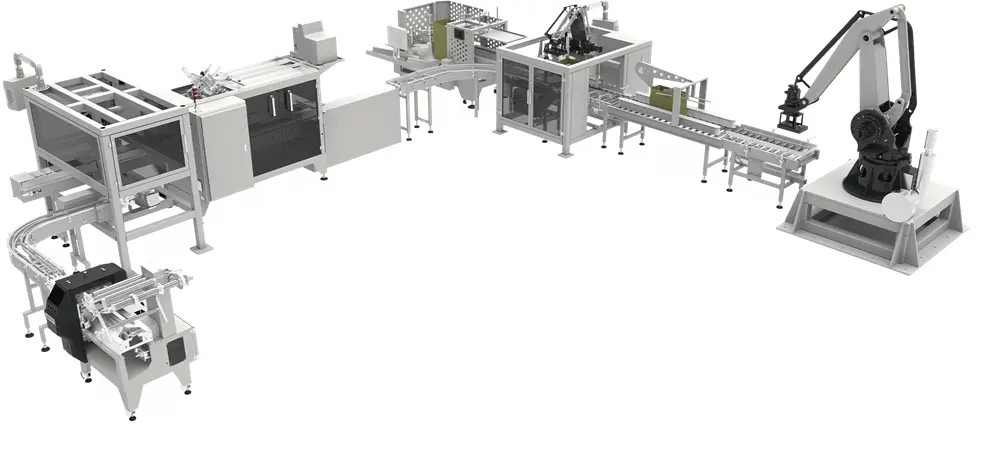
Automated Flow Packaging Solution – horizontal flow wrapper integrated with end-of-line automation
Free-flowing and frozen items—dumplings, frozen vegetables, snack pellets—pair best with multihead weighers of 10 to 24 heads and vertical form-fill-seal (VFFS) machines. The weigher combination delivers precise portion control while the VFFS unit forms, fills, and seals bags from a continuous film roll in a single vertical motion.
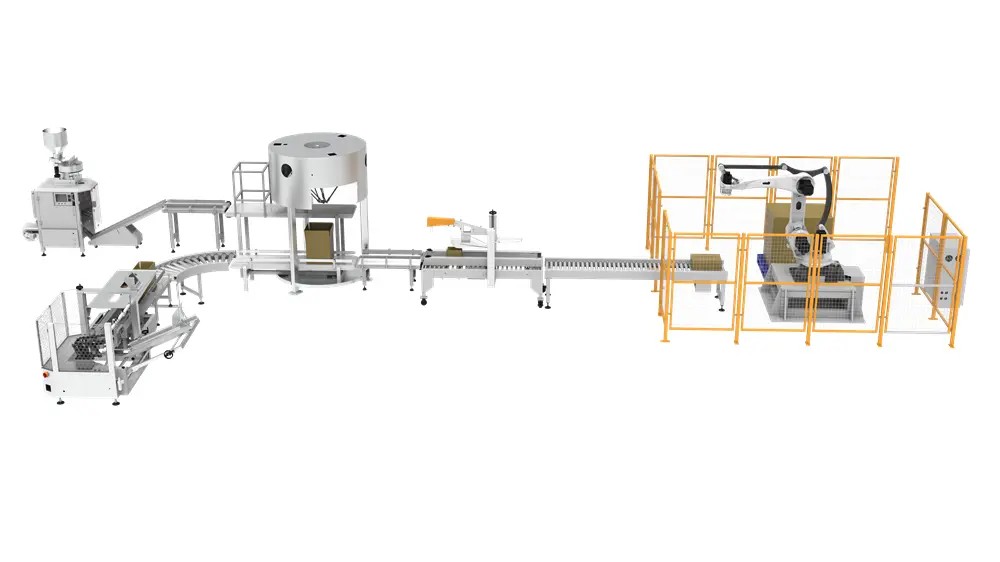
Automated Vertical Packaging Solution – multihead weigher + VFFS integrated with case packing and palletizing
Sticky, wet, or fresh products including meat, seafood, and prepared meals require dimpled or textured weigher surfaces, stainless-steel chutes, and often combined with flow wrappers or tray sealers. These surfaces reduce product adhesion and keep the dosing system clean between cycles.
Packaging Materials and Sealing Technology
Film choice influences both shelf life and sustainability goals. Sealing jaws must accommodate traditional laminate structures as well as newer mono-material recyclable films. Box-motion sealing jaws provide longer dwell time and produce hermetic seals that extend product life under modified atmosphere conditions. Nitrogen flushing modules further control residual oxygen for oxidation-sensitive items such as snacks and baked goods.
Food Safety and Sanitation Compliance
Wet or wash-down environments typical of frozen food, ready meals, and seafood processing require IP65 or IP67 stainless-steel construction in grades 304 or 316. Frames should incorporate sloped surfaces for drainage, and conveyor belts need quick-release mechanisms that allow thorough cleaning without tools. Dry environments found in bakery, confectionery, and snack plants emphasize tool-less disassembly, open-frame profiles, and interfaces for dust extraction systems.
Match the Line to Your Physical Factory Environment
Even the best-engineered equipment fails when it cannot fit the available space or connect to existing utilities. Early layout and utility audits prevent costly field modifications.
Layout Footprint and Height Clearance
Vertical form-fill-seal systems paired with multihead weighers need adequate ceiling height and often a mezzanine platform for the weigher. Straight-line, L-shape, and U-shape configurations each solve different constraints around pillars, aisles, and existing conveyors. Compact modular designs maximize usable floor area while preserving access for operators and maintenance staff.
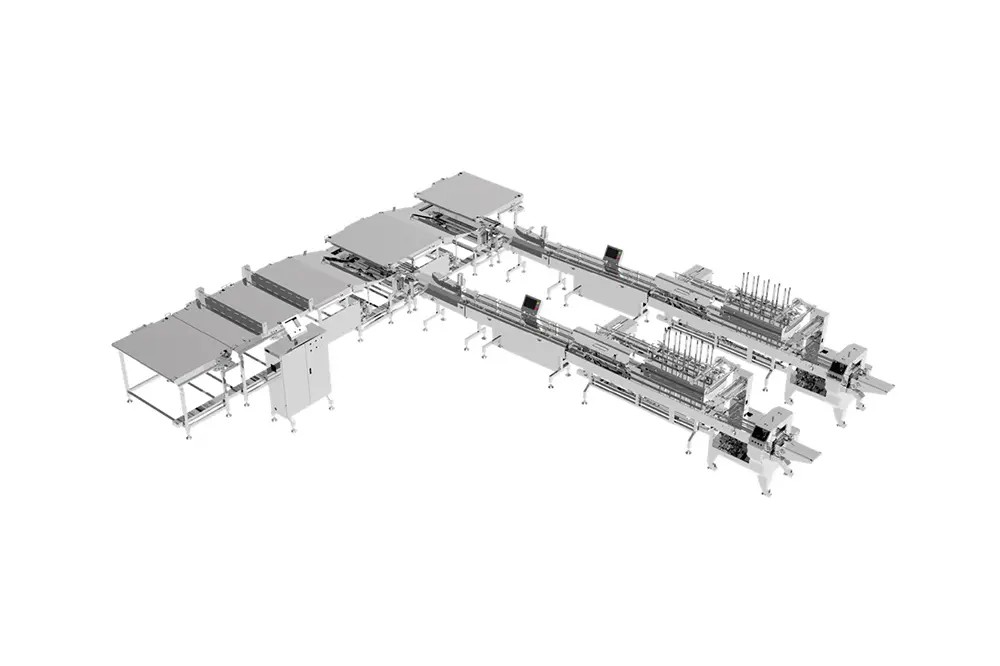
Automatic Packaging Line With Tray – example of an L-shaped modular layout that fits around existing factory constraints
Utility Requirements and Energy Efficiency
Compressed-air volume, electrical load, and drainage locations must be verified before equipment arrives. Servo-driven actuators replace many pneumatic cylinders and reduce both electricity consumption and compressed-air demand over the life of the line. These savings accumulate into a measurable reduction in operating cost.
Ergonomics and Maintenance Access
A clear perimeter around film-roll loading stations, reel changers, and major mechanical modules allows operators to work safely and maintenance teams to reach components without dismantling adjacent sections. Tool-less access points further shorten planned downtime.
Evaluate TCO and OEE
Purchase price represents only the first installment of ownership cost. Overall equipment effectiveness and total cost of ownership over five to ten years determine the true economic value of the investment.
|
Metric / Dimension |
Core Focus |
Selection Strategy |
|
OEE |
Availability, Performance, Quality |
Prioritize high MTBF and integrated reject stations that remove defective packs without stopping the line. |
|
Changeover Efficiency |
Downtime during SKU switches |
Specify tool-less changeovers following SMED principles. Recipe switches via HMI should complete in 10–25 minutes. |
|
Material & Yield Waste |
Film scrap and product giveaway |
Select weighers with accuracy of 0.5 g or better and sensor interlocks that prevent empty bags. |
|
Total Cost of Ownership |
Maintenance, energy, spares, labor |
Confirm that PLC, servo, and sensor systems use open industry standards rather than proprietary locked architectures. |
High overall equipment effectiveness compounds over years of operation. A line that maintains 85 percent OEE instead of 70 percent produces substantially more saleable output from the same capital base and the same labor hours.
Evaluate Supplier Capabilities, Not Just Equipment
Hardware specifications matter, yet the supplier’s ability to integrate, customize, and support the line often determines long-term success.
Multi-Vendor versus Single-Source Integration
Purchasing individual modules from separate suppliers introduces mechanical interface mismatches, communication protocol conflicts, and divided responsibility when performance falls short. A single-source turnkey partner supplies synchronized controls, unified project management, and one point of contact for the entire lifecycle. This approach shortens commissioning and simplifies future upgrades.
Customization and Pre-Purchase Trial Testing
Request factory trials that run actual product samples and the intended packaging film. These trials verify seal integrity, weigh accuracy, film tension stability, and maximum sustainable speed without product damage. Factory Acceptance Testing protocols agreed before shipment further reduce on-site surprises and accelerate final commissioning.
Digital Integration and Lifecycle Service
Modern control architectures support OPC-UA protocols that exchange real-time OEE data, batch records, and alarm histories with existing MES and ERP systems. This connectivity turns the packing line into a data source for continuous improvement rather than an isolated island of automation. Ongoing spare-parts availability, remote software updates, and structured operator training complete the support package needed for multi-year reliability.
How Soontrue Helps Food Manufacturers Reduce Selection Risks
Soontrue delivers end-to-end engineered packing line solutions that cover primary packaging through secondary cartoning, case packing, and palletizing. The product range includes automated flow packaging solutions built around horizontal flow wrappers for bakery, confectionery, and solid products; automated vertical packaging solutions centered on VFFS machines for free-flowing, powdered, and frozen items; and specialized configurations such as tray-in-bag lines, deoxidizer insertion systems, and frozen dumpling packaging lines.
Each project begins with real product samples and factory CAD drawings. Engineering teams develop custom machine configurations and three-dimensional layouts that respect existing pillars, aisles, and utility locations. Pre-shipment Factory Acceptance Testing, rapid on-site commissioning, operator training, and continuous spare-parts supply form a complete lifecycle assurance package.
These turnkey systems integrate multihead weighers, flow wrappers or VFFS units, checkweighers, metal detectors, case erectors, robotic or mechanical case packers, and palletizers into one synchronized control architecture. The result is a single-source solution that eliminates interface risk and provides one accountable partner from concept through long-term operation.
Conclusion
Selecting an automatic packing line for a food factory requires careful alignment of product characteristics, layout constraints, sanitation standards, and long-term cost structure. Speed ratings alone never guarantee success. Plants that define realistic production goals, match equipment to physical product behavior, verify factory fit, and measure total cost of ownership achieve higher uptime and faster return on capital.
A turnkey partner further reduces integration risk and supplies the engineering depth needed for reliable performance. Soontrue combines primary packaging technologies with complete end-of-line automation, custom engineering based on real samples and CAD data, and lifecycle support that keeps lines running at high overall equipment effectiveness. That combination turns the capital decision into a durable competitive advantage.
FAQ
1.What is the main operational difference between a VFFS machine and a Flow Wrapper?
A horizontal flow wrapper receives solid, regularly shaped products such as biscuits, snacks, or trayed meals and wraps them in continuous film moving horizontally. A vertical form-fill-seal machine forms a bag from flat film, receives loose or bulk product from above via a multihead weigher or filler, and seals the bag vertically. VFFS systems suit powders, frozen dumplings, and free-flowing snacks.
2.How do automated packaging lines support HACCP and food safety standards?
Automated lines remove direct human contact during the packaging sequence. Stainless-steel IP65 or IP67 wash-down designs, inline quality gates that include checkweighers, metal detectors, and vision sensors, plus continuous PLC batch logging all contribute to audit-ready records and consistent hygiene performance.
3. What tests should be performed on product samples before finalizing a machinery contract?
Lab trials should use the actual product and the intended packaging film. Key checks include seal integrity under pressure, residual oxygen after gas flushing, weigh accuracy across the full speed range, film tension stability, and sustained maximum speed without product breakage or deformation.
4. How quickly can an automated food packing line recover its investment?
Most fully automatic packing lines achieve complete return on investment within 18 to 36 months. Payback speed depends on local labor rates, number of operating shifts, reduction in material waste, increase in daily output, and avoidance of retailer defect penalties. A detailed cost-benefit model built from plant-specific data provides the most accurate projection.