
Next-Gen Food Packaging Lines: Balancing High-Speed Automation, Sustainable Material Saving, and Hygiene Compliance
Packaging Knowledge Hub

If you're seeking packaging automation solutions, please contact us, and we'll be delighted to offer you the most tailored solution.
Food processing plants face rising pressure to deliver higher throughput while meeting stricter hygiene rules and sustainability targets. Primary packaging, secondary cartoning or case packing, and tertiary palletizing can no longer operate as isolated stations. When these stages remain disconnected, speed mismatches create accumulation, product damage increases, and labor costs climb. Fully integrated packaging lines close those gaps by synchronizing every transfer from infeed to finished pallet.
Modern full-servo systems routinely deliver measurable gains: labor cost reductions approaching 35 percent, film waste cuts of 1.5 to 2 percent, and product changeovers completed up to 50 percent faster. These figures matter most to plant managers, automation engineers, and procurement directors responsible for bakery, frozen food, and confectionery operations. The following sections examine the technical architecture, material-saving methods, sanitary design features, and investment logic behind next-generation lines. Detailed equipment options appear on the automatic packing line solutions page.
1. The Evolving Food Packaging Landscape: Why End-to-End Line Automation Is Urgent
1.1 Shift from Standalone Machinery to Fully Integrated Systems
Many factories still rely on individual machines linked by manual transfer or simple conveyors. When a high-speed flow wrapper outpaces the cartoner downstream, product piles form on intermediate tables. Operators must intervene, introducing both ergonomic risk and contamination points. The reverse situation, where secondary packaging waits for primary output, leaves expensive equipment under-utilized.
An integrated line treats feeding, primary wrapping, secondary packaging, and palletizing as a single synchronized process. Servo-driven infeed systems meter product at the exact rate the wrapper can accept. Finished packs move directly into cartoners or case packers without intermediate buffering. The result is continuous flow rather than stop-start accumulation. Overall line efficiency often doubles because every station operates at its design speed without waiting for the slowest neighbor.
Complete systems also reduce product damage. Manual handling of soft bakery items or frozen dumplings frequently causes edge breakage or surface defects. Automated transfer using vacuum belts, flighted conveyors, or gentle robotic pick-and-place keeps product orientation stable from the moment it leaves the production line until it reaches the shipping pallet. More information on complete configurations is available in the end-of-line packing series.
1.2 The Triad Challenge: High-Speed Requirements, Hygiene Standards, and ESG Goals
Food packaging sits at the intersection of three demanding requirements. First, production schedules demand high cycle rates to meet retail and food-service volume. Second, regulatory frameworks such as FDA and EHEDG set strict hygienic design criteria: smooth surfaces, minimal crevices, and full wash-down capability. Third, corporate ESG commitments and emerging plastic-reduction policies push plants toward thinner films and recyclable materials.
These three goals can appear to conflict. Higher speeds increase the mechanical stress on sealing jaws, making consistent seals harder to achieve with lighter-gauge film. Wash-down requirements limit the use of certain lubricants and electrical components. Material-saving initiatives reduce film thickness, which in turn demands tighter temperature and pressure control. The engineering response has been the widespread adoption of multi-axis servo drives, hygienic stainless-steel frames, and closed-loop process monitoring. Together these technologies allow lines to run faster, stay cleaner, and consume less packaging material without sacrificing seal integrity.
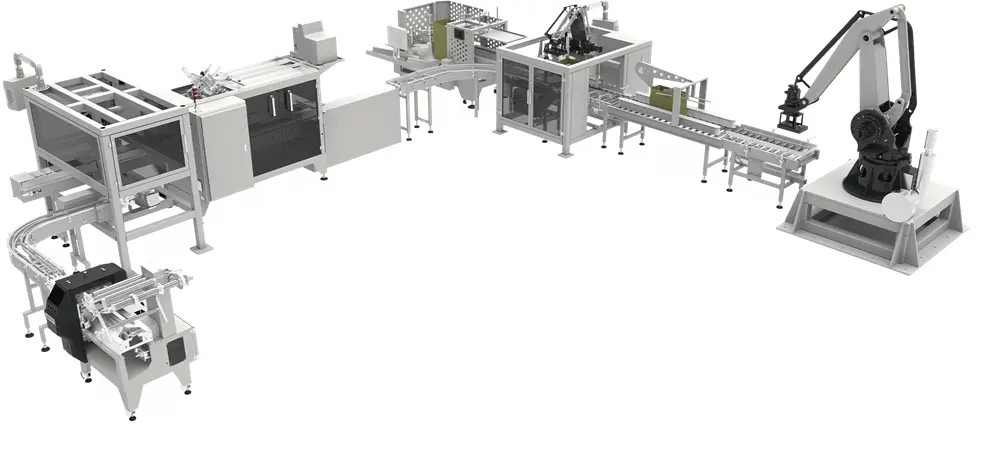
Automated flow packaging solution integrating primary wrapping with downstream handling
2. Core Components of an Automated Food Packing Line: From Feeding to Palletizing
2.1 Automated Feeding and Smart Sorting (Primary Stage)
The first critical stage is product presentation. Servo feeders and magnetic levitation conveyors provide precise spacing and orientation without the mechanical complexity of older timing-screw systems. Vision inspection cameras mounted above the infeed detect missing products, surface defects, or incorrect orientation. Reject mechanisms remove non-conforming items before they enter the wrapper, protecting both packaging film and finished-goods quality.
For irregular or delicate items such as filled pastries or frozen dumplings, multi-lane distribution systems spread product across several parallel tracks. This arrangement matches the capacity of high-speed wrappers while keeping individual lanes within the mechanical limits of gentle handling. Recipe-driven servo profiles store optimal acceleration and deceleration curves for each product, so changeovers require only a few parameter selections on the HMI rather than mechanical adjustment.
2.2 High-Speed Primary Packaging (Flow Wrapping & VFFS)
Primary packaging for solid food products typically uses horizontal form-fill-seal (flow wrap) machines or vertical form-fill-seal systems. Flow wrappers excel with discrete items—biscuits, chocolate bars, bread slices—while VFFS machines handle free-flowing or bulk products. Modern lines often incorporate both technologies in modular configurations so a single plant can switch formats according to order mix. Explore available flow wrapping machines for detailed specifications.
Two features have become standard on next-generation primary machines. No-product-no-bag logic stops film advance when sensors detect an empty flight, eliminating empty packages that waste film and complicate secondary packaging. Anti-cutting systems use photocell or ultrasonic detection to ensure the sealing jaws never close on product, protecting both the product and the expensive cutting blades. Combined with multi-axis servo film feed, these controls keep film waste well below one percent even at speeds exceeding 200 packs per minute.
2.3 Secondary Packaging & Robotics Integration
Once primary packs leave the wrapper, secondary packaging consolidates them into retail-ready cartons or shipping cases. Automatic cartoners erect, load, and close folding cartons at rates matching the upstream flow. For case packing, robotic systems—particularly Delta parallel robots and collaborative arms—provide the flexibility needed for mixed-SKU environments. Vision-guided pick-and-place allows a single robot cell to handle multiple pack sizes without change parts.
Robotic case packers also improve ergonomics. Manual case packing of heavy frozen-food cartons generates repetitive-strain injuries and slows the line during peak seasons. A robotic cell can operate continuously at consistent cycle times, freeing operators for higher-value tasks such as quality checks and line supervision. Integration between primary and secondary stages relies on intelligent buffering and real-time communication so that speed variations at one station do not cascade into stoppages further down the line.
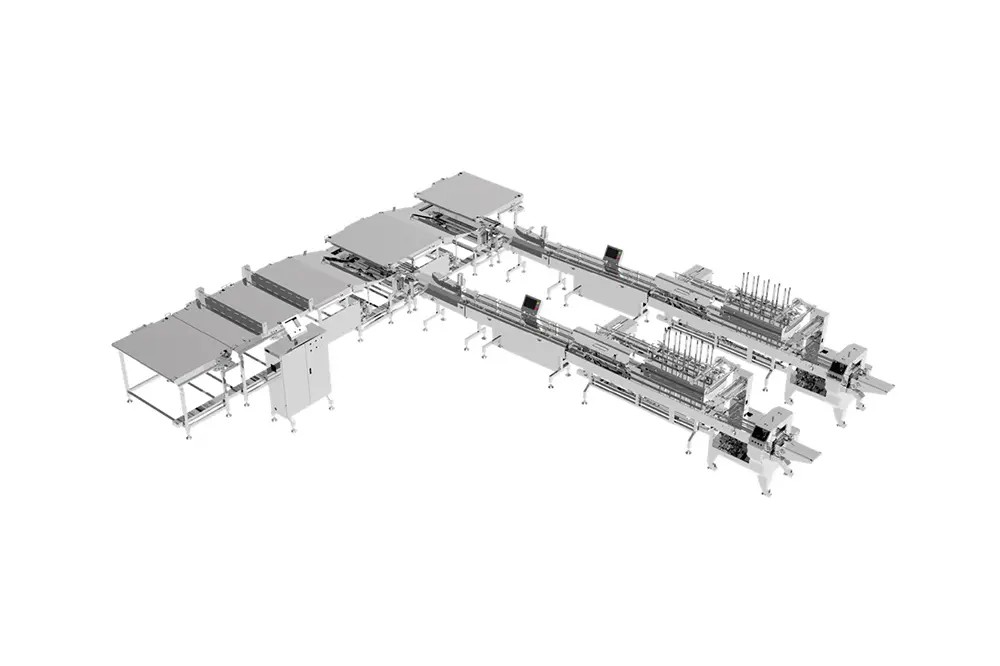
Automatic packaging line with tray loading for bakery and prepared-meal products
2.4 End-of-Line Palletizing (Tertiary Stage)
The final automation stage stacks finished cases onto pallets according to programmed patterns. Robotic palletizers equipped with vacuum or clamp grippers handle a wide range of case weights and dimensions. Pattern software optimizes load stability while maximizing pallet utilization. Safety fencing, light curtains, and collaborative operating modes keep personnel protected without sacrificing throughput. Full details on available systems appear under robotic palletizing solutions.
When primary, secondary, and tertiary stages share a common control architecture, the entire line can be monitored from a single HMI. Operators see real-time OEE, reject rates, and material consumption for every station. This visibility supports continuous improvement programs and simplifies root-cause analysis when performance drifts.
3. Material Savings & Sustainability: How Advanced Servo Control Reduces Operating Costs
3.1 Precise Temperature and Motion Control in Film Sealing
Film cost represents a substantial portion of packaging operating expense. Traditional mechanical or single-servo systems often require thicker film to compensate for variation in sealing temperature and dwell time. Multi-axis servo drives control film feed, longitudinal seal, and end-seal jaws independently. Temperature controllers with rapid response and closed-loop feedback maintain jaw temperature within a narrow band even during speed changes.
These capabilities enable reliable sealing of thinner films. Where a conventional line might need 40-micron film to achieve consistent seals at high speed, a full-servo system can run 30-micron or even 25-micron material without increasing leak rates. The same precision also supports newer mono-material and recyclable films whose sealing windows are narrower than traditional multi-layer laminates.
3.2 Quantitative Impact of Waste Reduction
The combined effect of accurate product detection, precise film feed, and stable sealing shows up clearly in plant metrics. The table below compares typical performance ranges observed on traditional lines versus fully integrated servo packaging lines operating under similar product and speed conditions.
|
Performance Metric |
Traditional Line |
Full-Servo Integrated Line |
Quantitative Benefit |
|
Film Waste Rate |
2.5% – 4.0% |
< 0.5% |
Saves 1.5–3.5 tons film/year |
|
Product Damage Rate |
~1.5% |
< 0.2% |
Thousands fewer losses/day |
|
Line Efficiency (OEE) |
65% – 72% |
88% – 93% |
>20% throughput gain |
These savings compound over multi-shift operation. A mid-size bakery running three shifts can recover the cost of film waste alone within the first year of operation. Additional gains appear in reduced scrap handling, lower landfill fees, and improved sustainability reporting. Further guidance on selecting systems that maximize material efficiency is available in the complete packing line overview.
4. Overcoming Operation Bottlenecks: Sanitary Design, Quick Changeovers, and Maintenance
4.1 Sanitary and Washdown Designs for Food Safety
Hygienic design is non-negotiable in food environments. Frames constructed from SUS304 or SUS316 stainless steel resist corrosion from cleaning chemicals and humidity. Surfaces are continuous and free of horizontal ledges where product residue can accumulate. IP65 or IP69K-rated electrical enclosures and motors withstand high-pressure wash-down, allowing the entire line to be cleaned without disassembly of major components.
Open-frame construction and rounded corners eliminate dead zones. Cable routing is external and accessible so that cleaning crews can reach every surface. These features reduce the time required for sanitation cycles and lower the risk of allergen cross-contamination when the line switches between product families. Plants operating under EHEDG or equivalent guidelines find that properly designed equipment simplifies both internal audits and external certification.
4.2 Modular Architecture and Tool-less Quick Changeover
Multi-SKU production has become the norm rather than the exception. A bakery may run six different biscuit formats in a single shift; a frozen-food plant may alternate between dumplings, spring rolls, and filled buns. Modular machine architecture addresses this reality. Quick-release guide rails, recipe-stored servo parameters, and tool-less adjustment points allow operators to complete a full changeover in 15 minutes or less, compared with 45 to 60 minutes on older equipment.
HMI recipe management stores every critical setting—film tension, sealing temperature, infeed timing, carton dimensions—under a unique product code. Selecting a new recipe automatically adjusts servo positions and temperature set-points. Mechanical change parts, when required, are color-coded and designed for hand-tightened fasteners. The net result is higher productive time and the ability to accept smaller, higher-margin orders without excessive downtime.
4.3 Predictive Maintenance and IoT Connectivity
Unplanned stoppages remain one of the largest sources of lost capacity. Modern control platforms collect continuous data from servo drives, temperature sensors, and vibration monitors. Algorithms flag gradual changes that precede failure—rising motor current, increasing seal-jaw temperature variance, or unusual vibration signatures. Maintenance teams receive alerts on the HMI or via remote dashboards, allowing intervention during planned stops rather than emergency repairs.
Remote diagnostics further reduce response time. Secure VPN connections enable manufacturer engineers to review machine status and recommend corrective actions without on-site visits for routine issues. This capability is especially valuable for plants operating multiple shifts or located far from major service centers. Additional technical resources on automation architecture can be found on the Soontrue.
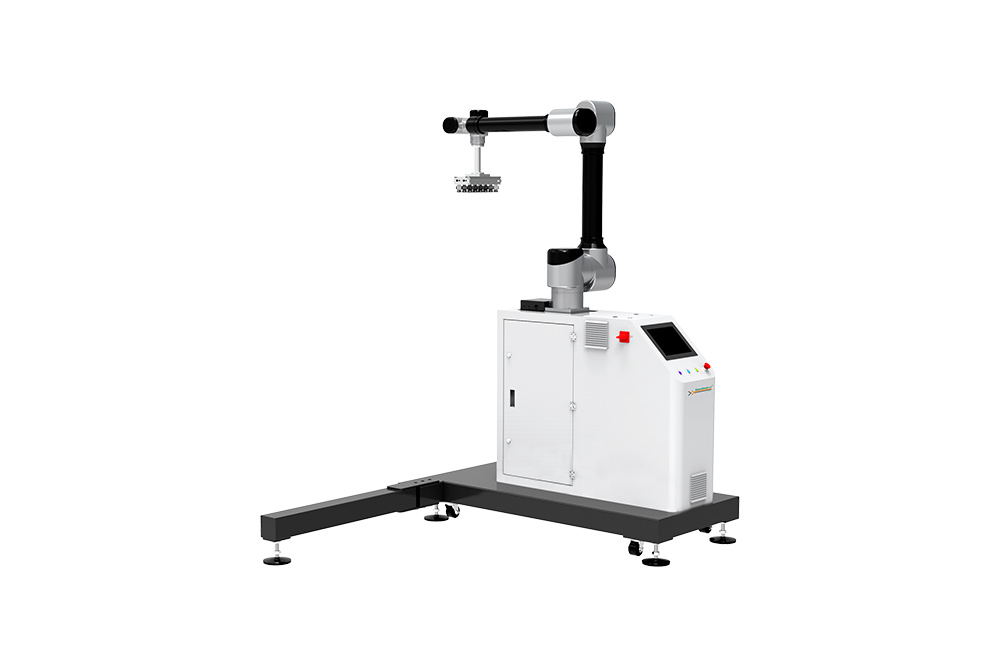
Robotic palletizing system completing the end-of-line sequence with dense, stable stacking (Source: Soontrue)
5. Cost-Benefit & ROI Analysis for Plant Upgrades
5.1 Estimating Total Cost of Ownership (TCO)
Capital expenditure for a complete packaging line includes the primary wrapper or VFFS machine, secondary cartoning or case packing, robotic or conventional palletizing, conveyors, and control integration. Installation, training, and initial spare-parts kits form additional first-year costs. Against this outlay, plants calculate ongoing savings in labor, film, product giveaway, and energy.
Labor reduction is typically the largest single contributor. A line that previously required eight to ten operators per shift can often run with three or four once automation is complete. Film savings of 1.5 to 3.5 percent translate directly into lower material invoices. Higher OEE increases output from existing floor space, deferring the need for building expansion. When these factors are modeled over a five- to seven-year horizon, the total cost of ownership of an integrated servo line frequently falls below that of a collection of standalone machines.
5.2 ROI Calculation Formula & Real-World Example
A simplified ROI model divides the net annual benefit by the net investment. Net annual benefit equals labor savings plus material savings plus value of additional throughput minus incremental maintenance and energy. Net investment equals equipment cost plus installation minus any residual value of replaced machines.
Consider a mid-size frozen-food plant packaging 12 000 packs per hour across two shifts. Replacing a mixed fleet of older wrappers and manual case packing with a full-servo integrated line might require an investment of approximately 1.2 million USD after installation. Annual labor savings of 280 000 USD, film savings of 45 000 USD, and throughput gains valued at 90 000 USD produce a combined benefit of 415 000 USD. Payback occurs in under three years, with subsequent years delivering pure operating surplus. Actual results vary with local wage rates, film prices, and utilization, yet the structure of the calculation remains consistent across bakery, confectionery, and frozen-food applications.
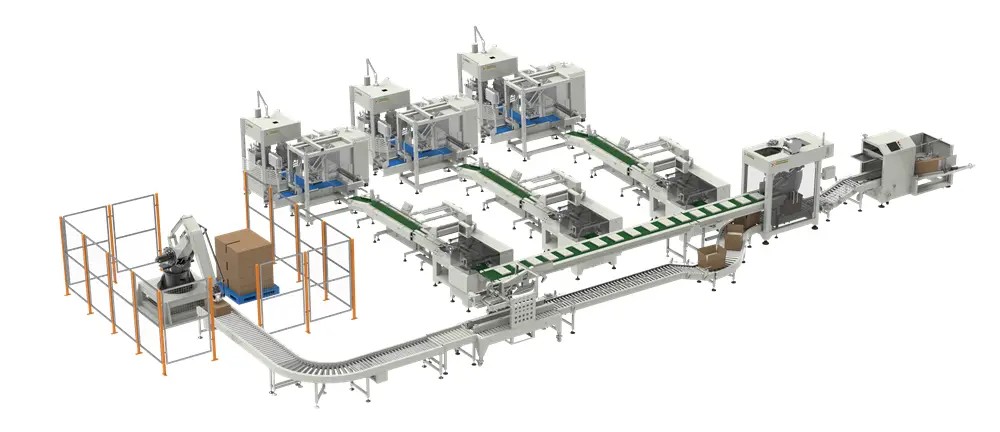
Integrated packaging solution tailored for frozen dumplings, covering gentle transfer and strong sealing (Source: Soontrue)
6. Frequently Asked Questions
Q1: What is the average ROI payback period for a fully automatic food packaging line?
Payback periods typically fall between 12 and 24 months for plants operating two or three shifts with significant labor content. Facilities with lower labor costs or single-shift operation may see returns closer to 30–36 months. Detailed modeling that incorporates local wage rates, film consumption, and expected utilization provides the most accurate forecast.
Q2: How does a packaging line maintain speed while working with sustainable or biodegradable films?
Multi-axis servo temperature compensation and low-inertia sealing jaws deliver precise heat control. The system adjusts dwell time and pressure in real time to achieve reliable seals on thinner eco-films without scorching or incomplete fusion. Continuous monitoring of seal integrity further protects against process drift.
Q3: Can one packaging line handle multiple food product sizes?
Yes. Modular lines equipped with recipe memory on the HMI store complete parameter sets for each product. Quick-release guide rails and servo-driven adjustments allow rapid changeover between sizes. Many installations successfully run six to ten different SKUs on the same primary and secondary equipment with changeover times under 20 minutes.
Q4: What hygiene standards can modern lines meet?
Properly specified equipment complies with FDA food-contact requirements and supports EHEDG hygienic design principles. Stainless-steel construction, IP69K protection, and open-frame architecture enable full wash-down. Documentation packages include material certificates and cleaning validation support.
Q5: How does integration with existing production equipment work?
Most suppliers design infeed interfaces to accept product from upstream ovens, freezers, or process conveyors. Standard communication protocols (OPC-UA, Ethernet/IP, Profinet) allow the packaging line to exchange status and recipe data with plant MES or ERP systems. Site surveys and layout studies ensure mechanical and electrical compatibility before equipment is manufactured. For project-specific consultation, visit the Soontrue.
7. Partnering with Soontrue for End-to-End Packaging Line Solutions
7.1 Decades of Expertise in Bakery and Food Automation
Soontrue has accumulated extensive practical experience designing and installing packaging systems for bakery, frozen food, confectionery, and snack applications. The engineering focus remains on solving the real constraints of food plants: high hygiene standards, frequent product changeovers, and the need to reduce material consumption while raising line speed. Solutions range from single high-speed flow wrappers to complete lines that integrate primary packaging, robotic secondary packaging, and automatic palletizing.
Custom engineering is central to the approach. Product characteristics—shape, fragility, temperature, and required pack format—drive the selection of infeed technology, sealing method, and end-of-line configuration. This product-first methodology produces lines that achieve the targeted throughput and quality levels from the first production runs rather than after prolonged trial-and-error adjustment.
7.2 Tailored Engineering, Global Service, and Seamless Integration
A complete project lifecycle begins with capacity analysis and layout design, continues through machine manufacturing and factory acceptance testing, and extends to on-site installation, commissioning, and operator training. After start-up, a global service network supplies spare parts and technical support. Remote diagnostics capabilities further shorten response times for plants located outside major industrial centers.
Integration with existing upstream equipment and plant information systems receives equal attention. Open control architectures and standardized communication protocols ensure the new packaging line becomes a coherent part of the overall production system rather than an isolated island. The result is measurable improvement in OEE, material yield, and labor productivity—outcomes that directly support both operational and sustainability objectives.
Plant managers and procurement teams evaluating next-generation packaging capability can review current solution portfolios on the Soontrue packing line portal or request a detailed line assessment tailored to specific product and throughput requirements. The combination of proven technology, hygienic design, and measurable material savings positions fully integrated servo packaging lines as a practical route to higher efficiency and lower operating cost in today’s demanding food manufacturing environment.