
How to Eliminate Bottlenecks Between High-Speed Production and Secondary Packaging
Packaging Knowledge Hub

If you're seeking packaging automation solutions, please contact us, and we'll be delighted to offer you the most tailored solution.
High-speed processing equipment such as ovens, extruders, and depositors frequently reaches peak efficiency on the factory floor. The real challenge appears the moment those products leave the processing zone and move toward secondary packaging. Output begins to accumulate, conveyors slow, and operators scramble to keep pace. The result is a classic production bottleneck that quietly erodes throughput, raises waste, and places unnecessary strain on both equipment and people. In many facilities this imbalance remains hidden until overtime hours climb or customer orders start slipping.
Upgrading packaging automation goes far beyond installing a faster wrapper. The decisive factor lies in managing product flow control and creating a continuous bridge between primary wrapping and the end-of-line systems that follow. When every stage moves at a matched rhythm, the entire line operates as a single coordinated system rather than a series of disconnected islands. Factories that achieve this balance report higher overall equipment effectiveness and more predictable daily output.
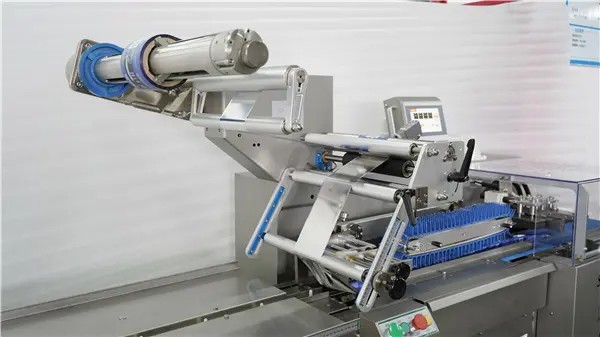
High-speed horizontal flow wrapper (HFFS) for primary packaging of bakery and snack products
Direct Impact: What Happens When Packaging Cannot Keep Up with Processing
A mismatch between processing speed and packaging capacity produces measurable losses across several operational dimensions. Understanding these effects helps production managers identify the true cost of delayed automation.
Upstream Backlog and Rising Scrap Rates
Continuous processing lines rarely stop cleanly. When packaging slows, product continues to emerge from the oven or extruder. Operators respond by reducing line speed or diverting product into temporary holding areas. Each slowdown increases the risk of overcooking, texture changes, or contamination. In biscuit and snack plants, even short interruptions can push scrap rates upward by several percentage points over a single shift. Over a full production week these losses compound into significant material and energy waste that directly affects the cost per finished unit.
Product Fragility and Handling Damage
Delicate items such as biscuits, layered bakery products, and puffed snacks suffer the most under manual intervention. During peak periods, workers move product by hand from one conveyor to the next or into cartons. Breakage climbs, appearance suffers, and finished goods fail quality checks. Automated transfer systems eliminate these touch points and protect product integrity from the moment it leaves the primary wrapper. Consistent orientation and spacing also improve the visual quality of multipacks and reduce the number of packs rejected at the metal detector or checkweigher.
The Cartoning and Case Packing Gap
Modern horizontal form-fill-seal or vertical form-fill-seal machines routinely deliver several hundred packs per minute. Manual or semi-automatic cartoning cannot absorb that volume. Finished packs stack up on accumulation tables, creating space constraints and forcing primary machines to pause. Closing this gap requires secondary equipment that matches primary output in both speed and reliability. When the secondary stage keeps pace, the primary machines can run at their designed capacity for longer stretches of each shift.
The Key Engineering Solution: Multi-Stage Automated Packaging Line Architecture
Successful high-speed lines rely on a carefully sequenced architecture that treats product flow as a continuous stream. Three interconnected layers form the foundation of this approach. A complete automated packaging line integrates these layers into one coordinated system.
Smart Product Flow and Distribution
After primary wrapping, products must be spaced, oriented, and distributed without collision or delay. Multi-belt servo-driven distribution systems achieve this by sensing pack position and adjusting belt speeds in real time. Non-contact transfer methods further protect fragile items. The goal is steady, predictable delivery of packs into the next station at the exact rate the downstream equipment can accept. Advanced systems also incorporate reject stations that remove defective packs without interrupting the main flow, preserving overall line efficiency.
Primary Packaging Automation
Horizontal flow wrappers and vertical form-fill-seal machines remain the workhorses of primary packaging. Servo-controlled film feed, precise sealing jaws, and recipe-driven changeovers allow these machines to maintain consistent output across multiple product formats. Integration with upstream processing equipment through shared control networks keeps the entire front end synchronized. Modern designs also support rapid film roll changes and automatic film tracking, reducing the time operators spend on routine adjustments during a production run.
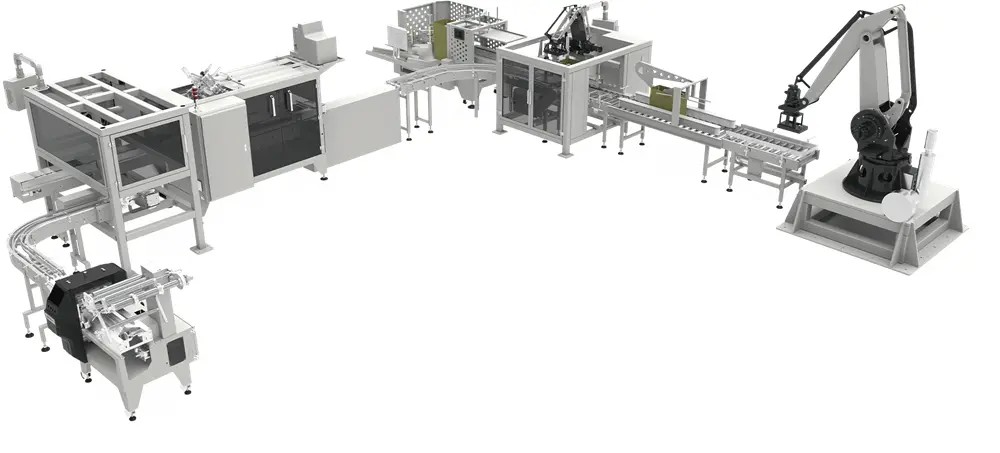
Fully automated packaging line integrating flow wrapping with secondary and end-of-line systems
Seamless Transition to End-of-Line
Cartoners, case packers, and palletizers complete the chain. Automatic cartoners receive individual packs or multipacks and erect, load, and seal cartons at rates that match primary output. Robotic or drop-style case packers then place those cartons into shipping cases. Finally, robotic palletizers build stable pallet loads ready for warehouse or shipping. When each of these stages shares a common control platform and product tracking data, changeovers and speed adjustments propagate smoothly through the entire line.
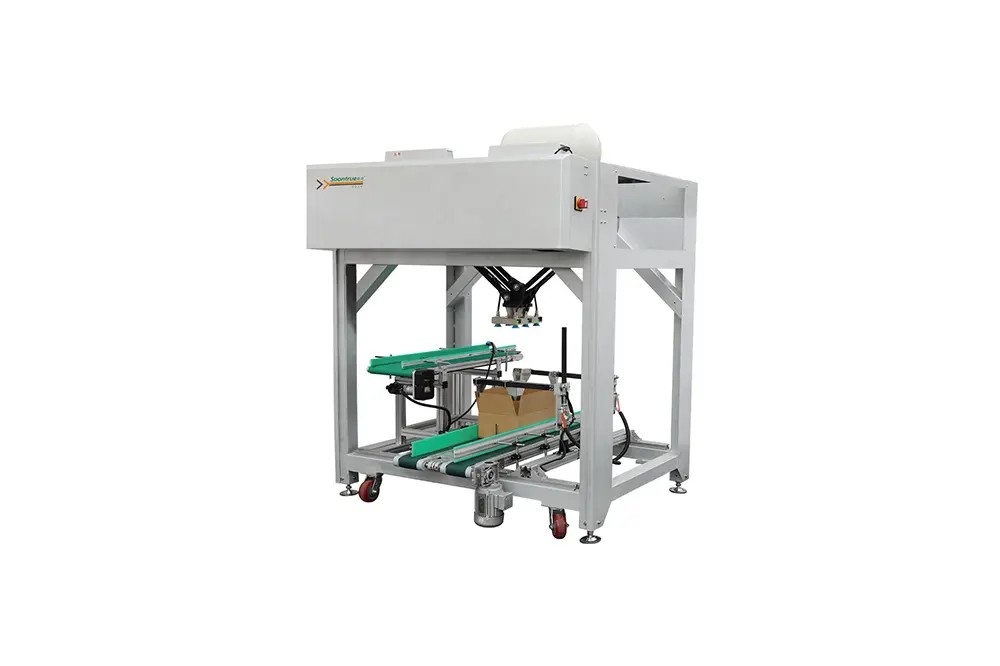
Robotic case packer for high-speed, flexible end-of-line packing
Implementation Roadmap: How Food Factories Can Upgrade Without Stopping Production
Factories rarely enjoy the luxury of a complete production shutdown for equipment installation. A phased, carefully planned approach allows upgrades to proceed while maintaining output.
Step 1: Conduct a Line Speed and Flow Balance Audit
Begin with detailed measurement of every station. Record actual output rates, accumulation levels, changeover times, and downtime causes over several full production days. Map the physical layout and note available floor space. The resulting data reveals the precise locations and severity of bottlenecks, providing a factual basis for equipment selection and sequencing. Many plants discover that the true constraint is not the primary wrapper but the secondary packing stage that follows it.
Step 2: Prioritize High-Impact Bottlenecks Through Phased Integration
Focus first on the stations that constrain overall line speed. Installing an automatic cartoner or case packer often unlocks capacity more effectively than replacing a primary wrapper that already meets target rates. Once the new equipment stabilizes, the next bottleneck becomes visible and can be addressed in a subsequent phase. This stepwise method spreads capital expenditure and allows operators to adapt gradually.
Step 3: Ensure One-Stop Component Compatibility
Selecting equipment from a single engineering source simplifies mechanical interfaces, electrical communication protocols, and software recipes. Shared spare-parts inventories and unified training programs reduce long-term operating costs. When primary wrappers, distribution systems, cartoners, and palletizers are designed to work together from the outset, commissioning proceeds faster and ongoing support remains consistent.
Application Matrix Across Food Segments
Different product categories impose distinct handling and packaging requirements. The following matrix illustrates typical equipment combinations that maintain balanced flow from primary packaging through to the finished pallet.
|
Food Industry |
Primary Packaging Solution |
Flow Control Mechanism |
Secondary / End-of-Line Solution |
|
Bakery & Biscuits |
Horizontal Flow Wrapper (HFFS) |
Multi-belt non-contact servo distribution line |
Automatic Cartoner + Pick-and-Place Case Packer |
|
Snacks & Frozen Foods |
VFFS / Premade Pouch Machine |
Multi-head combination weighers & bucket elevators |
Drop-type Case Packer + Robotic Palletizer |
|
Noodles & Staple Foods |
Specialized Flow Wrapper / Bundler |
Automated counting and alignment conveyors |
Automated Bundling + Case Packer |
In bakery applications, gentle handling preserves product shape and surface quality. Snack and frozen food lines benefit from precise weighing and high-speed vertical bagging followed by robust case packing. Noodle and staple food operations often combine counting accuracy with compact bundling before cases are formed.
Conclusion
Matching packaging capacity to high-speed processing eliminates the bottlenecks that quietly limit output and inflate costs. A structured approach that begins with accurate measurement, progresses through prioritized equipment upgrades, and relies on fully compatible components delivers measurable gains in throughput, product quality, and operational stability. Factories that complete this transition often find they can accept larger orders and introduce new product variants without expanding headcount.
Soontrue provides complete packaging automation solutions that cover primary wrapping, intelligent product distribution, cartoning, case packing, and robotic palletizing. With engineering support tailored to each factory’s layout and product range, manufacturers gain a reliable path from isolated high-speed machines to a balanced, continuous packaging line ready for sustained growth. From initial line audit through installation and long-term technical support, the focus remains on practical results that protect product quality and improve daily production reliability.
Frequently Asked Questions
How long does a typical return on investment take for a complete automated packaging line?
Most food manufacturers recover the investment within 18 to 36 months. The exact period depends on local labor costs, the number of production shifts, and the volume of product currently lost to breakage or scrap. A detailed cost-benefit analysis based on actual plant data produces a reliable projection.
What factory floor space is required for a full turnkey packaging line?
Space requirements vary with product size, desired speed, and the number of secondary packaging steps. Modern modular designs keep the footprint compact. During the planning stage, engineers use existing facility drawings to develop a layout that fits available space while preserving clear pathways for materials and personnel.
How can installation be completed with minimal disruption to ongoing production?
Installation schedules are aligned with planned maintenance windows or lower-demand periods. Pre-assembly and factory acceptance testing of major modules reduce on-site work. Temporary bypass conveyors keep primary production running while the new secondary equipment is commissioned.
How quickly can product changeovers be performed on an automated line?
With recipe storage on the human-machine interface and tool-less adjustment mechanisms, trained operators typically complete a full changeover in 15 to 25 minutes. This agility supports high-mix production without sacrificing overall equipment effectiveness.
Can the control system connect with existing plant MES or ERP platforms?
Open-architecture controllers support industry-standard protocols such as OPC-UA. Real-time production data, recipe downloads, and status messages flow directly into higher-level plant systems, enabling full visibility and traceability.