
How to Calculate ROI Before Purchasing Automated Packaging Equipment
Industry news

If you're seeking packaging automation solutions, please contact us, and we'll be delighted to offer you the most tailored solution.
A useful ROI assessment starts before a supplier quotation is compared. It begins with the current packaging process and establishes what that process costs under normal production conditions. From there, the investment can be evaluated against measurable annual benefits and tested under different production scenarios. This approach gives procurement and operations teams a clearer basis for assessing whether a packaging automation project can deliver sustainable financial value.
Start With Current Packaging Cost
The most reliable ROI model begins with a baseline for the existing packaging process. This baseline provides the reference point for measuring what automation is expected to improve. A production line that appears inexpensive on paper may carry substantial costs through labor, material losses, downtime, rework, or limited capacity.
Calculate Labor Cost
Labor is often one of the most visible components of packaging operating costs. The calculation can include the number of operators involved in feeding, packaging, inspection, case packing, and other manual activities across each shift.
A practical annual labor baseline can include wages, benefits, overtime, temporary labor, and other employment-related costs. Production schedules also matter. A facility operating multiple shifts may see a very different automation opportunity from one running a single shift.
The analysis becomes more useful when labor is measured by the actual packaging process. For example, several operators may be distributed across different steps, with only some activities directly affected by automation. This makes the expected labor impact more realistic.
Add Waste, Rework and Downtime
Packaging costs extend beyond direct labor. Product losses caused by inconsistent filling, sealing defects, damaged packages, or handling errors can gradually increase the cost of each saleable unit.
Material waste deserves similar attention. Film, labels, cartons, trays, and other packaging materials represent recurring operating expenses. Historical production records can provide a useful basis for estimating the current waste rate.
Downtime and rework can also be converted into financial terms. If a recurring packaging issue reduces productive hours or requires additional handling, its annual impact can be included in the baseline.
Include Outsourcing and Capacity Constraints
Some manufacturers use external packaging services when internal capacity is insufficient. Others have enough equipment for current orders but face bottlenecks during peak production periods. These conditions can affect the economic value of automation.
A complete baseline therefore considers the cost of outsourcing, overtime, temporary labor, and unused production opportunities where reliable data is available. This establishes a clearer picture of the current process before the potential benefits of automated packaging equipment are calculated.
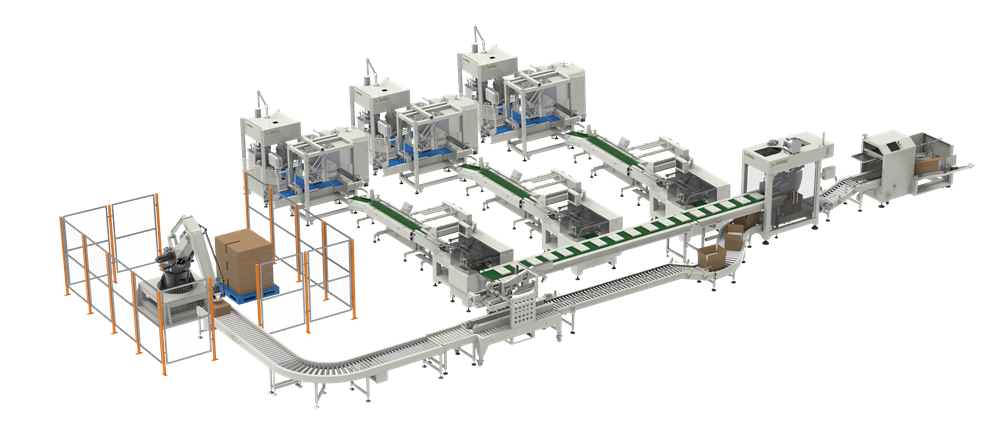
Soontrue Automated packaging solution tailored to industry-specific requirements for frozen dumpling
Consider the Full Investment
The equipment quotation is only one part of the initial investment. For an automated packaging project, the ROI calculation becomes more representative when the denominator reflects the cost of putting the system into stable production.
Equipment and Integration
The investment can include the packaging machine, feeding systems, conveyors, inspection equipment, coding units, case packing, palletizing, and other equipment required for the planned process. Integration costs are also relevant when multiple machines need to operate as one automated packaging line.
Installation, Commissioning and Training
Installation, commissioning, testing, and operator training can add to the initial project cost. These expenses are particularly important when the system involves several interconnected processes or requires changes to the existing production workflow.
Facility, Tooling and Initial Spare Parts
Depending on the project, facility modifications, electrical work, tooling, format parts, and initial spare parts may also need to be included. A realistic ROI model can therefore use the total installed investment as its starting point. This provides a more reliable basis for comparing the expected annual benefits with the actual capital required to bring automated packaging equipment into operation.
Quantify the Four Main Sources of Automation Return
Once the full investment is established, the next step is to identify where the financial return will come from. For automated packaging equipment, the annual benefit usually comes from several sources instead of a single saving. Each category can be estimated separately and then combined into the ROI model.
1. Labor Savings
Automation can reduce the number of operators required for repetitive packaging tasks such as feeding, wrapping, inspection, case packing, and palletizing. The potential annual saving can be estimated by comparing the current labor requirement with the expected staffing model after automation.
2. Material and Product Savings
More consistent feeding, sealing, dosing, and handling can reduce packaging material consumption and product losses. Historical waste rates provide a useful baseline for estimating the potential annual saving.
3. Additional Sellable Capacity
Higher packaging speed or longer productive operating time can create additional output capacity. This should be treated as financial value when the additional capacity can support confirmed or realistic sales demand.
4. Avoided Costs
Automation may also reduce expenses associated with overtime, temporary labor, outsourced packaging, rework, and recurring downtime. Including these items gives the ROI calculation a broader view of the economic value generated by packaging automation.
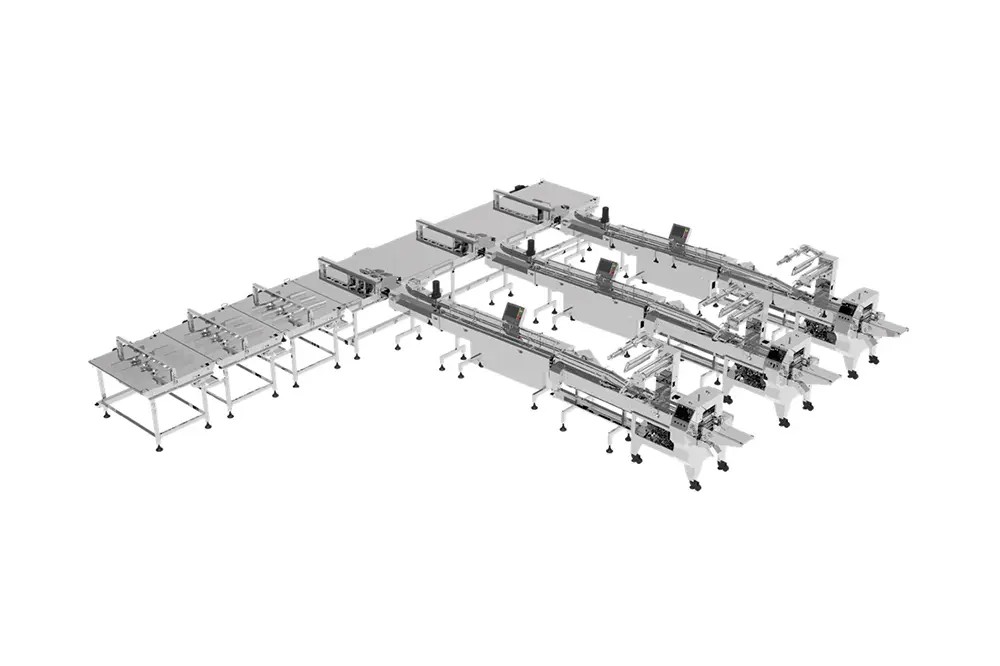
Soontrue Automatic Packaging Line With Deoxidizer
Separate Cash Savings From Capacity Gains
Not every operational improvement should be treated as immediate cash savings. A more reliable ROI model separates benefits that directly reduce annual expenses from those that create additional production capacity.
Realized financial savings can include lower labor costs, reduced packaging waste, less rework, and lower outsourcing or overtime expenses. These benefits can generally be linked to existing production costs and measured against historical data.
Capacity value comes from producing more units within the available production time. Its financial contribution depends on whether the additional output can actually be sold. For example, a faster automated packaging line may increase available capacity, but that capacity has limited direct revenue value when current market demand is already fully covered.
This distinction helps keep the ROI calculation commercially realistic. A useful model can therefore calculate direct annual savings first, then evaluate additional capacity as a separate value category. This also makes it easier to test different demand scenarios and understand how much of the projected return comes from measurable cost reduction versus future growth.
Apply the ROI and Payback Formulas
With the investment and annual benefits defined, the calculation can be reduced to a few practical financial indicators. A simple model for automated packaging equipment can use:
ROI = Annual Net Benefit ÷ Total Investment × 100
Where:
Annual Net Benefit = Labor Savings + Material Savings + Capacity Value + Avoided Costs − Additional Operating Costs
The payback period provides a second perspective:
Payback Period = Total Investment ÷ Annual Net Benefit
For example, suppose an automation project requires a total investment of $300,000 and generates $120,000 in annual net benefits. The estimated ROI is 40%, while the payback period is approximately 2.5 years.
The calculation becomes more meaningful when annual operating costs are included. Energy consumption, maintenance, spare parts, software support, and other recurring expenses can reduce the net benefit. Using these figures helps procurement teams assess the actual financial contribution of the investment instead of relying on gross savings alone.
Check the ROI Before Comparing Machine Quotes
Supplier quotations become easier to evaluate when each proposal is placed into the same financial model. Key comparison points can include:
- Total installed investment
- Annual labor savings
- Material and waste savings
- Additional capacity value
- Annual operating costs
- Payback period
- Three-year net benefit
This approach shifts the comparison from equipment price to business value. A higher-priced automated packaging solution may have a different financial profile when integration, labor requirements, productivity, and operating costs are considered together.
Use ROI to Choose the Right Automation Scope
ROI analysis can also help determine the appropriate level of automation for a production process. For manufacturers evaluating a broader automation project, Soontrue provides packaging machinery and integrated automation solutions covering multiple stages of the production process. This makes it possible to evaluate automation scope around the actual production flow, capacity requirements, and expected return, instead of selecting equipment based only on individual machine specifications.
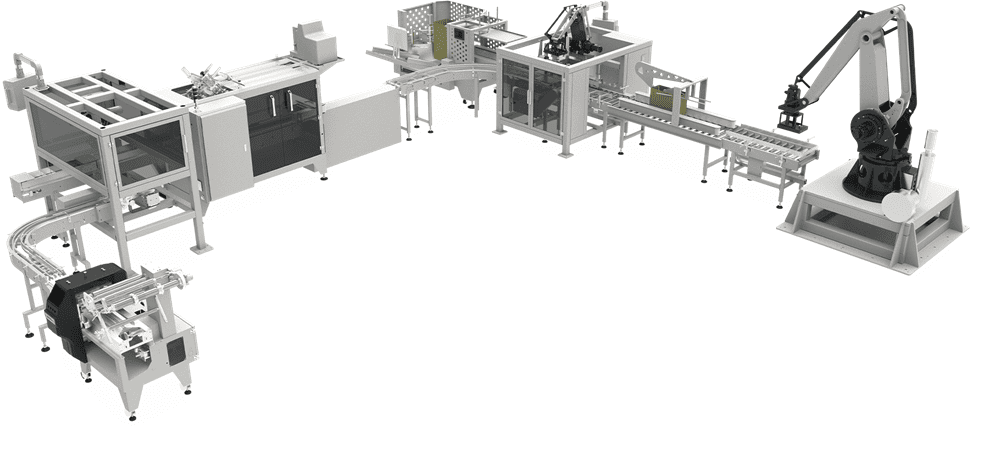
Soontrue Automated Flow Packaging Solution
The right solution may involve upgrading one critical process or connecting several stages into an automated packaging line. By matching the automation scope with measurable cost savings and capacity requirements, manufacturers can build an investment that supports both current production and future growth.
Conclusion
Calculating ROI before purchasing automated packaging equipment provides a clearer view of the investment beyond its initial price. By measuring current packaging costs, total project investment, annual financial benefits, payback period, and different production scenarios, manufacturers can better understand the potential value of automation and determine an appropriate automation scope. Soontrue can help manufacturers evaluate equipment and complete packaging lines according to their production requirements, capacity goals, and investment expectations. Contact Soontrue to discuss your packaging process and explore an automation solution built around measurable production and business needs.
FAQ
1. What factors should be included when calculating ROI for automated packaging equipment?
A reliable ROI calculation should include both the initial investment and the annual financial benefits generated by automation. The investment may cover equipment costs, installation, integration, training, tooling, and initial spare parts. The annual benefits can include labor savings, reduced material waste, lower rework costs, avoided overtime, and the value created by additional production capacity.
2. How long does it take for automated packaging equipment to pay for itself?
The payback period depends on several factors, including equipment cost, production volume, labor structure, operating hours, and expected savings. High-volume production environments often achieve faster payback because automation can generate greater labor and productivity benefits. A complete evaluation should consider realistic operating conditions instead of relying only on ideal production assumptions.
3. Does higher packaging speed always mean a better ROI?
Higher speed can improve production capacity, but speed alone does not determine ROI. The financial value depends on whether the additional output can support actual market demand. A packaging machine with suitable capacity, stable operation, and efficient resource utilization may provide better long-term value than equipment selected only for maximum speed.
4. What costs should be considered besides the price of the packaging machine?
The total investment should include all costs required to bring the equipment into production. These may include installation, system integration, conveyors, inspection equipment, facility modifications, training, spare parts, and ongoing operating expenses such as maintenance and energy consumption.
5. How can manufacturers compare different automated packaging equipment suppliers?
A supplier comparison can be based on more than the initial quotation. Important factors include total installed cost, expected productivity improvement, equipment reliability, maintenance requirements, service support, and the projected payback period. Evaluating the complete financial impact helps manufacturers compare solutions based on long-term value.
6. Can a small or medium-sized manufacturer benefit from packaging automation?
Packaging automation can create value for manufacturers of different production scales when the investment matches their operational needs. Companies facing labor challenges, increasing production requirements, inconsistent packaging quality, or limited capacity may find automation valuable. The appropriate automation level depends on production volume, product characteristics, and future growth plans.
7. How does an integrated packaging line affect ROI compared with a single packaging machine?
An integrated packaging line can improve ROI when multiple processes create production bottlenecks. By connecting feeding, packaging, inspection, case packing, and palletizing, a complete solution can reduce manual handling and improve overall workflow efficiency. The best automation scope depends on where the largest operational gains can be achieved.