
Flow Wrapper Troubleshooting Guide: Solving Feeding, Film Tracking and Sealing Problems
HFFS Machine Blog

If you're seeking packaging automation solutions, please contact us, and we'll be delighted to offer you the most tailored solution.
Have you ever watched a flow wrapper run smoothly for an hour, only to see the next batch of packs arrive with open seals, skewed film edges, or empty bags? In most cases the trouble does not start at the sealing jaws. It begins earlier, in the way products arrive, how the film is tensioned, or how these two streams meet inside the machine. This article follows that path. It describes the most common packaging defects on horizontal flow wrappers, shows how to isolate their real sources, and outlines practical steps that improve day-to-day stability. Matching the feeding system to the machine and looking at the wider line layout often limits the interruptions that keep coming back.
Common Flow Wrapper Problems and Their Likely Causes
Irregular Feeding and Product Jams
Uneven product spacing or sudden jams at the infeed often appear as empty packs, double packs, or hard stops that force the operator to clear the forming area. Upstream conveyors or sorting tables may release items at irregular intervals. Soft or sticky items can cling to guide rails, while rigid items may tip when lug-chain timing is slightly off. Temperature differences between the product and the surrounding air can also change surface friction during a shift.
Mismatch between the machine cycle and the supply rate is another frequent contributor. When the flow wrapper runs faster than the feeding system can deliver, gaps widen and the registration system may interpret them as missing products. Observing the product stream for several minutes under normal load usually reveals whether the issue originates in spacing, orientation, or overall throughput alignment.

Product infeed conveyor on a Soontrue SZ602 flow wrapping machine, designed for controlled spacing and orientation.
Film Tracking and Cutting Misalignment
Film that drifts left or right, or cut lines that wander relative to the print registration mark, produce packs with uneven side margins or incomplete seals at the ends. Tracking problems frequently stem from uneven tension across the web, a forming box that is not centered, or guide rollers that have accumulated residue. Printed film relies on the photoelectric eye reading the registration mark correctly; changes in mark contrast or ambient light near the sensor can shift the cutting position by several millimeters.
Tension settings that suit one film grade may prove unsuitable for another. Stretchable films respond more readily to small changes in unwind brake pressure, while stiffer laminates can telescope on the roll if the core is not held firmly. Checking the film path from the reel stand through the forming shoulder and confirming that each roller turns freely helps isolate mechanical drag before software offsets are adjusted.
Weak Seals and Wrinkled Packages
Seals that open under light pressure or packages that show wrinkles along the fin seal or end seals usually point to temperature, dwell time, or pressure settings that no longer match the film structure. A new film lot with a different sealant layer thickness can require a few degrees of temperature change. Contaminants such as product crumbs or oil on the sealing jaws reduce heat transfer and leave weak spots. Over-tight film tension can stretch the web just before the jaws close, introducing wrinkles that prevent full contact during sealing.
Rotary sealing jaws and box-motion jaws respond differently to speed changes. At higher speeds the available dwell time shortens, so temperature or pressure may need recalibration. Reviewing the current recipe against the film supplier's recommended sealing window and inspecting the jaw surfaces for wear or residue provides a clear starting point for correction.
Trace the Fault to Its Source
Effective troubleshooting follows the product path rather than jumping straight to the sealing jaws. A short sequence of checks that starts at the infeed and ends with a finished-pack evaluation helps separate single-machine issues from problems created by upstream or downstream coordination.
Check Product Positioning and Spacing
Begin by observing the products as they leave the preceding conveyor or sorter and enter the flow wrapper's lug chain or flight system. Consistent pitch between items and correct orientation relative to the film tube reduce the chance of empty packs or product collisions inside the forming area. Simple tools such as a stopwatch and a length gauge can confirm whether the average gap matches the machine's current bag-length setting. For items that tend to tip or rotate, adjustable side guides or a short accumulation section often restore order without major hardware changes.
When the same product runs on multiple shifts, comparing the infeed behavior across those shifts can reveal differences in operator loading technique or ambient conditions. Documenting the observed spacing and any corrective actions creates a useful reference for later teams.
Inspect Film Tension and Sealing Conditions
Next, walk the film path from the unwind stand to the sealing jaws. Confirm that the film leaves the roll evenly, that dancer rollers or tension control systems respond smoothly, and that the forming box is free of product residue. Note the current jaw temperature and compare it with the value recorded for the previous successful run of the same film. A small change in ambient humidity can alter film behavior enough to affect tracking, so recording both machine settings and room conditions is useful.
Many modern flow wrapping machines store recipe data that includes film type, temperature, and tension parameters. Restoring a known-good recipe and then making only one adjustment at a time isolates the variable responsible for the current defect.
Verify Changes With Finished Packs
After any adjustment, collect a short run of finished packs and inspect them under consistent lighting. Check seal strength with a simple peel test, examine the alignment of the print registration, and look for wrinkles or product residue trapped in the seal area. Recording the pack appearance alongside the machine settings creates a closed-loop record that confirms whether the change solved the original problem or introduced a new one.
This verification step also distinguishes isolated machine faults from broader line issues. If the packs look correct at the flow wrapper discharge yet arrive damaged or misoriented at the case packer, attention can shift to the transfer conveyors or secondary equipment rather than further changes to the wrapper itself.
Soontrue Flow Wrapping Solutions for More Stable Packaging
Stable flow wrapping results from the coordinated performance of the infeed, the wrapper, and any secondary stations that follow. Soontrue designs horizontal flow wrappers and supporting automation with this coordination in mind, so that product characteristics and target speeds guide the selection of feeding methods and machine configurations.
Match Product Feeding Systems With Flow Wrapping Requirements
Product shape, surface texture, and required packing rate determine the most suitable feeding approach. Rigid bakery items may travel well on a timed lug chain, while softer or more irregular items benefit from gentle belt transfer or automatic sorting modules that establish consistent pitch before the film tube forms. Soontrue evaluates these factors for each application and configures the infeed accordingly, reducing the likelihood of the spacing and jam problems described earlier.
When the target speed exceeds what manual loading can sustain, automatic collation and alignment systems keep the product stream continuous. The same principle applies to multi-SKU operations where frequent changeovers must preserve the same spacing accuracy. Selecting a feeding solution that matches both the product and the horizontal flow wrapper cycle time supports longer uninterrupted runs.
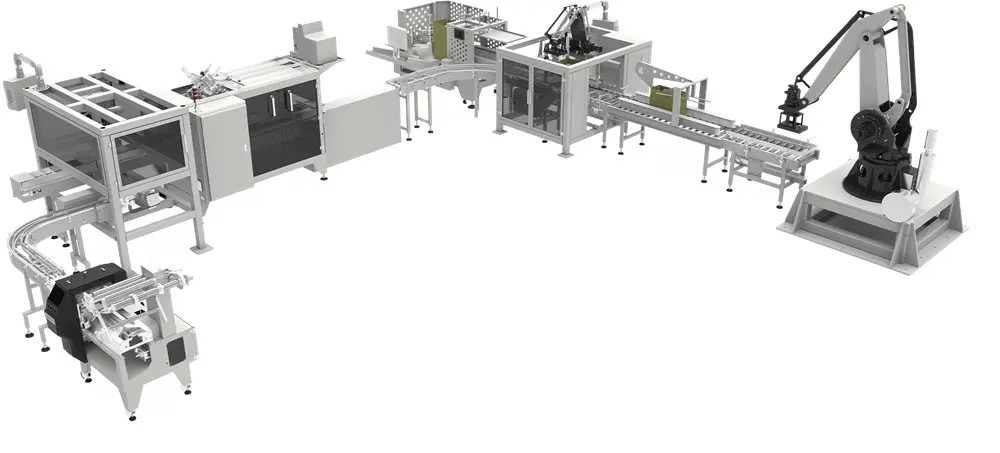
Automated packing solution built around a Soontrue flow packaging machine for continuous product flow.
Improve Packaging Consistency Through Integrated Line Design
A flow wrapper that runs smoothly in isolation can still generate defects when its speed or discharge pattern conflicts with upstream or downstream equipment. Soontrue approaches each project by reviewing product characteristics, required output, and the existing plant layout, then configures the wrapper and supporting modules as a coordinated system. Attention focuses on infeed stability, product positioning, speed matching across stations, and continuous run performance under normal production conditions.
This integrated view helps address the interaction effects that pure machine-level adjustments cannot solve. Further details on how flow wrappers fit into larger systems appear in the discussion ofintegrating flow wrapping machines into a complete automatic packaging line.
Customer Case: Automated Waffle Feeding and Flow Wrapping
At a customer site producing waffles, the packaging line struggled with three related problems: operators spent most of their time manually arranging and spacing the product, the infeed remained uneven, and the packaging speed could not stay in step with the upstream baking output. Empty packs and occasional jams became regular occurrences. The manual loading process simply could not deliver a steady product pitch that matched the flow wrapper's cycle.
The project response combined automatic product collation with a matched horizontal flow wrapper. An automatic sorting and alignment system established consistent pitch and orientation before each waffle entered the film tube. Once the infeed stabilized, the wrapper ran at a steady rate aligned with the baking line. Empty packs dropped sharply and unplanned stops became rare. The same pairing of automatic collation and flow wrapping has since been applied to other bakery items that previously relied on manual arrangement.
Conclusion
Troubleshooting a flow wrapper becomes more efficient when the investigation follows the product and film path rather than treating every defect as a sealing-jaw issue. Confirming product spacing, verifying film tension and tracking, and checking finished packs against known-good standards isolate the real source of the problem. For defects that return after temporary adjustments, reviewing the feeding method and the overall line balance often reveals opportunities for more durable improvement.
Soontrue supports manufacturers with horizontal flow wrappers and complementary automation that address the practical sources of feeding, tracking, and sealing variation. Teams facing recurring packaging interruptions can discuss their product characteristics and production targets with Soontrue to identify configurations that promote longer, more stable runs. Further information on available models and line solutions is available on the Soontrue website, and direct inquiries can be directed through the contact page.
FAQ
1. Why does the film keep drifting to one side even after the forming box is centered?
Uneven tension across the web, a partially blocked guide roller, or residue on the film path can still pull the film sideways. Checking that every roller rotates freely and that the unwind brake applies even pressure often restores tracking without further mechanical changes.
2. How often should sealing jaw temperature be verified during a production day?
A practical interval is at the start of each shift and after any film change. Ambient temperature swings or a new film lot can shift the effective sealing window, so periodic confirmation keeps pack integrity consistent.
3. Can the same flow wrapper handle both printed and plain film without major adjustment?
Most machines can switch between the two, but the registration eye settings and cut-to-mark offset need to be updated for printed film. Saving separate recipes for each film type shortens the changeover and reduces the chance of misaligned packs.
4. What is a practical first check when empty packs begin appearing?
Observe the product spacing at the infeed for several machine cycles. Gaps that exceed the set bag length or products that arrive out of orientation are common causes of empty or double packs.
5. How does product temperature affect flow wrapping performance?
Warm or cold products can change surface friction and moisture levels, altering how items slide on conveyors and how film contacts the product. Recording product temperature alongside machine settings helps explain intermittent defects that appear only at certain times of day.
6. When should an automatic feeding system be considered instead of manual loading?
Automatic feeding becomes advantageous when manual spacing cannot keep up with the required packing rate, or when product damage and empty packs remain frequent despite operator attention. A short trial with an automatic collation module often clarifies the improvement in stability.