
How to Design an End-of-Line Packaging System from Cartoning to Palletizing
Packaging Knowledge Hub

If you're seeking packaging automation solutions, please contact us, and we'll be delighted to offer you the most tailored solution.
Linking cartoning, case erecting, case packing, sealing, and palletizing into a stable production system requires more than matching machine ratings. Transfer methods, interface design, buffer capacity, and shipping-case formats all shape real throughput. This guide walks through the practical steps for building a coordinated end-of-line layout, from process mapping and capacity balancing to interface definition, accumulation planning, and early validation of case and pallet configurations. For individual machine selection, see the companion article on choosing cartoning and case packing equipment.
Map the Process from Cartoning to Palletizing
Before any equipment is selected, the material path itself needs clarity. Products leave primary packaging, enter retail cartons, move into shipping cases, and finally settle onto pallets. Each transition carries its own constraints on orientation, spacing, and timing.
Understand the Role of Each Packaging Stage
- Cartoning places individual products or small groups into retail cartons ready for shelf presentation.
- Case erecting takes flat corrugated blanks, forms them into open shipping cases, and seals the bottom so the cases stand upright and ready for loading.
- Case packing loads the cartons or product groups into those cases according to a fixed pack pattern.
- Case sealing closes the filled cases with tape or hot-melt adhesive.
- Palletizing stacks the finished cases into the required layer pattern on pallets prepared for storage or dispatch.
Cartoners and case erectors normally run on separate streams. Retail cartons exit the cartoner while blank cases are formed on the parallel erector line. The two flows meet at the packing station. From there the sequence continues through sealing and on to the palletizer. Conveyors, inspection points, labeling, and short accumulation zones fill the gaps according to the plant’s layout and product handling needs.
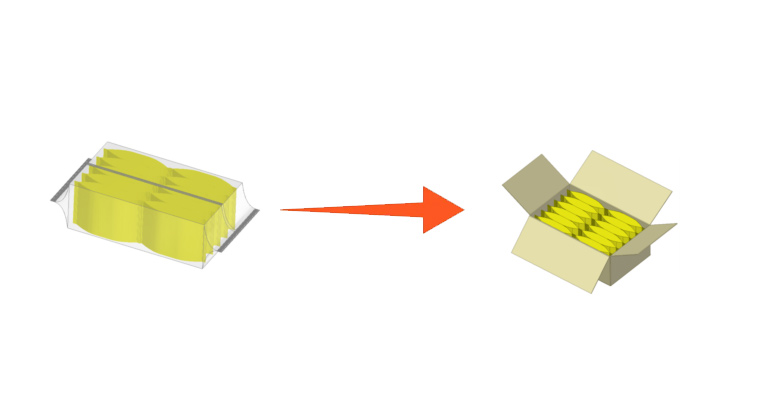
Integrated carton and box secondary packaging equipment forming part of an end-of-line system
Balance Line Capacity Before Finalizing the Layout
Rated speeds alone give an incomplete picture. Throughput must be examined across the entire chain so that no single station becomes the limiting factor once the line is running under normal production conditions.
Convert Product Output into Cases per Minute
A useful common unit is cases per minute. If a cartoner delivers 120 cartons each minute and twelve cartons fill one shipping case, the theoretical demand at the case packer is ten cases per minute. The simple relation—carton output divided by cartons per case—provides the starting figure. Real sustained output then depends on loading method, cycle time, product spacing on the conveyor, and overall equipment efficiency.
Account for Real Operating Conditions
Short stops, feed interruptions, changeovers, case-blank supply, and downstream palletizing capacity all reduce the effective rate. A faster machine improves overall output only when the stations around it can keep pace. The practical target is a balanced line that holds the required sustained rate with modest allowances for the variability that appears in daily operation.
Define the Interfaces Between Machines
Mechanical, material-handling, and control interfaces at every transfer point determine whether the line runs as a single system or as a collection of isolated machines. Specifying these details early avoids costly field adjustments later.
Product Transfer from Cartoner to Case Packer
Carton size, discharge orientation, spacing, and grouping method must match the case packer’s loading configuration. When the transfer system presents products in a consistent arrangement, the packer can run continuously without repeated stops or manual intervention. Conveyor height, transfer direction, and the physical hand-off are confirmed during detailed engineering.
Case Supply and Sealing Interfaces
The erector must deliver square, bottom-sealed cases at the correct rate and orientation. The packer accepts those cases and loads them to the agreed pattern. The sealer then closes the filled cases using the chosen method. Control signals for machine-ready status, start and stop logic, downstream blockage, upstream backup, and fault recovery complete the interface package so the stations can coordinate automatically.
Case Discharge to Palletizer
Case orientation, conveyor speed, spacing, and infeed conditions for the palletizer receive the same attention. Label position, inspection requirements, and reject handling are defined when those stations sit between sealing and palletizing. A clear interface description allows the robotic palletizing system and the upstream equipment to function as one coordinated cell.
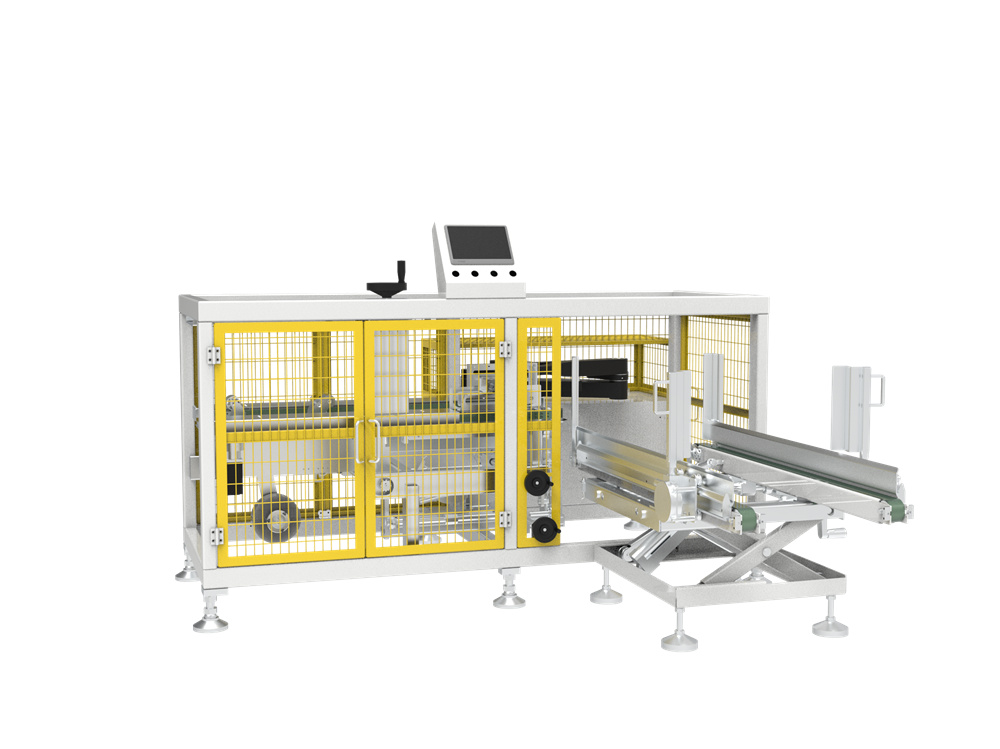
Robotic case erecting equipment preparing consistent shipping cases for automatic packing
Size Accumulation Buffers Around Actual Downtime Risks
Short interruptions are inevitable. Properly sized accumulation zones absorb those stops and keep downtime from cascading through the entire line.
Where Buffering Matters Most
The most useful locations are usually between the cartoner and the case packer, a supply buffer for erected cases, and finished-case accumulation ahead of the palletizer. Each zone addresses a different interruption risk. Capacity is set according to expected stop duration, available floor space, product stability, and how quickly the machines on either side can recover.
Estimate Buffer Capacity from Recovery Needs
A first estimate multiplies the incoming rate by the target buffer time. At 120 cartons per minute, a 30-second stop requires theoretical capacity for 60 cartons. Usable capacity also depends on conveyor layout and product stability. A buffer can cover a short stop; it cannot hide a permanent capacity mismatch between stations.
Match Case Formats with Palletizing Patterns
Case dimensions and pallet patterns belong in the early design discussion. A format that packs smoothly at the case packer may still create problems at the palletizer or during transport if the two ends of the line were never checked together.
Choose the Shipping Case Before Finalizing the Layout
Length, width, height, board strength, closure method, and the number and arrangement of retail cartons inside the case all influence erection, loading, sealing, and handling. Regular slotted cases and wraparound styles often call for different forming and loading arrangements, so the style decision feeds directly into machine selection.
Validate the Pallet Pattern
Pallet size, cases per layer, stacking orientation, total stack height, and load stability are confirmed against the chosen case dimensions. The pattern must also suit the palletizer’s infeed, gripping method, and handling limits. Label orientation and downstream transport requirements complete the check. Reviewing these points together prevents a case that works at packing yet creates later difficulties.
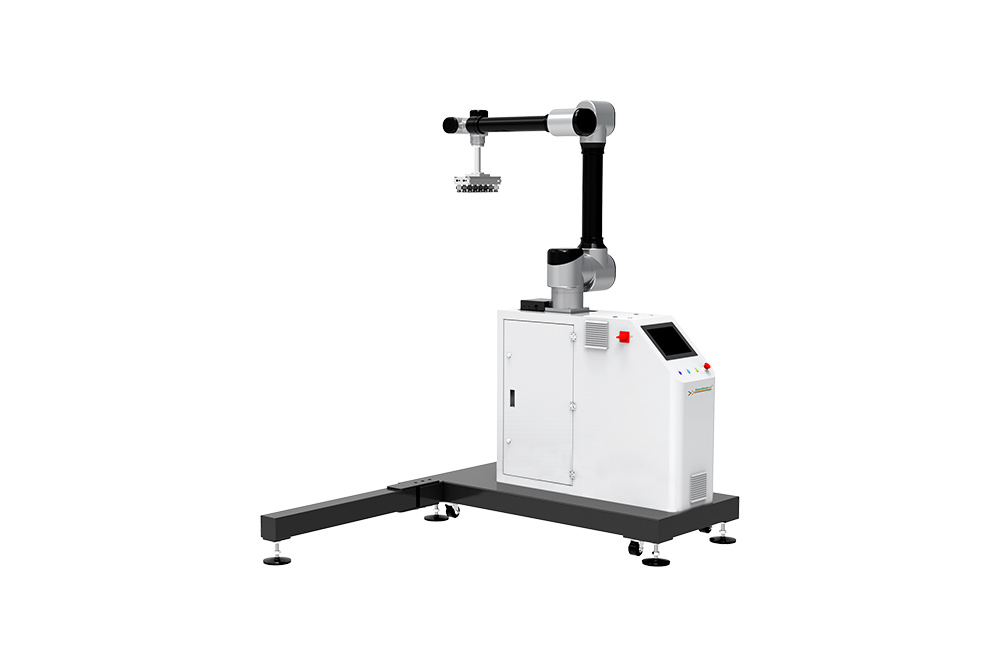
Robotic palletizing cell stacking sealed cases according to a defined layer pattern
Validate the Complete Line Before Installation
Individual machine tests confirm local performance. Integrated trials confirm that interfaces, buffers, and control logic work as a single system under conditions close to real production.
A practical checklist includes:
- Compatibility of products and packaging materials across every station
- Sustained output and clear identification of the bottleneck station
- Stable product transfer, case supply, sealing quality, and palletizing accuracy
- Buffer behaviour during short stops and the subsequent recovery
- Changeover procedures and time required for format adjustments
- Interlocks, fault signals, reject handling, and restart sequences
- Case seal integrity and finished pallet load stability
Design an Integrated End-of-Line Solution with Soontrue
A stable end-of-line system rests on coordinated process flow, balanced capacity, compatible interfaces, appropriate accumulation, and validated case and pallet formats. Soontrue supports manufacturers with packaging line planning and full system integration that covers cartoning, case erecting, case packing, sealing, and robotic palletizing under one engineering approach. Plants ready to share product specifications, target throughput, shipping-case dimensions, pallet requirements, and available factory layout can discuss a solution matched to their production needs. Further detail on modular equipment appears in the end-of-line packing series and the related carton and box secondary packaging solutions.
Frequently Asked Questions
What machines are included in an end-of-line packaging system?
A typical system combines cartoning equipment, a case erector, a case packer, a case sealer, conveyors, and a palletizer. Inspection, labeling, checkweighing, and other auxiliary stations are added according to the quality and logistics needs of each project.
How do you calculate the required case packing speed?
Divide the required carton output by the number of cartons that fit in each shipping case. The resulting theoretical case rate is then adjusted for actual operating efficiency, product spacing, and the capacity of the connected upstream and downstream machines.
How much accumulation capacity does an automated packaging line need?
Buffer capacity depends on line speed, the length of interruptions that need to be absorbed, available floor space, and the recovery performance of the machines on either side of the buffer. No single buffer size suits every line; the design starts from the most frequent interruption scenarios observed in similar applications.
Can a case erector, case packer, and palletizer operate as one integrated system?
Integration succeeds when machine capacities, case formats, conveying arrangements, control signals, and safety requirements are coordinated during the system design phase. Modern lines from suppliers such as Soontrue routinely combine these stations into continuous automated cells.
How do case dimensions affect palletizing performance?
Case length, width, and height determine the number of cases that fit in each layer, the possible stacking patterns, maximum pallet height, and overall load stability. Dimensions that align with the palletizer’s gripping method and infeed constraints support consistent, high-speed palletizing without later layout changes.