
A Complete Guide to Automatic Packing Lines: Components, Working Process, Applications & Buying Guide
Packaging Knowledge Hub

If you're seeking packaging automation solutions, please contact us, and we'll be delighted to offer you the most tailored solution.
Modern food and consumer-goods factories face a clear set of pressures: fewer skilled operators available on the floor, rising hourly labor rates, tighter food-safety audits, and a constant need to launch new SKUs without slowing the main line. An automatic packing line addresses these pressures by linking primary packaging, secondary packaging, inspection and end-of-line handling into one continuous, recipe-driven process.
This guide walks engineering managers, plant owners and procurement teams through the full decision path. Readers will see how an automatic packing line is defined, how the machines work together, which components matter for bakery, frozen food, snacks, vegetables, noodles and ready meals, and what practical checks to make before signing a purchase order. The primary focus remains the automatic packing line and the closely related automatic packaging line, both of which appear throughout the sections that follow.
What Is an Automatic Packing Line?
An automatic packing line is a coordinated sequence of machines that receives finished product from upstream processing, forms or fills primary packs, groups those packs into secondary containers, inspects every unit, and prepares the finished cases for warehouse or dispatch. The line runs under a central PLC or industrial PC that stores product recipes, monitors sensors and coordinates timing between stations.
Three levels of automation commonly appear in factories today. Manual packing relies on operators for almost every motion. Semi-automatic lines keep operators at critical points such as tray loading or case packing while machines handle forming, sealing and conveying. Fully automatic lines remove operators from the continuous path and leave only supervisory and change-over tasks.
Comparison of Manual, Semi-Automatic and Fully Automatic Lines
|
Aspect |
Manual |
Semi-Automatic |
Fully Automatic |
|
Labor per shift |
8–15 operators |
3–6 operators |
1–2 supervisors |
|
Typical speed |
Limited by hand speed |
40–120 packs/min |
80–300+ packs/min |
|
Consistency |
Varies with fatigue |
Good on sealed packs |
High across all stations |
|
Change-over |
Minutes to hours |
15–40 minutes |
Tool-less, 10–25 minutes |
|
Traceability |
Paper records |
Partial digital logs |
Full batch & sensor data |
|
Best fit |
Very low volume |
Mid volume, frequent SKUs |
High volume or multi-shift |
Factories that run two or three shifts, manage more than a handful of SKUs, or face strict hygiene audits normally move to a fully automatic packing line. The investment pays back through higher output per square meter, lower scrap rates and the ability to document every pack for retailers and regulators.
Soontrue designs complete lines for bakery products, frozen foods, snacks, vegetables, noodles and ready meals. The same modular platform can start with a single flow wrapper or vertical form-fill-seal machine and later expand to case packing and palletizing without redesigning the entire layout.
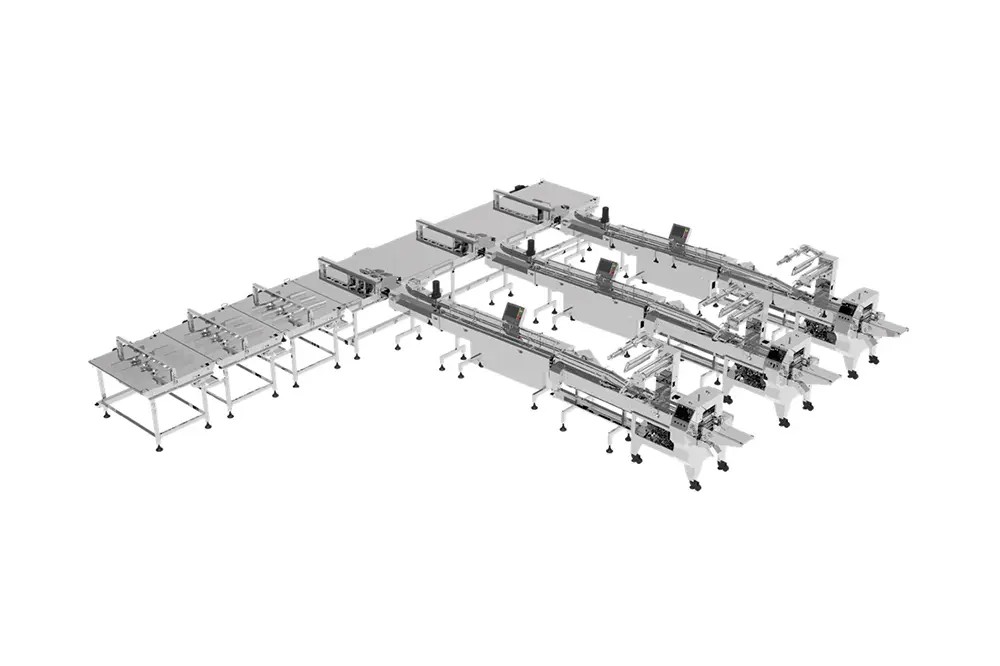
Soontrue bakery, biscuit and snack automatic packing line
Why Manufacturers Are Investing in Automatic Packing Lines
Labor availability remains the strongest single driver. Many plants report difficulty filling packing-line roles, especially on night shifts and weekends. An automatic packing line reduces the head-count needed on the continuous path and frees remaining staff for quality checks, sanitation and change-over tasks.
Production bottlenecks appear when upstream forming or cooking capacity outruns the packing area. A synchronized line matches the speed of the slowest upstream process and eliminates temporary storage of unprotected product. Consistency improves because every pack receives the same seal temperature, the same film tension and the same label position.
Food-safety regulations continue to tighten. Retailers and export markets demand full batch traceability, metal-detection records and weight-control data. A modern automatic packaging line records these data points automatically and links them to the production order, reducing the time needed for audits.
Smart-manufacturing initiatives also push investment. Factories that already run MES or ERP systems look for packing equipment that can exchange real-time status, recipe downloads and OEE figures. Open PLC architectures and OPC-UA support make that exchange straightforward.
Finally, long-term competitiveness depends on the ability to introduce new pack formats quickly. A modular line with stored recipes and tool-less change parts lets a plant switch from pillow bags to tray packs or from single packs to multi-packs in minutes rather than hours.
How Does an Automatic Packing Line Work?
The typical sequence begins at the product infeed. Product arrives from the processing area on a belt or vibratory conveyor. Orientation and spacing devices place each piece at the correct pitch for the primary packaging machine.
Feeding and Conveying
Feeding systems range from simple belt infeeds for biscuits to multi-lane vibratory feeders for frozen dumplings. Smart sensors detect gaps or double feeds and adjust speed so that the next station never starves or jams. Hygienic conveyors with quick-release belts support frequent wash-down in frozen and ready-meal plants.
Weighing and Dosing
For free-flowing products such as snacks, frozen vegetables or noodles, a multihead weigher calculates the target weight in a fraction of a second and drops the portion into the forming tube or pouch. Auger fillers and volumetric cups serve powders and sticky products. The weigher or filler sits directly above the primary packaging machine so that product falls a short distance and keeps its shape.
Primary Packaging
Two main technologies dominate primary packaging. Vertical form-fill-seal (VFFS) machines form a bag from flat film, fill it, and seal it in a continuous vertical motion. Horizontal flow wrappers receive already oriented product, wrap film around it, and create a pillow or fin-seal pack. Premade-pouch machines open, fill and reseal pre-made bags that already carry high-quality graphics.
Inspection
Immediately after sealing, packs travel through a checkweigher, a metal detector and, when required, a vision system. Out-of-weight or contaminated packs are rejected to a locked bin. Vision systems verify print quality, seal integrity and correct placement of labels or deoxidizer sachets.
Secondary Packaging and Case Packing
Accepted packs move to a cartoner or a case packer. Cartoners erect folding cartons, load the primary packs, and close the flaps. Case packers erect corrugated cases, place packs or cartons in the correct pattern, and seal the case with tape or hot melt. Robotic case packers add flexibility for mixed SKUs and varying case counts.
Palletizing and Warehouse Interface
Finished cases travel to a palletizer. Conventional layer palletizers or robotic cells build stable pallet loads according to stored patterns. Stretch wrappers or hood stretchers secure the load. The finished pallet is labeled and transferred to the warehouse conveyor or AGV system.
Throughout the entire path the central control system records production counts, reject reasons, film usage and energy consumption. Operators monitor the line from a single HMI and can call up any station’s status in seconds.
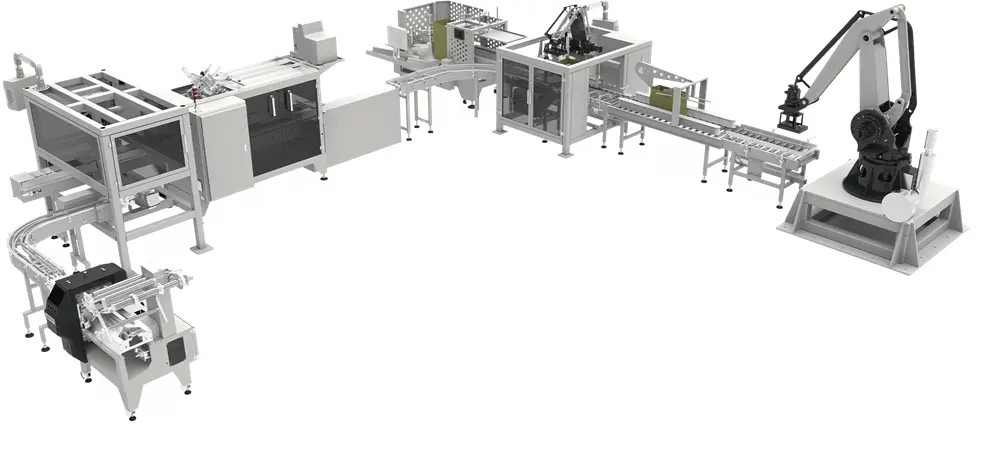
Integrated flow-wrapping and end-of-line automatic packaging solution
Main Components of an Automatic Packing Line
Selecting the right combination of machines determines both throughput and long-term reliability. The sections below describe the most common modules and the situations in which each is preferred.
Feeding Systems and Conveyors
Feeding systems must match product fragility and shape. Soft bakery items need gentle transfer belts; rigid snacks can use high-speed vibratory feeders. Modular plastic-belt conveyors allow quick cleaning and reconfiguration when SKUs change.
Multihead Weighers
A multihead weigher remains the standard for high-speed, high-accuracy portioning of free-flowing products. Modern units combine up to 24 weighing heads, achieve target weights within 0.5 g, and support mixed-product recipes for variety packs.
Vertical Form-Fill-Seal Machines
VFFS machines suit powders, granules, frozen vegetables and many snack products. They produce pillow bags, gusseted bags and block-bottom bags from a single roll of film. Integration with multihead weighers or auger fillers is straightforward and keeps the footprint compact.
Horizontal Flow Wrappers
Flow wrappers excel with solid, regularly shaped items such as biscuits, chocolate bars, rice crackers and trayed ready meals. High-speed models reach 300 packs per minute while maintaining seal integrity. Box-motion sealing jaws improve hermetic quality for longer shelf-life products.
Cartoners and Case Packers
Cartoners convert flat blanks into finished retail cartons. Case packers handle the heavier corrugated cases that travel through the distribution chain. Both machines accept recipe downloads so that case count and pack pattern change with a few screen touches.
Palletizers
Robotic palletizers offer the greatest flexibility for mixed-SKU production. Conventional layer palletizers deliver higher speed for single-SKU, high-volume lines. Both types interface with stretch wrappers and pallet labeling systems.
Checkweighers, Metal Detectors and Vision Systems
These inspection devices form the quality gate of the line. Checkweighers confirm net weight, metal detectors protect consumers and equipment, and vision systems catch print defects or missing components. Reject confirmation sensors ensure that every defective pack leaves the main flow.
PLC Control and HMI
A modern PLC stores product recipes, manages interlocks and exchanges data with higher-level systems. The HMI presents line status, alarm history and production statistics in a clear graphical format. Open protocols such as OPC-UA allow connection to existing MES platforms.
Soontrue integrates these modules into a single engineered system. Mechanical interfaces, electrical cabinets and software recipes are designed together, so commissioning time stays short and future expansion remains possible.
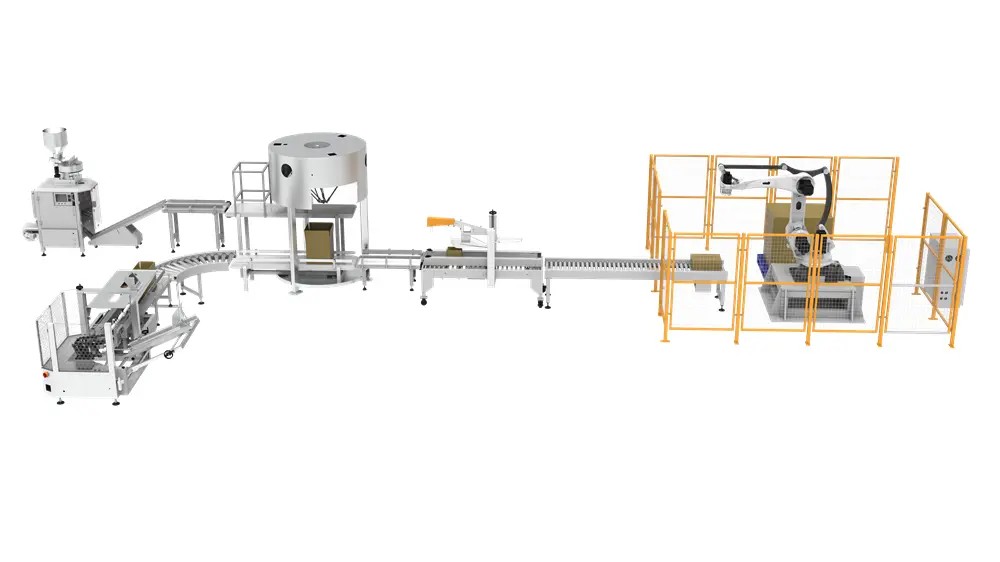
Soontrue Automated Vertical Packaging Solution
Applications Across Industries
Different product categories place different demands on an automatic packing line. The table below summarizes typical challenges and the solutions that address them.
|
Industry |
Packaging Challenge |
Recommended Solution |
Key Benefits |
|
Fragile products, high mix of SKUs |
Gentle flow wrappers + tray loaders + case packers |
Low breakage, fast change-over |
|
|
Condensation, hygiene, cold environment |
Stainless VFFS or flow wrappers + robotic case packing |
Wash-down design, consistent seals |
|
|
High speed, nitrogen flush, accurate weight |
Multihead weigher + high-speed VFFS or flow wrapper |
High OEE, reduced film waste |
|
|
Confectionery |
Precise portion, attractive pack finish |
Flow wrappers with print registration + cartoners |
Shelf appeal, brand consistency |
|
Vegetables |
Variable product size, moisture |
Weighers + VFFS with perforated film options |
Accurate weight, extended freshness |
|
Seafood |
Hygiene, odor control, portion accuracy |
Stainless multihead + VFFS or tray lines |
Easy clean, regulatory compliance |
|
Prepared Meals |
Mixed components, tray presentation |
Tray denesters + flow wrappers + case packers |
Retail-ready packs, high throughput |
|
Pharmaceuticals |
Traceability, validation, cleanroom rules |
Validated flow wrappers + serialization modules |
Full audit trail, GMP compliance |
|
Daily Necessities |
Multiple formats, high volume |
Modular flow wrappers + end-of-line automation |
Scalable capacity, low labor |
Each industry benefits from a line that can grow with demand. Starting with primary packaging and adding secondary and tertiary modules later keeps capital outlay aligned with actual sales growth.
Key Benefits
Throughput rises because the line runs at a steady, recipe-defined speed instead of fluctuating with operator fatigue. Typical gains range from 30 percent to more than 100 percent compared with previous manual or semi-automatic methods, depending on the starting point.
Labor cost per pack falls sharply. One or two operators supervise a line that previously needed a full team. The remaining staff focus on quality, sanitation and rapid change-overs, raising overall plant productivity.
Packaging consistency improves. Seal strength, film tension, label position and case pattern stay within tight tolerances. Retailers receive packs that look identical from the first case to the last.
Product waste declines. Accurate weighing and gentle product handling reduce give-away and breakage. Reject rates drop because defects are caught early and the root cause is logged for continuous improvement.
Food safety strengthens through reduced human contact, automatic metal detection, weight control and full electronic batch records. Audits become faster and documentation is always complete.
Traceability is built in. Every pack can be linked to the production order, the film lot and the inspection results. In the event of a market withdrawal the affected range is identified in minutes.
Scalability follows from modular design. Extra lanes, additional case packers or a second palletizer can be added without discarding the original investment. Digital integration with MES and ERP systems prepares the plant for Industry 4.0 reporting.
Return on investment typically falls between 18 and 36 months. The exact period depends on local labor rates, the number of shifts and the complexity of the line. A detailed cost-benefit model based on actual plant data provides the clearest picture before purchase.
How to Choose the Right Automatic Packing Line
A structured procurement checklist reduces the risk of buying equipment that later proves hard to integrate or expand. The following points cover the main decision areas.
Product Characteristics
Record the full range of products the line must handle: dimensions, weight, fragility, temperature and any special requirements such as nitrogen flushing or deoxidizer insertion. Fragile bakery items need gentler transfer systems than rigid snack bars.
Package Type and Materials
List every primary pack format (pillow bag, tray, premade pouch, carton) and the secondary case styles. Confirm that the chosen film or carton suppliers can supply materials compatible with the sealing systems on the short-list machines.
Production Capacity
Define both current peak demand and the expected volume in three to five years. Size the line for the future peak while keeping the ability to run efficiently at lower rates. Oversizing wastes capital; undersizing forces a second investment too soon.
Factory Layout and Utilities
Measure available floor space, ceiling height, power supply, compressed air and drainage. Provide CAD drawings early so that the supplier can propose a layout that respects existing traffic routes and sanitation zones.
Sanitation Requirements
Decide the required IP rating, the wash-down frequency and the materials of construction. Frozen-food and ready-meal plants usually specify stainless-steel frames and open structures that allow full access for cleaning.
Future Expansion
Ask whether extra modules can be added later without major redesign. Modular platforms that share the same control architecture make expansion far simpler.
Digital Integration
Confirm that the control system supports the plant’s existing MES or ERP protocols. Open architectures reduce custom programming and keep data flowing reliably.
After-Sales Service and Total Cost of Ownership
Evaluate spare-parts availability, remote-diagnosis capability, training programs and response times. The purchase price is only one part of the total cost; uptime and support quality determine the real lifetime cost.
Why Choose a One-stop Packaging Line Supplier?
Purchasing individual machines from several vendors creates interface risks. Mechanical dimensions may mismatch, communication protocols may differ, and each supplier may point to the other when a problem appears at the junction between two machines.
A turnkey supplier designs the entire line as one system. Mechanical, electrical and software interfaces are defined together. Project management stays under a single schedule. Commissioning teams arrive already familiar with every station. Maintenance training covers the whole line rather than isolated machines.
Soontrue builds both the individual packaging machines and the complete line integration. Engineering teams customize layouts for bakery, frozen food, snacks and ready-meal plants. Lifecycle support includes remote diagnostics, spare-parts logistics and on-site training so that the line continues to deliver the planned output year after year.
Conclusion
An automatic packing line converts labor pressure, quality variation and limited traceability into a controlled, measurable process. From the first product infeed through primary packaging, inspection, case packing and palletizing, each station contributes to higher throughput, lower cost per pack and stronger compliance records.
The decision path begins with a clear definition of products and pack formats, continues through a realistic capacity forecast and factory-layout study, and ends with a supplier that can deliver both the machines and the integration engineering. Choosing a one-stop partner reduces interface risk and shortens the time from order to stable production.
Soontrue designs and builds complete automatic packing lines for bakery, frozen food, snacks, vegetables, noodles and ready meals. Engineering teams work from actual product samples and factory drawings to create a solution that fits both today’s volume and tomorrow’s growth. To receive a customized packaging-line assessment based on specific products and plant conditions, contact the Soontrue application team.
FAQ
1. What typical return on investment can a fully automatic packing line deliver?
Most projects reach payback between 18 and 36 months. The exact period depends on local labor costs, the number of operating shifts, current scrap rates and the complexity of the chosen configuration. A tailored cost-benefit analysis that uses the plant’s own production data and utility rates produces a realistic financial model. Savings come from reduced head-count on the continuous path, higher throughput, lower film and product waste, and fewer quality claims. Many plants also value the softer benefits of easier audits and faster new-product introductions.
2. How much factory floor space does a complete turnkey packing line require?
Footprint varies with product size, speed and the number of secondary packaging stations. A compact primary packaging cell with weigher and flow wrapper may occupy only 20–30 square meters, while a full line including case packing and palletizing can require 80–150 square meters or more. Modular design keeps the layout as compact as practical. Early exchange of CAD drawings allows the engineering team to propose a layout that fits existing columns, aisles and sanitation zones without unnecessary relocation of other equipment.
3. How is downtime minimized during installation and commissioning?
Installation is scheduled to coincide with planned shutdowns or lower-demand periods whenever possible. Mechanical and electrical pre-assembly in the supplier’s workshop shortens on-site work. A detailed project plan lists every task, required utilities and the sequence of functional tests. Training of operators and maintenance staff begins during commissioning so that the plant team is ready to run the line independently as soon as production resumes.
4. How long does a product change-over take and is it tool-less?
Modern lines designed around SMED principles complete most change-overs in 10–25 minutes. Pre-programmed recipes on the HMI adjust speeds, temperatures and timing automatically. Quick-release forming sets, guide rails and sealing jaws remove the need for hand tools in the majority of adjustments. Operators follow a short checklist displayed on the screen, and the line returns to production speed once the first packs pass inspection.
5. Can the control system integrate with existing MES and ERP platforms?
Yes. Open architectures that support OPC-UA and other industry-standard protocols allow real-time exchange of production counts, alarm data, recipe downloads and OEE figures. The packing line becomes a transparent data source for higher-level systems. Custom interface work is minimized when both parties agree on the data map early in the project.
6. What hygiene and food-safety features are built into the equipment?
Food-grade materials, smooth surfaces, open-frame structures and IP65 or higher protection ratings are standard on machines intended for food plants. Quick-release belts and tool-free covers speed wash-down. Metal detectors, checkweighers and optional vision systems form an automatic quality gate. Full electronic batch records link every pack to the production order, film lot and inspection results, supporting both internal quality systems and external audits.
7. What maintenance schedule should be expected?
Daily tasks center on cleaning and visual checks. Weekly and monthly routines cover lubrication points, belt tension and filter changes according to the supplier’s schedule. Predictive features such as servo-load monitoring and film-break sensors help plan interventions before a stop occurs. Remote diagnosis allows the supplier’s engineers to review alarm history and guide local technicians, reducing the need for emergency travel.
8. How much customization is possible for special products or pack formats?
Almost every project includes some degree of customization. Product-specific infeed systems, special forming sets, nitrogen-flush options, deoxidizer inserters and unique case patterns are routinely engineered. The modular platform keeps the core machines standard while the interfaces adapt to the exact product and factory constraints. Prototype trials with real product confirm performance before the final design is released.
9. What is the practical difference between a flow wrapper and a VFFS machine on a packing line?
A horizontal flow wrapper receives already oriented solid product and wraps film around it, producing a pillow or fin-seal pack. It suits biscuits, chocolate, rice crackers and trayed items. A vertical form-fill-seal machine forms a bag from flat film, fills it from above, and seals it, making it ideal for free-flowing snacks, frozen vegetables, powders and many noodle products. Many complete lines combine both technologies when the product portfolio requires both pack styles.
10. What production speeds can a typical automatic packing line achieve?
Primary packaging speeds range from 60 packs per minute on complex tray lines to more than 300 packs per minute on high-speed flow wrappers or multi-lane VFFS systems. Secondary packaging and case packing are matched to the primary output so that no station becomes a bottleneck. Actual sustainable speed depends on product characteristics, film quality and the required inspection intensity. Trials with the customer’s product establish the realistic running rate for each project.
11. What after-sales support is available once the line is running?
Support normally includes remote diagnosis, spare-parts supply from regional or central warehouses, scheduled maintenance visits and operator refresher training. Many suppliers maintain 24-hour hotlines and can dispatch technicians within agreed response times. Access to software updates and recipe libraries keeps the line current as new products are introduced. Clear service-level agreements define the expected response and the availability of critical spare parts.
12. How does a project with Soontrue typically begin?
The process starts with a detailed discussion of products, pack formats, target speeds and factory constraints. Sample product and packaging materials are evaluated in the application laboratory. A layout proposal and preliminary commercial offer follow. Once the concept is approved, detailed engineering, manufacturing, factory acceptance testing and on-site installation proceed according to an agreed schedule. Training and handover complete the project so that the plant team can operate and maintain the line independently.