
How to Choose Between Flow Wrap and Sachet Packing? The 2026 Definitive Engineering & Business Guide
Packaging Knowledge Hub

If you're seeking packaging automation solutions, please contact us, and we'll be delighted to offer you the most tailored solution.
In the high-stakes world of industrial manufacturing, the "End-of-Line" is no longer just a destination; it is the final frontier of competitive advantage. Integrating the right packaging technology—be it flow wrap or sachet packing—is a multi-dimensional engineering project that requires the seamless synchronization of robotics, sensor logic, and material handling. As we move into 2026, the decision between Horizontal Form-Fill-Seal (HFFS) Machine and Vertical Form-Fill-Seal (VFFS) Machine has evolved beyond simple aesthetics into a complex calculation of Total Cost of Ownership (TCO), sustainability, and Industry 4.0 compatibility.
What Are the Fundamental Mechanical Differences Between Flow Wrap and Sachet Packing?
The primary mechanical difference lies in the orientation of the product flow and the sealing architecture: Flow wrapping (HFFS) operates on a horizontal axis where the product moves linearly through a forming tube, while sachet packing utilizes gravity or vertical forced-feeding to fill a pouch that is sealed on three or four sides.
The Horizontal Logic of Flow Wrapping
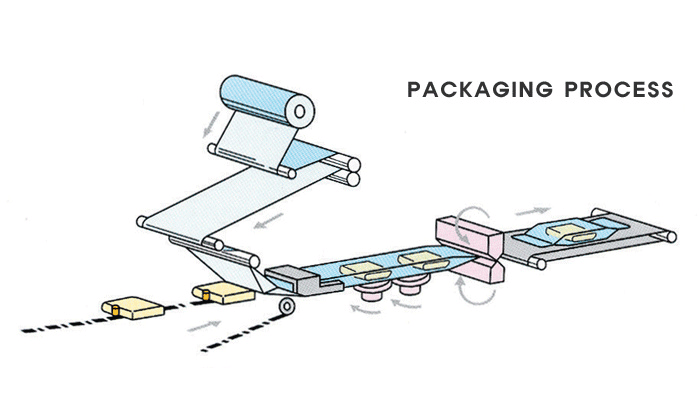
In a flow wrap system, the film is fed from a roll and formed into a continuous tube. The product is introduced horizontally into this tube, usually via a lugged chain or a friction belt. The longitudinal seal (back seal) is formed by heated rollers, and the end seals are created by rotating or reciprocating cutting heads. This continuous motion allows for incredible speeds, as there is no "stop-and-start" inertia to overcome. It is the ideal choice for products that require a consistent, flat surface for transport.
The Vertical Logic of Sachet Packaging
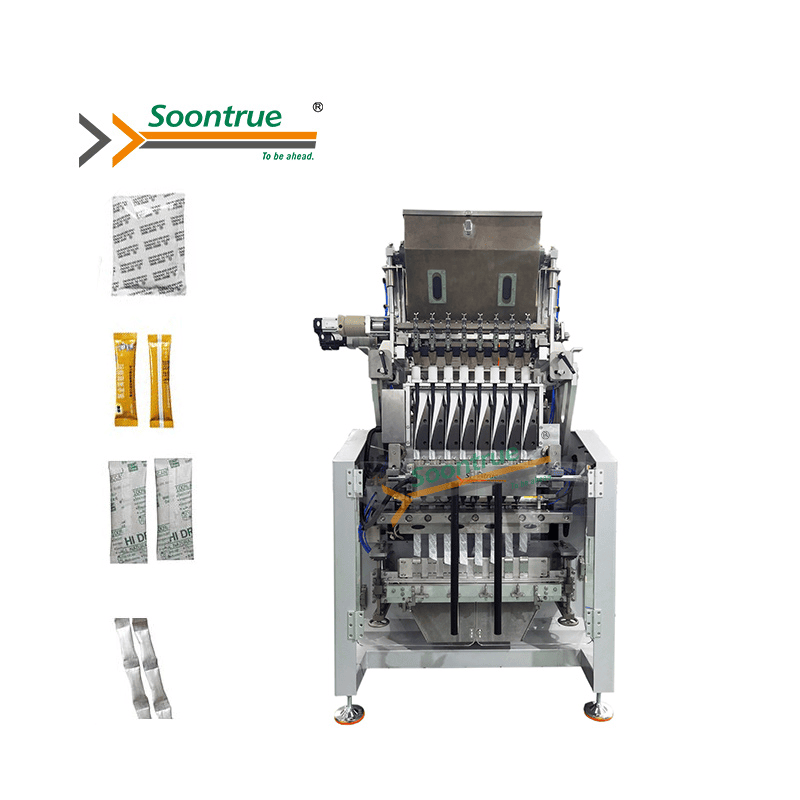
Sachet packing, conversely, is the master of gravity. The film is pulled over a forming shoulder, creating a tube. The bottom and sides are sealed, the product is dropped in from above, and the top is sealed. This method is inherently more compact. For multi-lane sachet machines, a single wide web of film is slit into multiple strips, allowing a single machine to act like ten or twenty small packaging lines in parallel. This vertical orientation is specifically engineered to handle loose materials—liquids, powders, or small granules—where gravity assists in the filling process.
| Mechanical Feature | Flow Wrap (HFFS) | Sachet Packing |
| Motion Axis | Horizontal (Linear) | Vertical (Gravity-assisted) |
| Sealing Type | Fin Seal or Lap Seal | 3-side or 4-side perimeter seals |
| Film Path | Single web, continuous | Single or Dual web, intermittent/continuous |
| Dosing Method | Timed infeed (Lugs/Sensors) | Auger, Volumetric, or Piston Fillers |
How Does Your Product Physical State Dictate the Choice Between Flow Wrap and Sachet?
The physical state of your product is the most critical determinant: Flow wrap is the gold standard for discrete, solid items with a consistent shape, whereas sachet packing is the superior choice for fluid, granular, or multi-component dose-controlled products.
Why Solids Demand Horizontal Support
Imagine trying to pack a fragile chocolate bar or a medical face mask vertically. The drop force alone could damage the product. Flow wrapping provides a "cradle" for the product from the moment it leaves the feeder until it is fully sealed. This is essential for items that must maintain a specific orientation for branding or secondary packaging.
- Bakery & Snacks: Biscuits, bread, and cakes.
- Personal Care: Soap bars, wet wipes, and hotel amenities.
- Medical Devices: Syringes, masks, and test kits.
The Vertical Advantage for Flowable Goods
For powders, liquids, and gels, horizontal movement is the enemy. Centrifugal force and sloshing make it impossible to maintain a clean seal area. Sachet machines solve this by using the "Vertical Drop" method. The product is dispensed into the pouch while it is still being formed, ensuring that the seal area remains free of contaminants.
- Powders: Coffee, protein supplements, and spices.
- Liquids: Ketchup, shampoo, and pharmaceutical syrups.
Which Packaging Method Offers Higher Production Speed and Throughput Efficiency?
When comparing raw speed, flow wrapping generally offers higher individual lane speeds for single units (up to 800 PPM), but sachet packing wins on total volume throughput via multi-lane configurations.
Scaling with Flow Wrap
Flow wrappers are designed for "Speed-to-Market." With a full-servo drive system, modern high-end flow wrappers can maintain a stable 500-800 PPM. However, this is a "single-stream" speed. If your production line produces 2000 items per minute, you would need multiple flow wrappers in parallel. The advantage here is flexibility; if one machine goes down, the others can continue running.
Scaling with Multi-Lane Sachet
A multi-lane sachet machine scales "sideways." Instead of running one lane faster, it runs 10, 12, or 20 lanes at a moderate speed (e.g., 60 cycles per minute).
- 10 lanes x 60 cycles = 600 PPM.
- 20 lanes x 60 cycles = 1200 PPM. This parallel processing is much more space-efficient for small-dose products like sugar packets or cosmetic samples. It reduces the total footprint of the factory floor while delivering massive throughput.
What Are the Total Cost of Ownership (TCO) Differences Between Flow Wrap and Sachet Systems?
The TCO analysis reveals that flow wrap systems typically have lower film costs per square inch but higher mechanical complexity, while sachet systems offer better material utilization for small doses.
CAPEX vs. OPEX
- Initial Investment (CAPEX): A single-lane flow wrapper is usually cheaper than a high-end multi-lane sachet machine. However, if you factor in the footprint and the number of operators required, the sachet machine often wins on a "per-pack" investment basis for small-format goods.
- Operational Expense (OPEX): Flow wrappers have more wearing parts (chains, lugs, rotary knives) that require regular replacement. Sachet machines have fewer moving parts but require more expensive dosing pumps or augers that need specialized, often validated, cleaning procedures.
Film Waste and Consumables
Flow wrapping often results in more "tail" waste at the beginning and end of a roll due to the length of the forming tube. Sachet machines, especially those using precision tension control, minimize the "unsealed leader" film, which can save thousands of dollars in high-barrier film costs annually in high-volume environments.
Which Packaging Format is More Sustainable and Eco-friendly in 2026?
In 2026, sachet packing leads in logistics efficiency by minimizing air volume, though flow wrapping is rapidly adopting paper-based and mono-material recyclable films.
The Logistics of Sustainability
A sachet is flat. You can fit 500 sachets in a box that would only hold 200 flow-wrapped pillow packs. This "Logistics Density" reduces the number of trucks on the road, directly lowering Scope 3 carbon emissions. For brands looking to hit aggressive ESG (Environmental, Social, and Governance) targets, the sachet format offers an immediate reduction in secondary packaging waste.
Material Innovation
The biggest hurdle for eco-friendly films (like Mono-PE or Paper) is their narrow "sealing window." They burn easily if the temperature is too high and leak if it's too low. Modern HFFS and VFFS systems are now incorporating adaptive thermal logic, where sensors monitor the film’s surface temperature 100 times per second, adjusting the heater output instantly to ensure a perfect seal on even the most sensitive biodegradable materials.
What Are the Common Integration Challenges for Flow Wrap and Sachet Lines?
The most significant integration challenge for flow wrap is the synchronization of high-speed infeed conveyors, while for sachet packing, the bottleneck is the precision of the upstream dosing systems.
Synchronization and Handshaking
Integrating a flow wrapper requires a sophisticated "handshake" between the primary production line and the wrapper’s lugs to ensure the product is timed perfectly. Any misalignment results in "product-in-seal" errors or machine jams. Sachet integration is more about "flow management." Since the product is often a liquid or powder, the challenge lies in ensuring the multi-head weigher or liquid pump can keep up with the machine's cycle speed without causing splashes or dust clouds that contaminate the sealing area.
Industry 4.0 and Unified Communication
In the era of Industry 4.0, the palletizing cell and the packaging machine should feed data back to the ERP (Enterprise Resource Planning) system. This allows management to see real-time production counts, track SKU-specific performance, and receive automated alerts when the film or pallet magazine is running low.
How to Troubleshoot Quality Issues in Flow Wrap and Sachet Packaging?
To maintain high OEE (Equipment Efficiency), flow wrap troubleshooting should focus on "seal dwell time," whereas sachet quality control must prioritize "dosing accuracy."
| Issue | Flow Wrap Solution | Sachet Solution |
| Leaky Seals | Adjust dwell time / Check film tension | Clean nozzles / Calibrate suck-back |
| Wrinkles | Align film mandrel | Synchronize dual-web tension |
| Product in Seal | Optimize infeed timing | Adjust auger/pump timing |
Predictive Maintenance
The future of troubleshooting is predictive. Modern machines track the "vibration signatures" of every motor. If a bearing is about to fail in two weeks, the system sends an alert to your maintenance team today. This shift from "Reactive" to "Predictive" maintenance is what allows top-tier facilities to achieve 98%+ OEE.
Conclusion
Choosing between flow wrap and sachet packing is a complex decision that requires a deep understanding of your product, your throughput goals, and your long-term sustainability strategy. While the technical differences are vast, the goal remains the same: a reliable, high-speed, and cost-effective packaging line.
Soontrue provides a "Single-Source Advantage" by engineering both packaging and palletizing systems as a unified ecosystem. When you buy a packaging machine from one vendor and a palletizer from another, you risk communication errors and finger-pointing during downtime. Soontrue eliminates this friction. Our HFFS and VFFS machines are designed with "Palletizer-Ready" control architectures, ensuring 100% mechanical compatibility.
Whether you are packaging fragile snack foods that require the "pillow effect" or high-precision pharmaceutical powders, Soontrue’s full-servo systems and AI-driven diagnostics ensure your production line never becomes a bottleneck. With Soontrue, you get a turnkey solution where the bagger, the metal detector, the checkweigher, and the robot all speak the same language.
FAQ
Q1: Can I use the same film for both flow wrap and sachet machines?
A: No. Flow wrap often uses "cold seal" for speed, while sachet films require specific "slip" properties for vertical filling. Using the wrong film can lead to "film wandering" or poor seal integrity.
Q2: Which machine is easier to clean for pharmaceutical standards?
A: Vertical sachet machines are generally easier to deep-clean. High-end sanitary series feature 316L stainless steel construction and tool-less disassembly for rapid, validated wash-downs.
Q3: Is flow wrapping suitable for liquids?
A: Generally, no. Liquids are best handled by vertical sachet machines to prevent leakage during sealing. However, for high-viscosity pastes, specialized horizontal systems can be engineered.
Q4: How do I decide between 3-side and 4-side seals?
A: 3-side is cost-effective (single web); 4-side offers a premium look, better barrier protection, and the ability to use different materials for the front and back of the pack.
Q5: What is the typical ROI for automated packaging systems?
A: Most clients achieve a full capital recovery within 12 to 18 months through labor reduction, material savings, and increased throughput.