
The Ultimate Guide to Integrating Palletizing Robots
Packaging Knowledge Hub

If you're seeking packaging automation solutions, please contact us, and we'll be delighted to offer you the most tailored solution.
In the high-stakes world of industrial manufacturing, the "End-of-Line" is no longer just a destination; it is the final frontier of competitive advantage. Integrating a palletizing robot is a multi-dimensional engineering project that requires the seamless synchronization of robotics, sensor logic, and material handling. When executed correctly, a robotic palletizing cell transforms a chaotic manual process into a rhythmic, data-driven operation that scales with your business.
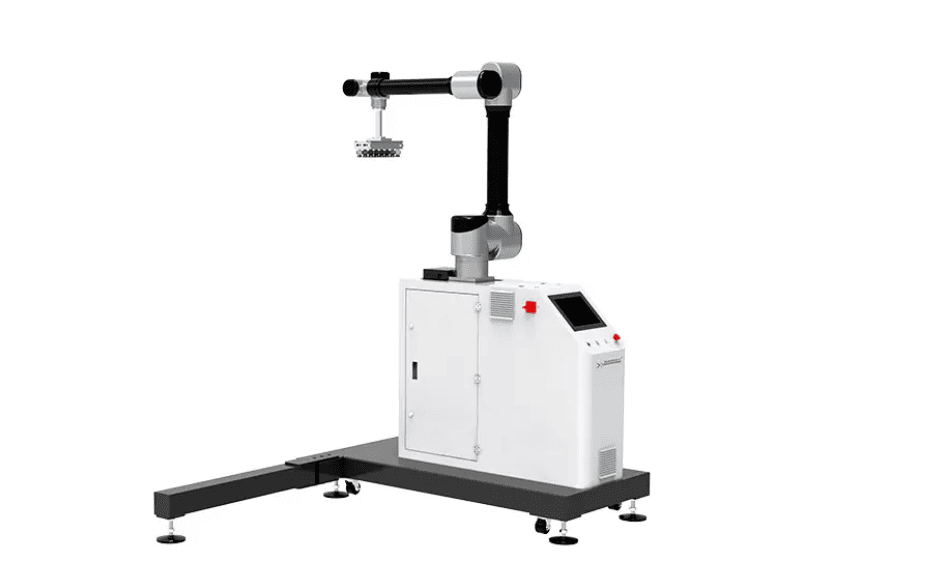
Why Should You Integrate a Palletizing Robot into Your Production Line Now?
Integrating a palletizing robot is the most effective strategy to decouple production throughput from labor availability, effectively eliminating the primary bottleneck in high-speed manufacturing while slashing long-term operational costs.
The global manufacturing landscape is currently facing a "perfect storm" of labor shortages and rising ergonomic insurance claims. Manual palletizing is inherently inefficient; a human operator, no matter how skilled, is subject to fatigue, repetitive strain injuries (RSIs), and inconsistent stacking patterns that lead to product damage during transit. By deploying a robotic solution, a facility can maintain a constant cycle time 24/7, ensuring that the output of high-speed primary packaging machines is never throttled by the inability to clear the line. Furthermore, the ROI of robotic palletizing has shifted dramatically; with the decrease in hardware costs and the increase in wage inflation, most enterprises now see a full capital recovery within 12 to 18 months.
The Ergonomic and Financial Imperative
- Injury Prevention: Palletizing involves heavy lifting, twisting, and reaching—the three primary causes of musculoskeletal disorders. Automating this task reduces workers' compensation premiums and improves employee retention by moving staff to higher-value supervisory roles.
- Precision and Load Integrity: Robots apply the exact same force and placement for every SKU. This leads to perfectly squared pallets that are safer to stack in warehouses and less likely to collapse during sea or truck freight, saving thousands in "unsellable" damaged goods.
How to Conduct a Site Assessment for Robotic Palletizer Integration?
A successful site assessment requires a holistic evaluation of the "Physical Footprint" and "Product Flow Dynamics," ensuring the robot has the necessary reach and payload capacity to handle peak production volumes without encroaching on vital facility traffic lanes.
Before a single bolt is turned, an integration team must map the 3D environment of the factory floor. This involves more than just measuring square footage; it requires an analysis of overhead clearances (for high-stacking pallets), floor load-bearing capacity (to support the robot’s mass and dynamic forces), and the proximity of utilities like high-pressure compressed air and 480V power drops. Crucially, the assessment must account for the "Infeed" and "Outfeed" logistics. Where do the full pallets go? How are empty pallets introduced? If the robot is starved for product or blocked by full pallets, its high-speed capabilities are wasted.
Key Assessment Parameters
- Reach and Envelope Analysis: The robot must be able to reach the furthest corner of the pallet and the lowest point of the infeed conveyor. Engineers use 3D simulation software to ensure no "singularities" or dead zones exist within the working range.
- Cycle Time Verification: You must calculate the "Picks Per Minute" (PPM). If your packaging line produces 60 bags per minute and the robot can only pick 15 times, you must design an EOAT that can pick 4 units simultaneously to maintain parity.
- Safety Zoning: Modern standards require a "Safety Buffer." Even with light curtains, there must be enough physical space to allow the robot to come to a complete emergency stop before it can make contact with a human entering the zone.
What Are the Critical Components of a Robotic Palletizing System?
The performance of a palletizing cell is determined by the synergy between the "Robot Manipulator," the "End-of-Arm Tooling (EOAT)," and the "Peripheral Material Handling" equipment, such as pallet dispensers and sheet applicators.
A palletizing robot is not a standalone tool; it is the conductor of an orchestral system. The Robot Arm (typically a 4-axis or 6-axis model) provides the raw movement, but the EOAT is the specialized interface that interacts with the product. Choosing the wrong gripper is the most common cause of integration failure. For example, a vacuum gripper that works perfectly for a sealed cardboard box will fail miserably on a porous burlap sack or a fragile, nitrogen-flushed snack bag. Beyond the arm, the system must include a Pallet Dispenser to automate the introduction of empty pallets and a Slip Sheet Applicator if the stack requires interlayer stabilization.
The Engineering of the EOAT (End-of-Arm Tooling)
- Vacuum Grippers: Utilize high-flow blowers or venturi systems. Ideal for rigid, non-porous items.
- Mechanical Clamps: Use side-pressure to lift heavy or irregular items. Essential for bags of grain, flour, or cement where the center of gravity shifts.
- Fork-Style Grippers: The "spades" slide under the product, providing total support from beneath. This is the gold standard for open-top crates or highly fragile items that cannot withstand side pressure.
- Hybrid Tools: Sophisticated tools that can pick a product, pick a slip sheet, and move an empty pallet, all with the same head, maximizing the robot's utility.
How to Design the Perfect Pallet Pattern for Maximum Stability?
Optimal pallet patterns are achieved through "Interlocking Logic" and "Center of Gravity Optimization," utilizing specialized software to ensure the load remains structurally sound during the high-G forces of transit.
A stack of boxes is only as strong as its weakest layer. In manual palletizing, workers often stack "columnar" (one on top of another), which is prone to "chimneying" or toppling. Robotic integration allows for complex "Interlocking Patterns," where each layer is rotated 90 degrees relative to the one below it. This creates a cohesive unit that resists lateral forces. For snack food manufacturers using Soontrue equipment, the challenge is often the "Pillow Effect"—bags filled with air. The palletizing logic must account for the "settling" of the product, often requiring the robot to apply a slight "tamping" force to level the layer before proceeding.
Stability Strategies for Flexible Packaging
- Overhang vs. Underhang: A slight underhang (product slightly inside the pallet edge) is preferred to prevent the product from being crushed by other pallets in a truck.
- Weight Distribution: The software must ensure the heaviest layers are at the bottom to maintain a low center of gravity.
- Layer Sheets: For slippery plastic bags, the integration of a paper or plastic slip sheet between every two layers can increase the coefficient of friction by 40%, preventing "load slumping."
How to Integrate Robot Controllers with Existing PLC and ERP Systems?
Seamless integration relies on "Unified Communication Protocols" (such as EtherNet/IP or PROFINET) that allow the robot controller to act as a transparent node within the factory’s wider Industrial Internet of Things (IIoT) ecosystem.
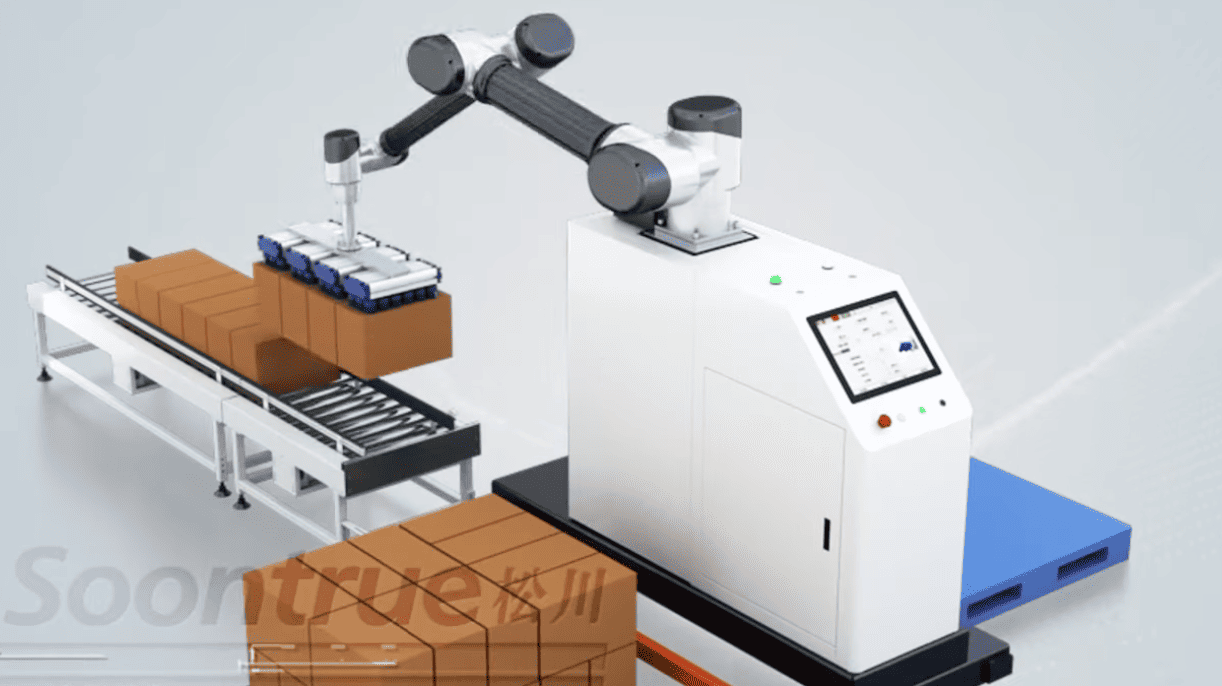
The robot cannot live on an island. It must "talk" to the upstream Soontrue packaging machine to know when a product is coming, and it must "talk" to the downstream stretch wrapper to signal that a pallet is complete. This is achieved through a PLC (Programmable Logic Controller) that acts as the brain of the line. Furthermore, in the era of Industry 4.0, the palletizing cell should feed data back to the ERP (Enterprise Resource Planning) system. This allows management to see real-time production counts, track SKU-specific performance, and receive automated alerts when the pallet magazine is running low.
The Digital Architecture of Integration
- Handshake Signals: Simple "Ready to Receive" and "Product Present" signals prevent collisions and wasted cycles.
- Recipe Management: When the brand switches from 500g bags to 1kg bags, the PLC sends a "Recipe Change" command to the robot, which automatically updates its stacking pattern and gripper pressure without human intervention.
- Remote Diagnostics: By integrating a secure VPN gateway, Soontrue engineers can troubleshoot a robot's logic from across the globe, reducing downtime from days to minutes.
What Are the Safety Standards and Compliance Requirements for Integration?
Compliance with ISO 10218 and ANSI/RIA R15.06 is non-negotiable, requiring a "Layered Defense Strategy" that combines physical barriers, optoelectronic sensors, and functional safety logic to eliminate human-robot collision risks.
Safety in robotic integration is defined by the Risk Assessment. You must assume that a human will attempt to enter the cell while it is operating. To mitigate this, engineers use a combination of Hard Guarding (steel mesh fences) and Soft Guarding (light curtains and area scanners). If a light curtain is tripped, the robot's safety-rated controller must execute a "Category 0" or "Category 1" stop. For collaborative robot (Cobot) applications, the safety focus shifts to "Power and Force Limiting," where the robot's internal sensors detect a collision and stop instantly before causing injury.
How to Calculate the Total Cost of Ownership (TCO) and ROI?
A comprehensive ROI calculation must account for "Direct Labor Displacement," "Yield Recovery from Reduced Damage," and "Operational Uptime Gains," typically revealing a much shorter payback period than initial CAPEX suggests.
Many decision-makers make the mistake of only looking at the sticker price of the robot arm. To find the true TCO, you must include the cost of the EOAT, the safety fencing, the integration labor, and the estimated annual maintenance (usually 2-3% of CAPEX). However, the "Savings" side of the ledger is equally deep. Beyond saving 2-3 shifts of manual labor, consider the "Hidden ROI": reduced insurance premiums, eliminated rework from dropped products, and the ability to run the line at 100% capacity during peak seasons without hiring temporary staff.
The ROI Formula for Palletizing
- Direct Savings: (Hourly Wage + Benefits) x (Number of Operators Replaced) x (Annual Operating Hours).
- Indirect Savings: (Value of Damaged Goods/Year) + (Cost of Recruitment/Training for High-Turnover Roles).
- The "Opportunity" Gain: The profit generated by the extra 10-15% throughput achieved by removing the manual bottleneck.
What Are the Common Challenges in Palletizing Integration and How to Solve Them?
The most frequent integration hurdles—Product Variability and Infeed Misalignment—are solved through "Adaptive Vision Systems" and "Precision Infeed Conditioning" that ensure the robot always receives a standardized target.
In a perfect world, every box arrives at the robot in the exact same orientation. In reality, boxes shift, bags slump, and pallets are sometimes slightly warped. Product Variability is the enemy of automation. To solve this, integrators use "Centering Conveyors" to square the product before it reaches the pick point. For more complex environments, 3D Vision Systems allow the robot to "see" the product and adjust its grip in real-time. Another challenge is "Slip Sheet Failures," where the robot's vacuum picks up two sheets instead of one; this is solved by adding "Air Ionizers" or "Sheet Fluffers" to break the static bond between sheets.
Troubleshooting the Integration
Issue: Dropped Products.
Solution: Increase vacuum flow or switch to a mechanical "side-support" gripper.
Issue: Pallet "Leaning"
Solution: Re-evaluate the interlocking pattern or increase the tension on the downstream stretch wrapper.
Issue: Slow Cycle Times.
Solution: Optimize the "Path Planning"—ensure the robot moves in a smooth arc rather than jerky, linear movements.
Why Choose Soontrue for Your End-of-Line Packaging Automation?
Soontrue provides a "Single-Source Advantage" by engineering the packaging and palletizing systems as a unified ecosystem, ensuring 100% mechanical compatibility and a single point of accountability for your entire production line.
When you buy a packaging machine from one vendor and a palletizer from another, you become the "accidental integrator," stuck in the middle of two companies blaming each other for a communication error. Soontrue eliminates this friction. Our HFFS machines and VFFS machines are designed with "Palletizer-Ready" control architectures. We understand the specific nuances of snack food packaging—from bag "puffiness" to the fragility of the product—and we build our robotic cells to handle those specific variables. With Soontrue, you get a turnkey solution where the bagger, the metal detector, the checkweigher, and the robot all speak the same language.
FAQ
Q1: Can one palletizing robot handle multiple production lines simultaneously?
A: Yes. This is known as "Multi-Line Palletizing." If the total PPM of both lines does not exceed the robot's maximum cycle speed, the robot can be positioned between two infeed conveyors, building two separate pallets (often of different SKUs) at the same time.
Q2: What is the typical lifespan of an industrial palletizing robot?
A: With proper maintenance, an industrial robot arm (like those from Fanuc, ABB, or Kuka used in Soontrue systems) is rated for 80,000 to 100,000 hours of operation. In a 24/7 environment, this equates to 10–12 years before a major overhaul is required.
Q3: How long does the actual on-site integration take?
A: While the engineering and build phase takes 12–16 weeks, the on-site "Commissioning" (installation and debugging) typically takes 5 to 10 business days, depending on the complexity of the PLC handshakes.
Q4: Do I need a specialized programmer on staff to operate the robot?
A: No. Modern Soontrue systems feature "Intuitive HMIs" (Human-Machine Interfaces). Operators can select a new SKU or adjust a stack pattern using a touchscreen interface that looks like a smartphone app, requiring zero coding knowledge.
Q5: What happens if the robot encounters a "Bad" product or a broken pallet?
A: The system is equipped with sensors to detect "Infeed Errors." If a bag is under-weight (via the checkweigher) or a pallet is detected as broken, the robot will either pause and alert the operator or automatically divert the faulty item to a "Reject Bin" without stopping the rest of the line.