
Premade Pouch Packaging Solutions for Nuts
Packaging Knowledge Hub

If you're seeking packaging automation solutions, please contact us, and we'll be delighted to offer you the most tailored solution.
Nut producers routinely confront several operational pressures that affect both product value and line efficiency. Inconsistent portion weights lead to excess product giveaway of expensive kernels. Mechanical stress during transfer and filling increases breakage on delicate items such as cashews, walnut pieces and whole almonds. Exposure to residual oxygen accelerates oil oxidation and shortens usable shelf life. In addition, frequent shifts between different pack weights, bag formats and recipes place continuous demands on changeover time.
A well-matched premade pouch packing machine therefore goes beyond simple automatic bag loading. It must work in concert with multihead weighing, careful product handling, nitrogen flushing when required, dependable sealing and smooth transfer to inspection and secondary packaging. This integrated approach is what enables nut manufacturers to meet quality standards and production targets at the same time.
Common Nut Packaging Challenges and Solutions
Weight Inconsistency and Product Giveaway
Nuts vary in size, density and mixture ratio within the same batch. Whole almonds, broken pieces and mixed trail-mix formulas all produce different flow patterns through a weigher. When the dosing system cannot compensate quickly, average fill weights drift above or below the declared net content. Overfill becomes direct material loss; underfill risks non-compliance.
A multihead combination weigher addresses this by selecting the best combination of individual hoppers that together reach the target weight within a narrow tolerance. Proper setup of vibration amplitude, hopper priority and combination algorithms keeps standard deviation low across continuous runs. Integrating a checkweigher after sealing further flags any systematic drift so operators can adjust parameters before large quantities of off-spec packs accumulate. Trial runs with actual nut samples remain the most reliable way to confirm achievable accuracy for a given recipe.
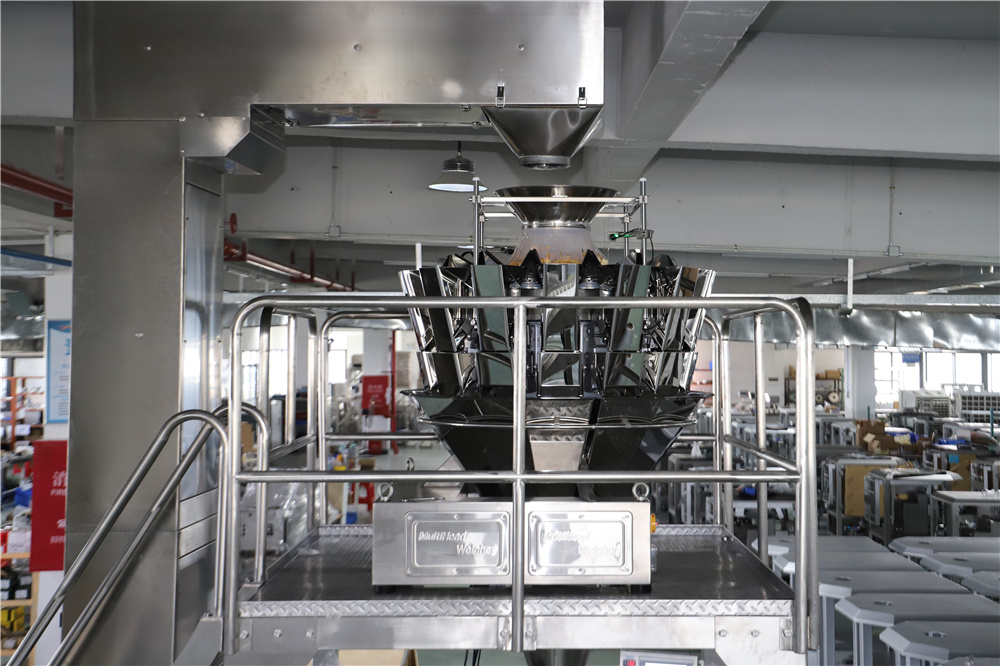
Multihead combination weigher integrated for precise nut portioning and reduced giveaway
Nut Breakage During Feeding and Filling
Premium cashews, walnut halves and whole roasted almonds command higher prices when they remain intact. High drop heights, sharp turns in conveyors or aggressive vibration settings generate impact forces that fracture kernels. Broken pieces lower visual appeal and can increase the proportion of fines that later contaminate the seal area.
Gentle feeding configurations reduce these forces. Inclined or vibratory conveyors with controlled amplitude, shortened free-fall distances into the weigher, and soft-drop transfer chutes limit mechanical stress. Some lines incorporate intermediate buffer hoppers that allow product to settle before the final discharge into the pouch. Matching the transfer path to the specific fragility of each nut type helps preserve whole-kernel percentages throughout the packaging cycle.
Oxidation and Freshness Loss
Nuts contain high levels of unsaturated fats that react readily with oxygen. Once oxidation begins, flavor notes shift toward rancidity and shelf life contracts. Packaging that simply excludes ambient air is rarely sufficient; residual oxygen inside the finished pouch still drives the reaction.
Nitrogen flushing replaces the headspace air immediately before sealing. When paired with high-barrier films that limit oxygen transmission, the residual oxygen level can be held low enough to slow oxidation markedly. Seal integrity remains equally important: any channel or weak seal allows oxygen re-entry over time. Final residual-oxygen targets depend on the specific nut variety, oil content, packaging material and expected storage conditions, so laboratory verification with the actual product and film combination is recommended before full production.
Contamination in the Sealing Area
Fine particles, oil residue or seasoning dust easily travel with the product stream. When these materials land on the sealing surfaces or between film layers, heat transfer is interrupted and seal strength declines. Weak seals raise the risk of package failure during transport and storage, and they compromise the oxygen barrier created by nitrogen flushing.
Coordinating the timing of product discharge with pouch opening and jaw closure reduces the window during which particles can reach the seal zone. Dust-extraction points near the fill station, guided product paths and periodic cleaning of contact surfaces further limit contamination. Continuous monitoring of seal quality through peel tests and visual inspection of sample packs helps maintain the integrity required for both product protection and retail presentation.
Frequent SKU Changes and Production Bottlenecks
Retail programs demand multiple net weights, bag widths, zipper styles and flavor combinations. Each changeover requires adjustments to the pouch magazine, gripper settings, weigher recipes and sealing parameters. Extended changeover times reduce available production hours and can shift the bottleneck downstream to checkweighing or case packing once the primary machine recovers speed.
Equipment that stores multiple recipes, supports quick-release change parts and offers servo-driven width adjustment shortens the mechanical portion of the changeover. Parallel attention to secondary packaging capacity ensures that higher primary speeds do not simply create a new queue at the case packer. Planning the entire line around the most frequent SKU transitions keeps overall equipment effectiveness closer to planned levels.
Premade Pouch Packaging Line Configuration for Nuts
The challenges above translate directly into specific equipment choices. A practical configuration starts with the product characteristics and works outward to the finished retail unit.
Feeding and Weighing System
Whole nuts, broken pieces, coated kernels and mixed blends each require different handling. Controlled vibratory or belt feeding delivers product to a multihead weigher without excessive impact. The weigher configuration (number of heads, hopper volume and combination logic) is selected according to target fill weight and desired accuracy. For high-value nuts, the combination of gentle infeed and precise multihead dosing typically yields the lowest giveaway while protecting product integrity.
Pouch Format and Freshness Requirements
Retail positioning often favors stand-up pouches or zipper bags that offer convenient reclosure and strong shelf presence. Barrier performance of the film structure must match the expected shelf life and distribution environment. Where residual oxygen targets are strict, the pouch machine incorporates a nitrogen-flush station timed to the sealing cycle. Zipper activation and final seal verification complete the primary package.
Production Line Integration
The premade pouch packaging machine forms the core of the line, receiving accurately weighed product and delivering sealed pouches to a checkweigher and then to case packing. Overall line rate is governed by the slowest balanced stage. Target output, changeover frequency and secondary packaging capacity therefore need to be evaluated together rather than in isolation.
One illustrative configuration for premium mixed nuts runs as follows: controlled feeding to a multihead weigher, transfer into a premade zipper pouch, nitrogen flushing where residual oxygen targets require it, sealing and inspection, then case packing. This sequence is only one possible arrangement; the final equipment combination is determined by the specific product range and project requirements.
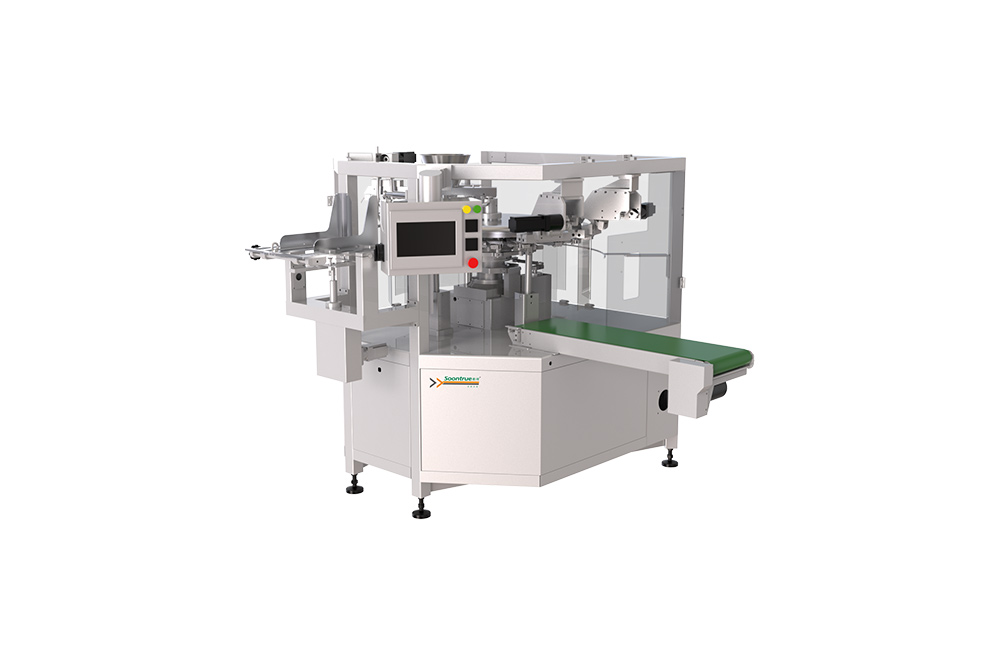
GDS210-10 rotary premade pouch packing machine suitable for high-volume nut packaging
Soontrue Nut Packaging Solutions
Premade Pouch Machine with Multihead Weigher for Nuts
In a typical nut packaging application, the previous process relied on manual bag loading, filling and sealing steps that were difficult to keep in sync. Operators had to coordinate pouch handling, product dosing and final closure by hand, which limited throughput and introduced variation between packs.
The solution combined a premade pouch packing machine with a multihead weigher. Empty pouches are automatically fed and opened, product is accurately portioned by the multihead scale, and the filled pouches are sealed in a continuous sequence. This configuration removes the bottlenecks created by manual connections between bagging, filling and sealing, delivering more consistent weight control and higher overall line efficiency for nut products.
This type of application illustrates how a focused pairing of pouch handling and precision weighing can already resolve core production constraints. Many facilities then build on the same foundation by adding further modules that address freshness, inspection and secondary packaging needs.
Integrated Equipment for Broader Nut Packaging Requirements
Building from configurations such as the one above, Soontrue expands the same modular logic to include optional nitrogen flushing, checkweighing and secondary case-packing. Premade pouch platforms such as the GDS210-10 serve as the central station, while multihead weighers, gas-flush units and downstream equipment are selected according to nut type, pouch specification, target output and the required level of automation.
Engineering teams evaluate product samples, film structures and production schedules to recommend a balanced equipment set. Manufacturers seeking a tailored configuration can review the full range of options on the Soontrue nuts packaging solutions page or discuss project requirements directly with the technical team.
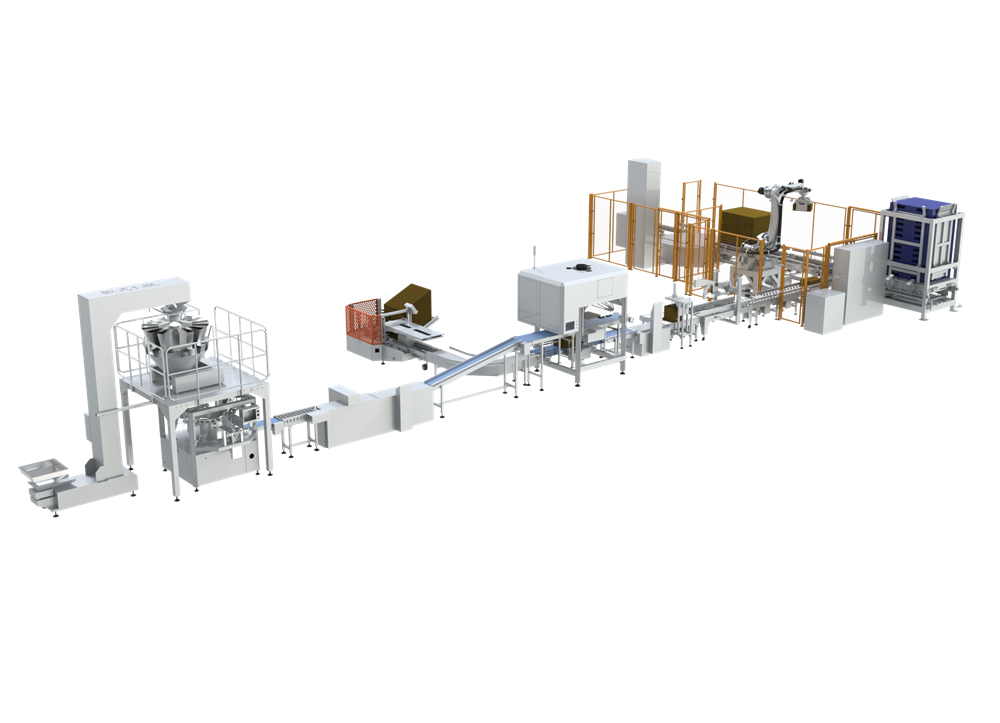
Integrated automated premade pouch packaging solution for food products including nuts
Key Considerations for Nut Packaging Equipment
Before finalizing a purchase or line layout, manufacturers benefit from confirming the following points with actual product trials:
• Nut types, product condition (whole, broken, coated) and target fill weights
• Pouch dimensions, zipper design and packaging material barrier properties
• Weighing performance measured with actual nut samples under continuous operation
• Product breakage rates and seal quality observed during extended trial runs
• Nitrogen flushing capability and residual oxygen targets where applicable
• Changeover requirements across the planned SKU range
• Integration points with inspection and secondary packaging equipment
Conclusion
Effective nut packaging rests on more than cycle speed. Weight control, gentle product handling, freshness protection, consistent sealing and balanced secondary packaging all contribute to overall line performance. When these elements work together, manufacturers protect product value, meet retail expectations and maintain stable daily output.
Soontrue supports nut producers with modular premade pouch systems and complete line engineering. Manufacturers can discuss product types, pouch specifications and production targets with the technical team to develop a configuration suited to their specific requirements. Visit the nuts packaging solutions page or contact Soontrue to explore tailored premade pouch packing options for your facility.
FAQs
Is a Premade Pouch Packing Machine Suitable for All Types of Nuts?
Suitability depends on nut morphology, pouch size range, weighing system selection and target output. Whole, broken and coated products may require different feeding and weigher settings, so product trials remain the practical confirmation method.
How Can Nut Manufacturers Reduce Product Breakage During Packaging?
Focus on controlled feeding, reduced free-fall distances and smooth transfer paths into the weigher and pouch. Matching vibration levels and chute design to the specific nut variety limits impact forces that cause fractures.
Does Nut Pouch Packaging Require Nitrogen Flushing?
Nitrogen flushing is recommended when the product is sensitive to oxidation, the packaging material has limited barrier performance, or the required shelf life exceeds what residual air would allow. The decision is product- and market-specific.
How Can a Nut Packaging Machine Reduce Product Giveaway?
A multihead combination weigher keeps average fill weight close to the target. Proper parameter settings and a downstream checkweigher together minimize systematic overfill while maintaining compliance with declared net content.
Can One Premade Pouch Packing Machine Handle Different Nut Products and Pouch Sizes?
Many machines support a range of pouch widths and formats when equipped with adjustable grippers and recipe storage. Confirm the supported bag-size window, change-part requirements and material handling limits for each product group before committing to a single machine.