
Biscuit Packaging Machine: The Complete Buyer's Guide (2026)
Packaging Knowledge Hub

If you're seeking packaging automation solutions, please contact us, and we'll be delighted to offer you the most tailored solution.
If you run a biscuit or cookie manufacturing operation, at some point you'll face a basic math problem: hand-packing products is slow, inconsistent, and expensive at scale. A biscuit packaging machine solves that problem by automating the wrapping, sealing, and sometimes labeling of your products. But the market is crowded with options, and choosing the wrong machine can mean wasted investment, production bottlenecks, or worse, damaged products reaching your customers.
This guide covers everything you need to know before purchasing a biscuit packaging machine in 2026: machine types, how they work, packaging materials, realistic pricing, and a decision framework to match the right equipment to your specific operation.
What is a biscuit packaging machine?
A biscuit packaging machine is a specialized piece of industrial equipment that automates the process of wrapping biscuits in protective film, bags, or boxes. Depending on the model, these machines handle individual packs, multi-packs, family-size portions, or even bulk trays.
The basic functions are consistent across most models: the machine receives biscuits from an upstream production line (or manual feeding station), groups or counts them, wraps them in packaging film, seals the package, and discharges the finished product for secondary packaging or boxing. More advanced models add gas flushing for extended shelf life, date coding, metal detection, and vision inspection systems.
What separates a biscuit packaging machine from general-purpose packaging equipment is the handling of fragile products. Biscuits crack easily. The feeding systems, transit speeds, and cushioning mechanisms in these machines are specifically designed to minimize product damage, which is something a standard packaging line won't reliably deliver.
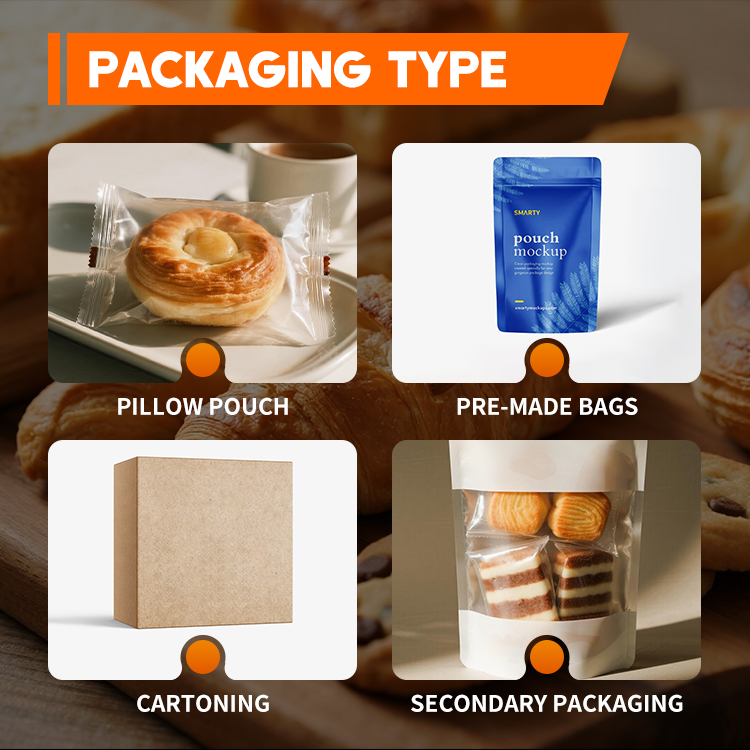
6 types of biscuit packaging machines
Not all biscuit packaging machines do the same thing. The right choice depends on your product type, production volume, packaging format, and budget. Here are the six main categories you'll encounter.
1. Horizontal flow wrapper (HFFS)
The horizontal flow wrapper is the most common machine for individual biscuit packs and multi-pack configurations. The product travels horizontally on a conveyor belt while packaging film is folded around it from below, sealed on the bottom and ends, and then cut into individual packages.
HFFS machines work well for sandwich cookies, crackers, and standard biscuit varieties. Most models handle 60 to 300 packs per minute. The main advantage is versatility: you can run different pack sizes on the same machine with relatively quick changeover times (15 to 30 minutes for experienced operators).
The limitation is that HFFS machines are best suited for pillow-pack style packaging. If you need stand-up pouches or rigid tray packaging, a different machine type will serve you better.
Typical speed: 60-300 packs/min
Best for: Individual packs, multi-packs, standard pillow packs
Price range: $5,000-$50,000
2. Vertical form fill seal (VFFS) machine
VFFS machines form a bag from a flat roll of film in a vertical orientation, fill it with product from the top, then seal and cut. These are more common for loose products like chips or nuts, but some biscuit manufacturers use them for small biscuits or cookie pieces that can be gravity-fed or dosed by a multihead weigher.
The advantage is a smaller machine footprint and generally lower cost. The disadvantage is that biscuits are fragile, and dropping them vertically can cause breakage. VFFS is usually not the first choice for whole, premium biscuits, but it works for broken biscuit pieces, cookies meant for further processing, or very small, hard biscuits.
Typical speed: 30-150 bags/min
Best for: Small biscuits, broken biscuit products, value-pack formats
Price range: $3,000-$25,000
3. Pillow pack machine
Pillow pack machines are essentially a subset of horizontal flow wrappers, but they deserve separate mention because they dominate the biscuit industry specifically. The "pillow" shape (sealed on both ends with a fin or lap seal along the back) is the most recognized biscuit packaging format worldwide.
Modern pillow pack machines use servo-driven systems for precise film tension control, which directly affects pack appearance and seal integrity. Three-servo systems are now the standard, offering independent control of film feeding, cross sealing, and product feeding. This precision matters because inconsistent film tension is a leading cause of packaging defects like wrinkles, misaligned seals, and product shifting inside the pack.
Typical speed: 40-250 packs/min
Best for: Standard biscuit packs, cookie multi-packs, cracker sleeves
Price range: $4,000-$35,000
4. Rotary premade pouch machine
Instead of forming packaging from a film roll, rotary premade pouch machines take pre-made pouches (stand-up pouches, flat pouches, zipper pouches), open them, fill them with biscuits, seal them, and discharge them. This format has gained significant market share in premium biscuit and cookie segments because stand-up pouches offer better shelf visibility and perceived quality.
The trade-off is speed and material cost. Premade pouches cost more per unit than film from a roll. And while modern rotary machines are fast (some reach 80-120 pouches per minute), they generally can't match the throughput of HFFS machines for simple pillow packs.
Typical speed: 40-120 pouches/min
Best for: Premium cookies, artisan biscuits, resealable packs, specialty formats
Price range: $15,000-$80,000
5. Biscuit cartoning machine
Cartoning machines take already-wrapped biscuit packs (usually pillow packs) and load them into cardboard boxes or cartons. This is a secondary packaging step, not a replacement for film wrapping. You'll see cartoning machines in larger operations that ship to retailers, where products need outer cartons for distribution and shelf display.
Most biscuit cartoning machines use either a horizontal loading configuration (packs slide in from the side) or a top-loading configuration (packs drop in from above). Horizontal loading is gentler on products but requires more floor space.
Typical speed: 60-200 cartons/min
Best for: Secondary packaging for retail distribution
Price range: $20,000-$100,000
6. Fully automatic packaging line
For high-volume manufacturers producing 5,000+ kg of biscuits per day, a fully integrated packaging line combines feeding, grouping, primary wrapping (usually HFFS or pillow pack), metal detection, date coding, and secondary cartoning into a single synchronized system.
These lines are typically custom-engineered for each factory. A supplier will assess your product range, factory layout, throughput requirements, and labor availability, then design a line that connects your baking oven output directly to finished pallets. Lead times range from 60 to 120 days, and prices start around $50,000 for a basic setup and can exceed $500,000 for complex, multi-format lines.
Typical speed: 200-600+ packs/min (combined line output)
Best for: Large-scale industrial biscuit manufacturers
Price range: $50,000-$500,000+
Machine type comparison
| Feature | HFFS | VFFS | Pillow Pack | Premade Pouch | Cartoning | Full Line |
| Pack format | Pillow, fin seal | Bag, pouch | Pillow | Stand-up, flat, zipper | Box, carton | Any combination |
| Speed (packs/min) | 60-300 | 30-150 | 40-250 | 40-120 | 60-200 | 200-600+ |
| Product fragility handling | Good | Fair | Good | Good | Excellent | Custom |
| Floor space | Medium | Small | Medium | Medium | Large | Very large |
| Changeover time | 15-30 min | 20-40 min | 15-30 min | 10-20 min | 20-45 min | 30-60 min |
| Price range | $5K-$50K | $3K-$25K | $4K-$35K | $15K-$80K | $20K-$100 | $50K-$500K+ |
How does a biscuit packaging machine work? Step-by-step
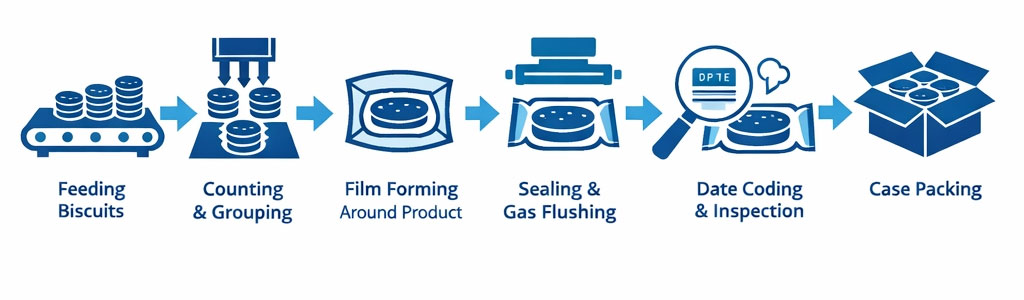
Understanding the packaging process helps you evaluate machines more effectively and spot potential problems during factory visits. Here's what happens inside a typical biscuit packaging line.
Step 1: Biscuit feeding and alignment
Biscuits arrive from the cooling and stacking section of your production line. A feeder mechanism (usually a vibrating conveyor, bucket elevator, or multi-lane conveyor) transfers them to the packaging machine's infeed section. The key concern at this stage is alignment: biscuits need to be oriented correctly for grouping and wrapping. Misaligned products cause packaging defects downstream.
High-end machines use optical sensors and servo-controlled diverters to correct product orientation automatically. Budget machines may require more manual intervention.
Step 2: Grouping, counting, or weighing
Depending on your pack configuration, the machine needs to group biscuits into the right quantity. This happens through one of three methods:
Counting systems use sensors (photoelectric eyes) to count individual biscuits as they pass, then release the correct number into each packaging cycle. This works well for uniform biscuits where each piece has a consistent weight.
Weighing systems use a multihead weigher for products with variable weight (like artisan cookies or irregular shapes). The weigher distributes product across multiple weigh heads, then selects the combination closest to the target weight.
Stacking systems physically arrange biscuits into layers (common for sandwich cookies or cream-filled biscuits where orientation matters).
Step 3: Film forming and product loading
The packaging film (typically a laminated roll stock) is unwound, tensioned, and formed around a forming tube or plow. In HFFS machines, the film wraps around the product as it moves horizontally. In VFFS machines, the film forms a tube vertically, and product drops in from the top.
Film tension control at this stage directly impacts package quality. Too loose, and you get wrinkles and misaligned prints. Too tight, and the film stretches, potentially causing seal failures or film breaks. Servo-driven tension systems with real-time feedback loops are the current standard for reliable operation.
Step 4: Sealing and gas flushing (MAP)
The package is sealed using heat (for thermoplastic films) or a combination of heat and pressure. Temperature, pressure, and dwell time are the three variables that determine seal quality. Most machines allow operators to adjust these parameters for different film types.
Many biscuit manufacturers use Modified Atmosphere Packaging (MAP), which flushes the package with nitrogen (or a nitrogen-carbon dioxide mix) before sealing. This displaces oxygen inside the package, which slows oxidation and rancidity, extending shelf life by 30-50% compared to standard air packaging. MAP is particularly important for biscuits containing fats or oils that oxidize quickly.
Step 5: Date coding, labeling, and inspection
After sealing, a date coder (thermal transfer, inkjet, or laser) prints production dates, batch codes, and expiration dates on each package. Some lines also add metal detectors or X-ray inspection systems at this point to catch foreign contaminants.
Vision inspection systems are becoming more common in 2026. These use cameras to verify date code legibility, check seal integrity, confirm print registration, and flag defective packages for rejection. The cost of vision systems has dropped significantly, making them accessible even for mid-range operations.
Step 6: Secondary and tertiary packaging
Finished primary packs are usually conveyed to a case packer or cartoning machine for secondary packaging (grouping into display boxes or shipping cartons). Tertiary packaging is the palletizing step, where cartons are stacked onto pallets, wrapped, and prepared for shipping.
Biscuit-specific packaging challenges
Most packaging challenges in the biscuit industry come down to one problem: the product is fragile. Here are the specific issues and how good equipment addresses them.
Preventing biscuit breakage
Breakage is the number one quality complaint in biscuit packaging. It happens at multiple points: during feeding (drops and impacts), in transit through the machine (vibration and friction), and during the sealing process (pressure from sealing jaws).
Solutions include cushioned infeed systems with soft-touch conveyors, controlled acceleration and deceleration profiles in servo-driven machines, adjustable sealing pressure for different biscuit types, and wider seal jaws that distribute pressure more evenly. If you're packaging delicate cream-filled biscuits or thin crackers, specify low-pressure sealing and gentle handling features when requesting quotes.
Moisture and oxidation control
Biscuits go stale when they absorb moisture from the air, and fats go rancid when exposed to oxygen. Proper packaging addresses both issues through film barrier properties and MAP technology.
Film barrier properties are measured by Water Vapor Transmission Rate (WVTR) and Oxygen Transmission Rate (OTR). For most biscuit applications, you want WVTR below 2 g/m2/24h and OTR below 20 cc/m2/24h. These numbers vary by product type and intended shelf life, but they give you a baseline for evaluating film suppliers.
Chocolate transfer and scuffing
For chocolate-coated biscuits or chocolate chip cookies, friction during the packaging process can cause chocolate to smear or transfer onto the film. This looks bad and creates a quality problem.
Solutions include lower friction film surfaces (slip additives in the film formulation), reduced product-to-film contact during feeding, and lower packaging speeds for chocolate products. Some manufacturers also use interleaving (placing a paper layer between stacked biscuits) to prevent direct contact.
Multi-format packaging needs
Many biscuit manufacturers produce multiple pack sizes (single-serve, multi-pack, family-size) and formats (pillow pack, tray, pouch) on the same line. This requires quick changeover capability. When evaluating machines, ask about changeover time (not just the supplier's best-case claim, but the realistic time their existing customers report), the number of change parts needed, and whether change parts are tool-free or require wrenches.
Packaging materials: The complete selection guide
Choosing the right packaging film is as important as choosing the right machine. The film needs to protect the product, look good on the shelf, run reliably through your machine, and fit your cost targets.
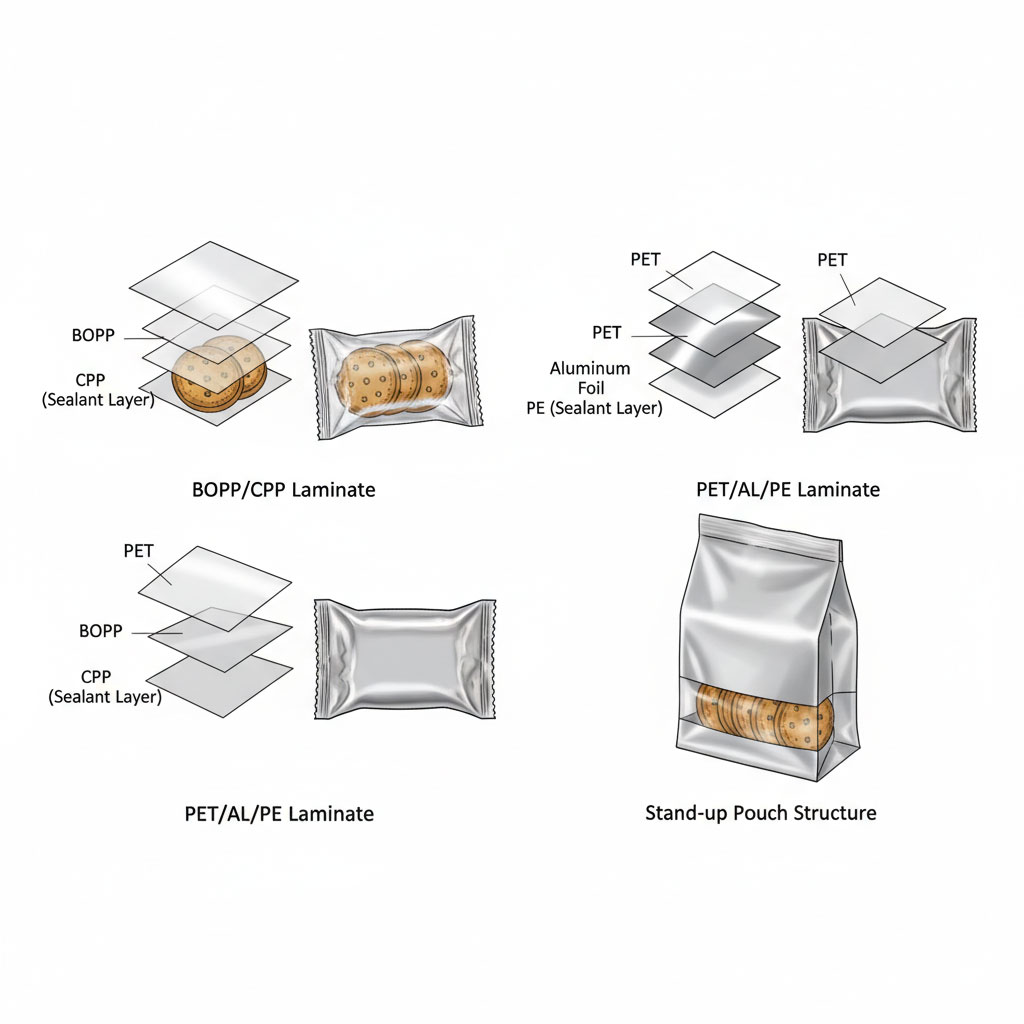
BOPP/CPP films
Biaxially Oriented Polypropylene (BOPP) laminated with Cast Polypropylene (CPP) is the most widely used film structure for biscuit packaging. It offers good moisture barrier properties, reasonable clarity for product visibility, and relatively low cost. BOPP/CPP works well for standard biscuits with moderate shelf life requirements (3 to 6 months).
BOPP can be printed with up to 8 colors using rotogravure or flexographic printing, which gives you strong shelf appeal. The material runs well on most HFFS and pillow pack machines, and it's widely available from film suppliers worldwide.
PET/PE and PET/AL/PE laminates
Polyethylene Terephthalate (PET) laminated with Polyethylene (PE) or with an aluminum foil layer (PET/AL/PE) provides superior barrier properties compared to BOPP/CPP. The aluminum layer in particular offers excellent oxygen and light barrier, making it the standard choice for premium biscuits, chocolate-coated products, and anything requiring extended shelf life (9 to 18 months).
The downside is cost. PET/AL/PE laminates typically cost 30-50% more than BOPP/CPP. The aluminum layer also means consumers can't see the product through the packaging, which some brands consider a disadvantage.
Premade pouches
Stand-up pouches with zipper closures are gaining popularity in the premium biscuit segment. These are typically made from PET/AL/PE or PET/PE structures and offer excellent barrier properties plus the convenience of resealability. The per-unit cost is higher than roll film, but the improved shelf presence and consumer convenience can justify the premium for certain product lines.
Eco-friendly and sustainable options
Sustainable packaging is moving from a marketing nice-to-have to a regulatory requirement in several markets. Current options include paper-based laminates (paper+PLA or paper+PE), recyclable mono-material PE films, and compostable cellulose-based films.
The trade-off with most eco-friendly options is barrier performance and machine runnability. Paper-based materials, for example, have higher WVTR than standard plastic films and may require slower machine speeds or modified sealing parameters. Before committing to a sustainable material, run a trial on your actual machine with your actual product to verify performance.
Biscuit packaging machine price guide (2026)
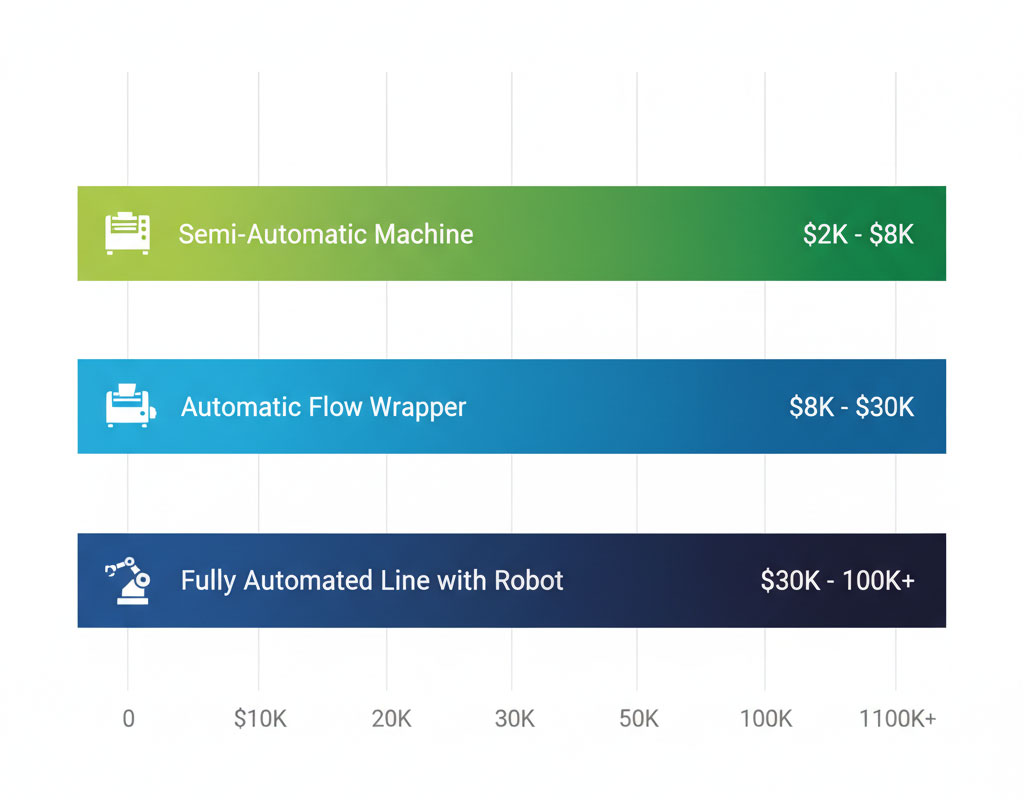
Machine pricing varies widely based on type, configuration, automation level, and country of manufacture. Here's a realistic breakdown based on current market rates. These figures assume purchase from Chinese manufacturers (the dominant supplier market). European and Japanese machines typically cost 2-3x more for comparable specifications.
Entry-level machines ($2,000-$8,000)
At this price point, you're looking at semi-automatic or basic single-function machines. Expect mechanical (non-servo) drives, manual changeover, basic temperature control, and limited speed (20-80 packs/min). These machines work for small bakeries or startups testing the market. Suppliers include smaller Chinese manufacturers found on Alibaba and Made-in-China.
The risk at this level is reliability and after-sales support. Cheaper machines use lower-grade components that wear faster, and technical support can be difficult to access when you need it most. Budget for maintenance and potential downtime.
Mid-range machines ($8,000-$30,000)
This is the sweet spot for most small-to-medium biscuit manufacturers. Mid-range machines feature servo-driven systems (usually 2-3 servo axes), PLC control with touchscreen HMI, automatic temperature regulation, photoelectric registration for print alignment, and speeds of 80-200 packs/min. Most include basic safety features (emergency stop, guard interlocks) and come with installation support.
At this price level, established Chinese manufacturers like Soonqian, GELGOOG, and KCPack offer reliable products with track records in export markets. Delivery typically takes 30-45 days, and most suppliers provide remote commissioning assistance.
Industrial-grade machines ($30,000-$100,000)
Industrial machines are designed for continuous, multi-shift operation in large-scale production facilities. They feature 4-5 servo axes, high-speed operation (200-500+ packs/min), advanced diagnostics, network connectivity for Industry 4.0 integration, and comprehensive safety systems certified to CE or ISO standards.
European manufacturers (Bosch, IMA, LoeschPack) and premium Chinese suppliers compete in this segment. The advantage of European machines is long-term reliability and global service networks. The advantage of premium Chinese machines is comparable performance at 40-60% of the price.
Total cost of ownership (TCO) breakdown
The purchase price is only part of the story. When evaluating machines, calculate your TCO over a 5-year period:
- Machine cost: 25-35% of TCO
- Packaging materials: 40-50% of TCO (film, ink, gas for MAP)
- Maintenance and parts: 10-15% of TCO (wear parts, annual servicing, unplanned repairs)
- Energy: 3-5% of TCO (electricity, compressed air)
- Labor: 5-10% of TCO (operator wages, training)
- Downtime costs: Variable (lost production, waste from defects)
A machine that costs 20% less to purchase but has 10% higher material waste or 5% more downtime will likely cost you more over its useful life. Factor these variables into your decision.
How to choose the right machine: A decision framework
Rather than starting with machine specs, start with your requirements and work backward to the right equipment.
Match machine type to your product
The single most important variable is your product. Fragile cream-filled sandwich cookies need different handling than hard crackers. Premium cookies targeting premium retail channels may benefit from stand-up pouches, while value biscuits for mass-market distribution are best served by high-speed pillow packs.
Map each product in your range to its ideal packaging format, then look for a machine that handles the formats you need. If you produce five different products in three different formats, you need either a very flexible machine or separate machines for different lines.
Evaluate production volume and speed
Calculate your required output in packs per minute, not just per day. A factory producing 50,000 packs per day on a single 8-hour shift needs a machine running at roughly 105 packs/min (accounting for changeovers, maintenance, and startup time). Add a 20-30% buffer for peak periods, and you're looking at a machine rated for 130-140 packs/min minimum.
Don't buy a machine that runs at 100% capacity all the time. Machines need headroom for efficiency. A machine running at 70-80% of its rated speed will have fewer jams, lower waste, and longer component life.
Consider integration and space constraints
Measure your available factory floor space before selecting a machine. An HFFS machine needs 6-10 meters of line length including infeed and discharge conveyors. A full packaging line can require 30+ meters. Also consider ceiling height (some machines are tall), floor load capacity, and access for maintenance.
Think about upstream and downstream integration. How will biscuits get from your cooling tunnel to the packaging machine? Will you need buffer conveyors to handle speed differences? How will finished packs reach your cartoning or case packing area?
Assess supplier quality and support
This is where many buyers make expensive mistakes. Before placing an order, ask potential suppliers:
- Can they provide references from customers producing similar products?
- What's their response time for technical support (hours, not days)?
- Do they stock spare parts in your region, or do all parts ship from China?
- What warranty do they offer, and what does it actually cover?
- Can they provide a video demonstration of their machine running a product similar to yours?
- What's included in the price (installation, training, commissioning, shipping)?
A machine that costs $5,000 more upfront but comes with local parts availability and responsive support can save you far more in reduced downtime over its lifetime.
ROI calculation: Will a packaging machine pay for itself?
For manufacturers currently hand-packing, the ROI case for automation is usually straightforward. Here's a simple calculation framework:
Labor savings: If hand-packing requires 4 workers at $600/month each ($2,400/month total), and a machine reduces that to 1 operator ($600/month), you save $1,800/month or $21,600/year.
Material savings: Automated machines typically achieve 2-5% better material utilization than manual packing due to more precise film cutting and fewer rejected packs. If your monthly film cost is $8,000, a 3% improvement saves $240/month or $2,880/year.
Quality improvement: Reduced product damage from manual handling means fewer returns and complaints. This is harder to quantify but can be significant for premium products.
Total annual savings (example): $21,600 (labor) + $2,880 (material) + $5,000 (estimated quality improvement) = $29,480/year
Machine cost: $25,000
Payback period: $25,000 / $29,480 = approximately 10 months
Adjust these numbers for your actual costs. The calculation gets more complex for operations that already have some automation and are considering an upgrade, but the framework remains the same: compare the annual cost of your current setup against the annualized cost of the new machine plus its operating costs.
8 common mistakes when buying a biscuit packaging machine
These come up repeatedly when talking to manufacturers who regret their purchasing decisions.
1. Buying based on price alone. The cheapest machine is rarely the cheapest to own. Focus on TCO, not purchase price.
2. Not testing with your actual product. Request a trial run with your biscuits (or a close equivalent) on the machine you're considering. Video demonstrations are helpful, but not sufficient.
3. Underestimating changeover complexity. If you run multiple products, verify that changeover is practical, not just theoretically possible. Ask existing customers how long their real-world changeovers take.
4. Ignoring after-sales support. Every machine will need service, parts, or technical assistance at some point. A supplier you can't reach when your line is down is a liability.
5. Over-specifying speed. Buying a 300 packs/min machine when you need 100 packs/min means you paid for capacity you won't use, and the machine may be less efficient at low speeds. But also don't under-specify: leaving no room for growth means another capital expenditure sooner than necessary.
6. Forgetting about packaging material availability. Some machines require specific film structures or widths. Before buying, confirm that suitable films are available from local or regional suppliers at competitive prices.
7. Not planning for utilities. Check voltage requirements (220V vs 380V, single-phase vs three-phase), compressed air needs, and cooling water if the machine uses a water-cooled sealing system.
8. Skipping operator training. A machine is only as good as the person running it. Budget for thorough initial training and periodic refresher courses, especially for servo-driven machines with complex control systems.
2025-2026 industry trends
Several developments are shaping the biscuit packaging machine market right now.
IoT-enabled monitoring is becoming standard on mid-range and above machines. Sensors track machine performance in real time, predicting maintenance needs before failures occur and allowing remote diagnostics by supplier technicians. This reduces unplanned downtime, which is the single largest cost driver in packaging operations.
Sustainable packaging materials continue to gain market share, driven by both consumer preference and regulation. The EU Single-Use Plastics Directive and similar policies in other regions are pushing manufacturers toward recyclable and compostable packaging. Machine manufacturers are responding by designing equipment that handles thinner films and alternative materials reliably.
Flexible manufacturing is another key trend. As consumer preferences shift toward product variety and smaller batch sizes, manufacturers need packaging lines that can switch between products and formats quickly. Modular machines with quick-change systems and digital recipe storage address this need.
Automation beyond primary packaging is accelerating. Robotic case packing, automated palletizing, and AGV-based material handling are becoming more common, especially in markets with rising labor costs. The economics of robotics have improved significantly, with payback periods dropping to 18-24 months for many applications.
Frequently asked questions
Q1: How much does a biscuit packaging machine cost?
A1: Prices range from $2,000 for basic semi-automatic machines to $500,000+ for fully integrated packaging lines. For a typical small-to-medium manufacturer, expect to spend $8,000-$30,000 for a reliable servo-driven machine producing 80-200 packs per minute.
Q2: What packaging speed do I need?
Calculate your daily production target, divide by operating hours (accounting for breaks, changeovers, and maintenance), then add a 20-30% buffer. For example, if you need 30,000 packs/day in an 8-hour shift: 30,000 / (8 x 0.8) x 1.25 = approximately 5,860 packs/hour or about 98 packs/minute. You'd want a machine rated for at least 120-130 packs/min.
Q3: What is MAP packaging and do I need it?
MAP (Modified Atmosphere Packaging) replaces air inside the package with nitrogen or a nitrogen-CO2 mixture. It extends shelf life by 30-50% by reducing oxidation. If your biscuits have a high fat content or need shelf life beyond 6 months, MAP is worth the additional equipment cost (usually $2,000-$8,000 for a gas flushing module).
Q4: How long does delivery take?
From Chinese manufacturers, standard delivery is 30-45 days for standard machines and 60-120 days for custom lines. European manufacturers typically quote 12-20 weeks. Shipping adds 2-4 weeks depending on your location.
Q5: Can one machine handle different biscuit types and pack sizes?
Most machines can handle a range of product sizes within their format category, but changing between fundamentally different pack formats (e.g., pillow pack to stand-up pouch) requires a different machine. Within pillow packs, changeovers between sizes typically take 15-30 minutes and involve adjusting guide rails, changing forming tubes, and updating control settings.
Q6: What certifications should I look for?
CE certification is mandatory for machines sold in the European Union. ISO 9001 from the manufacturer indicates a quality management system. For food-contact compliance, look for machines with food-grade materials (stainless steel 304 or 316 contact surfaces) and compliance with FDA or EU food contact regulations.
Q7: How do I verify supplier quality from overseas?
Request videos of the machine running your product type. Ask for customer references and contact them directly. Consider visiting the factory for final inspection before shipment, or hire a third-party inspection company to do it for you. Check the supplier's export history and how long they've been in business.
Q8: What maintenance does a biscuit packaging machine need?
Daily: clean contact surfaces, check film tension, inspect seals. Weekly: lubricate moving parts, check sensor alignment, verify temperature calibration. Monthly: replace wear parts (sealing jaws, cutting blades), check electrical connections, inspect pneumatic systems. Annually: comprehensive service by a qualified technician, including full calibration and safety system testing.
Conclusion
Choosing a biscuit packaging machine comes down to matching your product requirements, production volume, and budget to the right machine type from a reliable supplier. Start with your product: its fragility, shelf life needs, and target packaging format will narrow the machine type. Then evaluate production speed requirements, factory space, and integration needs. Finally, assess suppliers based on machine quality, after-sales support, and total cost of ownership over the machine's useful life.
The companies that make the best purchasing decisions are the ones that test machines with their actual products, calculate realistic TCO rather than comparing sticker prices, and prioritize supplier support over minor spec differences. Take the time to do this groundwork, and you'll end up with equipment that runs reliably, protects your product quality, and pays for itself within the first year or two of operation.
Last updated: April 2026