
Mastering Flow Wrapper Speed: A PPM Capacity Planning Guide
HFFS Machine Blog

If you're seeking packaging automation solutions, please contact us, and we'll be delighted to offer you the most tailored solution.
Are you confident your packaging line can meet next quarter's demand? Or does the gap between your flow wrapper's advertised speed and its actual output keep you up at night? Many production managers and plant engineers face this challenge: relying solely on theoretical flow wrapper speed PPM capacity planning often leads to production bottlenecks, missed targets, and wasted capital.
This guide will help you move beyond spec sheet data, providing a step-by-step framework for accurate capacity planning. You'll learn how to calculate your true PPM (Packs Per Minute), account for real-world variables, and select equipment that meets both current and future growth needs.
Decoding PPM: The Foundation of Flow Wrapper Capacity
What is PPM (Packs Per Minute)?
PPM, or Packs Per Minute, is the standard metric for measuring a flow wrapper's speed. It refers to how many individual units (packs or pieces) a machine can package within one minute. In some cases, PPM may also stand for Pieces Per Minute, depending on the industry context. For food processors, PPM typically reflects completed packs, not individual product pieces inside those packs.
Why Theoretical PPM vs. Effective PPM is the Most Critical Distinction
Theoretical PPM is the maximum speed listed on a machine's spec sheet under ideal conditions, akin to a car's top speed on an empty highway. Effective PPM, however, is the real-world speed your machine achieves on the factory floor. This discrepancy is often caused by factors like product fragility, operator skill, and changeover times. For example, a machine rated for 200 PPM may only deliver 140 PPM in a production environment. Understanding this distinction is crucial for accurate capacity planning.
The Core Calculation: How to Determine Your Required PPM
Accurate capacity planning starts with calculating your required PPM. This ensures your equipment can meet production demands without overinvesting in unnecessary speed.
Step 1: Quantify Your Production Targets
Determine the total units you need to package per shift or day. For example, if your facility packages snack bars, your target may be 80,000 units per 8-hour shift.
Step 2: Factor in Available Production Time
Account for non-operational time, such as breaks, cleaning, and maintenance. For an 8-hour shift, subtract downtime (e.g., 30 minutes for breaks and 20 minutes for cleaning), leaving 450 operational minutes.
Step 3: Use the Baseline PPM Formula
The basic formula is:
Required PPM = Total Units per Shift ÷ Total Operating Minutes per Shift
Worked Example:
- Target Output: 80,000 snack bars
- Available Time: 450 minutes
- Required PPM: 80,000 ÷ 450 = 178 Effective PPM
Comparison Table: Theoretical vs. Effective PPM
| Metric | Theoretical PPM | Effective PPM |
| Machine Rating (Spec) | 200 | 178 |
| Real-World Variables | Ignored | Accounted for |
| Risk of Bottlenecks | High | Low |
By calculating this requirement, you can align your production goals with realistic machine capabilities.
Beyond the Calculation: 7 Real-World Variables That Impact Speed
1. Product Characteristics
- Impact: Product size, shape, weight, and fragility can limit maximum PPM.
- Example: A soft cookie requires gentler handling, reducing speed, while a rigid granola bar allows faster throughput.
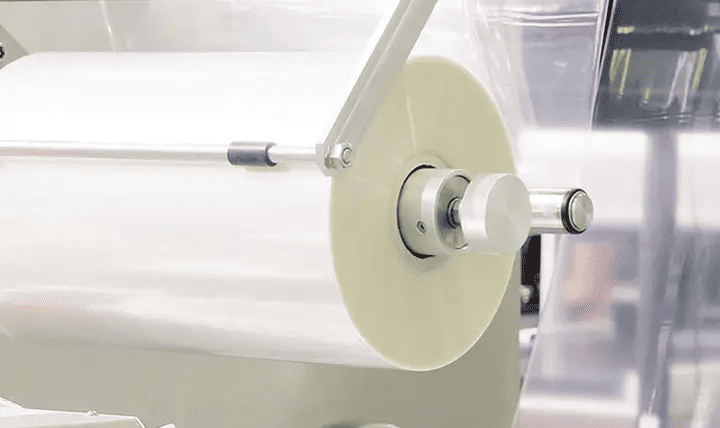
2. Packaging Film Specifications
- Impact: Film material, thickness, and sealing properties can slow down a wrapper.
- Example: Thicker films require longer sealing times, reducing PPM.
3. Machine Changeover Times
- Impact: Frequent product or packaging changes increase downtime.
- Example: A 20-minute changeover per shift reduces operational efficiency by 7%.
4. Infeed and Outfeed Integration
- Impact: Bottlenecks occur if conveyors can't match the wrapper's speed.
- Example: A slow infeed conveyor limits the wrapper to its speed, regardless of machine capability.
5. Operator Skill and Training
- Impact: Inexperienced operators may struggle to maintain optimal performance.
- Example: Skilled operators can execute faster setups and adjustments, boosting Effective PPM.
6. Maintenance Schedules and Machine Condition
- Impact: Poor maintenance increases downtime and reduces reliability.
- Example: Regular preventive maintenance keeps machines running closer to their rated speed.
7. Product Spacing and Pitch on the Conveyor
- Impact: Improper spacing can lead to jams or incomplete seals, slowing throughput.
- Example: A well-calibrated conveyor ensures consistent spacing, maintaining speed.
Integrating PPM with OEE for Holistic Capacity Planning
A Primer on OEE (Overall Equipment Effectiveness)
OEE measures the efficiency of your production line using three factors:
- Availability: Uptime as a percentage of total scheduled time
- Performance: Actual speed vs. theoretical speed
- Quality: Percentage of perfect packs produced
How Flow Wrapper Performance (PPM) Influences Your OEE Score
A reliable flow wrapper with high Effective PPM directly boosts Performance and Availability metrics. For example:
- Theoretical PPM: 200
- Effective PPM: 180 (90% Performance factor)
Using OEE Data to Justify a High-Speed Wrapper Investment
Improving OEE by investing in a faster, more reliable machine can significantly increase profitability. A 5% increase in OEE across a production line can save hundreds of thousands annually in labor and material costs, making the investment worthwhile.
Future-Proofing: How to Plan for Growth and Scalability
Analyzing Demand Forecasts and Product Line Expansion
Evaluate future production needs based on demand growth or new product launches. For example, if your product line is expected to expand by 20%, plan for a machine that can handle the increased output.
The ROI of "Over-spec'ing"
Investing in a machine that exceeds current needs reduces the risk of future capacity shortfalls. While the upfront cost is higher, it prevents the expense of purchasing additional machines later.
Evaluating Scalability: Servo vs. Mechanical Systems
Servo-driven systems offer greater flexibility and scalability, allowing for faster adjustments and a wider range of operational speeds. Mechanical systems, while cheaper upfront, lack the same adaptability.
Features That Bridge the Gap Between Theoretical and Effective PPM
Servo-Driven Technology for Precision at High Speeds
- Benefit: Maintains consistent speed even with variable product sizes.
"No Product, No Bag" Features to Minimize Waste and Stops
- Benefit: Automatically stops sealing when no product is detected, reducing downtime and film waste.
Automated Splicing and Quick-Change Formers
- Benefit: Minimizes changeover times, maintaining uptime and boosting Effective PPM.
Common Questions About Flow Wrapper Speed and Capacity
Flow wrapper speed is measured in PPM (packages per minute), indicating how many individual packs a machine can produce per minute. Most mid-range food wrappers achieve 100–200 effective PPM in real production environments, though high-end models can reach 300 PPM or more under ideal conditions.
Capacity planning ensures your flow wrapper can meet production demands without creating bottlenecks. The process involves analyzing PPM requirements, product sizes, and shift schedules to determine the optimal machine configuration. Without this planning, you risk either underutilizing expensive equipment or creating a persistent packaging bottleneck that limits your entire line.
A faster flow wrapper is not always the better choice. A machine rated for higher PPM may underperform if real-world variables aren't properly accounted for. Product fragility, film material, and operator skill levels can all significantly reduce actual throughput compared to the spec sheet number.
If your flow wrapper is rated for 200 PPM but you're only getting 120, start by checking product spacing on the infeed conveyor, operator training levels, and your maintenance schedule. These three factors account for the majority of real-world speed gaps we see in food production facilities.
For future growth, a 20–30% capacity buffer is typically sufficient. This margin accommodates seasonal demand spikes, new product launches, and gradual throughput improvements without overinvesting in speed you won't use for years.
Servo-driven flow wrappers use precise electronic control to maintain consistent speed even with variable product sizes. Unlike mechanical systems, servo machines automatically compensate for product variations and maintain reliable seal quality at higher speeds. If your production involves multiple SKUs or frequent changeovers, servo technology usually delivers better real-world PPM.
A synchronized infeed system is often the single most impactful upgrade for boosting effective PPM. When your infeed conveyor delivers products at a consistent pitch matching your wrapper's speed, you eliminate the most common cause of speed loss. Many plants discover that improving their infeed setup unlocks speed their wrapper already had but couldn't use.
OEE (Overall Equipment Effectiveness) is the industry-standard metric that combines availability, performance, and quality into a single efficiency score. Most well-maintained food packaging lines operate at 70–85% OEE. When planning flow wrapper capacity, you must divide your target PPM by your expected OEE rate to arrive at a realistic machine requirement. For example, a 100 PPM target at 80% OEE requires a machine capable of at least 125 PPM on paper.
FAQ
Q1: How is flow wrapper speed measured in PPM?
Flow wrapper speed is measured in PPM (packages per minute), which indicates how many products the machine can wrap in one minute. This metric helps businesses evaluate production efficiency and plan capacity. High-speed flow wrappers can often achieve speeds of 100-300 PPM or more, depending on the product and packaging material.
Q2: Why is capacity planning important for flow wrappers?
Capacity planning ensures your flow wrapper can meet production demands without bottlenecks. It involves analyzing PPM requirements, product sizes, and shift schedules to determine the optimal machine configuration. Proper planning helps avoid underutilization or overloading, ensuring consistent output and cost efficiency.
Q3: How do I choose the right flow wrapper for my production line?
To select the right flow wrapper, consider factors like product size, required PPM speed, packaging material, and budget. Assess whether the machine can handle your product dimensions and if it offers flexibility for future needs.
Q4: What is the typical cost of a flow wrapper for food packaging?
The cost of a flow wrapper varies depending on speed, features, and build quality, ranging from $5,000 to $150,000 or more. The investment often pays off through increased efficiency and reduced labor costs.
Q5: How do I calculate ROI for a flow wrapper machine?
To calculate ROI, compare the machine's cost to the savings it provides in labor, increased production capacity, and reduced downtime. A flow wrapper can often pay for itself in a few years, depending on production volume.
Q6: What maintenance is required for a flow wrapper?
Flow wrappers require regular maintenance, including cleaning, lubrication, and inspections of belts, seals, and motors. Preventative maintenance schedules can reduce downtime and prolong the machine's lifespan.
Q7: Which industries benefit most from flow wrapper machines?
Industries like food processing, pharmaceuticals, and consumer goods benefit most from flow wrappers. These machines are ideal for packaging items like snacks, baked goods, medical devices, and personal care products.
Q8: Can a flow wrapper handle multiple product sizes?
Yes, many flow wrappers are designed to handle multiple product sizes with adjustable settings. However, some may require additional tooling or changeover time. Investing in a versatile machine can save time and costs if your production line includes varied products.
Q9: How do I optimize flow wrapper performance?
To optimize performance, ensure proper machine calibration, regular maintenance, and staff training. Using high-quality materials and monitoring PPM rates can also help identify and address inefficiencies.
Q10: What is OEE and how does it relate to flow wrapper PPM planning?
OEE (Overall Equipment Effectiveness) accounts for availability, performance, and quality. Industry benchmarks suggest 70-85% OEE for well-maintained lines. You must divide your required PPM by your OEE rate to get the machine's true required speed.